

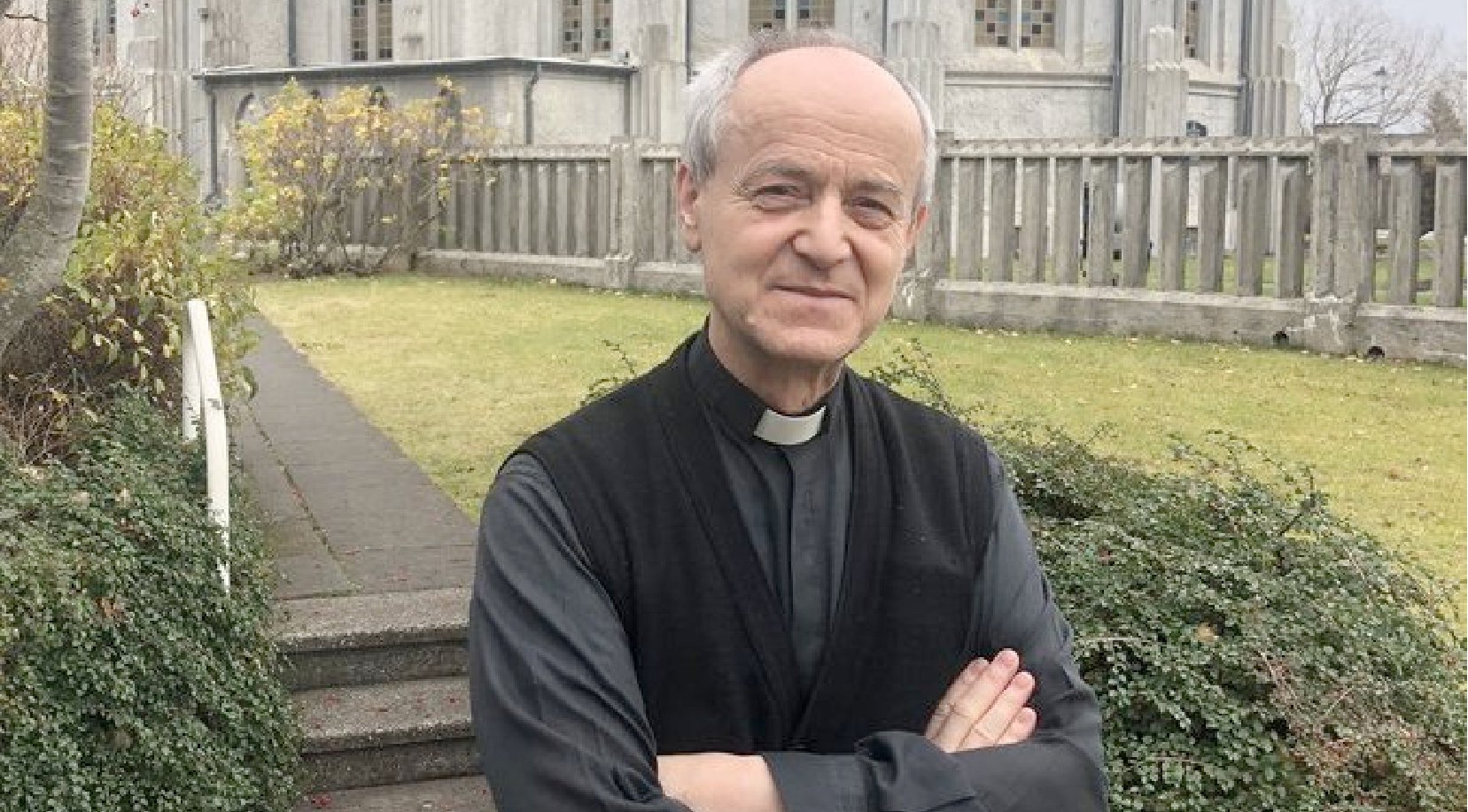
(ZENIT News / Iceland, 03.20.2026).- A radio interview lasting only a few minutes has evolved into one of the most sensitive church–state flashpoints in recent Icelandic history. At its center is Monsignor Jakob Rolland, chancellor of the Catholic Diocese of Reykjavík, whose public explanation of Catholic teaching on sexuality is now under police scrutiny for possible violation of the country’s ban on conversion practices.
The case is unfolding in a nation where Catholicism remains a minority presence—between 8 and 10 percent of the population, roughly 14,000 faithful, many of them immigrants—and where the legal framework on LGBTQ issues is among the most stringent in Europe. It is precisely this intersection—minority religion, strong secular legislation, and evolving cultural norms—that has turned a doctrinal clarification into a national debate.
The controversy began in early March, when Rolland, a French-born priest who has lived in Iceland for decades, appeared on the public broadcaster RÚV. Asked whether homosexual persons could receive Communion, he reiterated the Catholic Church’s established moral teaching: same-sex attraction in itself is not considered sinful, but sexual acts outside the Church’s understanding of marriage require repentance and sacramental reconciliation before receiving the Eucharist.
What might have remained a routine catechetical explanation instead triggered a chain reaction. Rolland went further, noting that some individuals with same-sex attraction seek spiritual guidance within the Church, including those who wish to change aspects of their lives. He emphasized that the Church does not engage in what are commonly termed “conversion therapies,” but offers pastoral accompaniment through prayer, sacramental life, and personal dialogue.
In Iceland’s current legal context, that distinction is precisely what is being contested.
Since 2023, the country’s penal code—specifically Article 227b—criminalizes attempts to suppress or alter a person’s sexual orientation, gender identity, or expression through coercion, threats, or deceptive practices. Violations can carry penalties of up to three years in prison. The law was designed to target structured or abusive forms of so-called conversion therapy, but critics argue that its scope may extend further.
Following Rolland’s interview, LGBTQ advocacy groups, led by the national organization Samtökin ’78, launched a campaign calling for legal action. Their argument is that even non-coercive forms of guidance could fall under the law if they are perceived as encouraging individuals to change their sexual orientation. Prominent political figures joined the criticism, and the issue was raised in the Alþingi, Iceland’s parliament, where questions were posed about the compatibility of such views with a society committed to human rights protections.
The police in Reykjavík have since confirmed that they are examining the priest’s statements to determine whether a formal criminal investigation should proceed.
Yet the reaction has not been uniform. The Ministry of Justice has publicly questioned the appropriateness of targeting an individual in a parliamentary setting, noting that such a move is unprecedented in Iceland’s legislative history. The case has therefore exposed not only legal ambiguities but also institutional tensions over how far the state should go in regulating religious expression.
Rolland himself has adopted a defiant tone. At 70, he presents his position as a matter of conscience rather than provocation. He insists that his remarks were a straightforward articulation of Catholic doctrine and that the Church’s role is to accompany individuals who seek its guidance, not to impose change through external pressure. From a legal standpoint, he argues, there is no basis for prosecution, since the law explicitly targets coercive practices, which he denies exist within the Church’s pastoral approach.
At the same time, his rhetoric—particularly references to what he describes as a prevailing “LGBT dictatorship”—has intensified the controversy, reinforcing perceptions among critics that his stance goes beyond pastoral explanation into cultural confrontation.
The broader question raised by the case is not easily resolved: where does legitimate religious teaching end and prohibited influence begin? In Catholic theology, the concept of “conversion” is foundational, referring to an ongoing moral and spiritual transformation that applies to all believers, not to any specific group. Rolland explicitly invoked this understanding, arguing that all Christians are called to regulate their behavior in accordance with Church teaching.
For his critics, however, the issue is not theological nuance but practical impact. Even if framed as voluntary, they contend, such guidance can exert psychological pressure and should therefore fall within the scope of the law.
The political dimension adds another layer of complexity. Iceland’s foreign minister, herself one of the few native-born Catholics in the country, distanced herself from Rolland’s comments, urging the Church not to act in ways that could be interpreted as undermining legal protections or social diversity. Meanwhile, legislators have framed the issue as a test of the country’s commitment to equality and inclusion.
Beyond Iceland, the case is being closely watched as a potential precedent. Across Europe, similar tensions are emerging between anti-discrimination laws and religious freedom, particularly in areas touching on sexuality, family, and moral teaching. What makes the Icelandic situation distinctive is the scale: in a small, highly secularized society, even a single cleric’s remarks can trigger a nationwide debate.
For the Catholic Church, the stakes are both pastoral and institutional. On one hand, it must remain faithful to its doctrinal framework; on the other, it operates within legal systems that increasingly scrutinize how that framework is expressed in public. The risk is not only legal sanction but also further marginalization in societies where religious language is already perceived as out of step with prevailing norms.
Rolland appears prepared to face that risk. He has stated openly that he would accept legal consequences if necessary, framing the issue in terms of fidelity to what he sees as divine law. At the same time, he points to what he describes as an unexpected outcome: a surge of interest from individuals seeking contact with the Church following the controversy.
Whether the case ultimately leads to prosecution or not, it has already achieved something more enduring. It has forced a confrontation between two systems of meaning—one rooted in secular legal frameworks, the other in religious anthropology—each claiming legitimacy in defining the boundaries of human freedom.
The resolution of that tension, in Iceland and beyond, is unlikely to come through a single court decision. But this case has made clear that the question can no longer be avoided.
Thank you for reading our content. If you would like to receive ZENIT’s daily e-mail news, you can subscribe for free through this link.

Publicaciones relacionadas:
 Professional footballer suspended 4 games for refusing to support LGBT campaign in Ligue 1 match
 Up to $100,000 fine and 1 year in jail for refusing to take photos at gay weddings
 USA: Colorado Supreme Court dismisses LGBT+ lawsuit harassing pastry chef Jack Phillips
 Comedy Writer Claims that the Human Skeletons of Men and Women Are Not the Same and Goes to Jail
