(ZENIT News / Rome, 03.22.2026).- Answered by Legionary of Christ Father Edward McNamara, professor of liturgy and sacramental theology at the Pontifical Regina Apostolorum university.
Q: Is it permitted to hold the Eucharistic adoration after the Mass of Holy Thursday in a monstrance? I have always learned and been told it is only permitted to have adoration in the ciborium on that evening. I see a lot of parishes where they do it in the monstrance, which for me is quite awkward regarding the nature and the gravity of the Holy Week. Can you please give me the right rubric? — M.S., Grimbergen, Belgium
A: The 1988 circular letter concerning the preparation and celebration of the Easter feasts, Paschalis Sollemnitatis, issued by the Congregation for Divine Worship, speaks of this point in general:
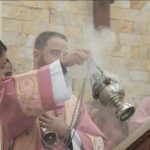
«54. After the postcommunion prayer, the procession forms with the crossbearer at its head. The Blessed Sacrament, accompanied by lighted candles and incense, is carried through the church to the place of reservation, to the singing of the hymn ‘Pange lingua’ or some other eucharistic song. This rite of transfer of the Blessed Sacrament may not be carried out if the liturgy of the Lord’s passion will not be celebrated in that same church on the following day.
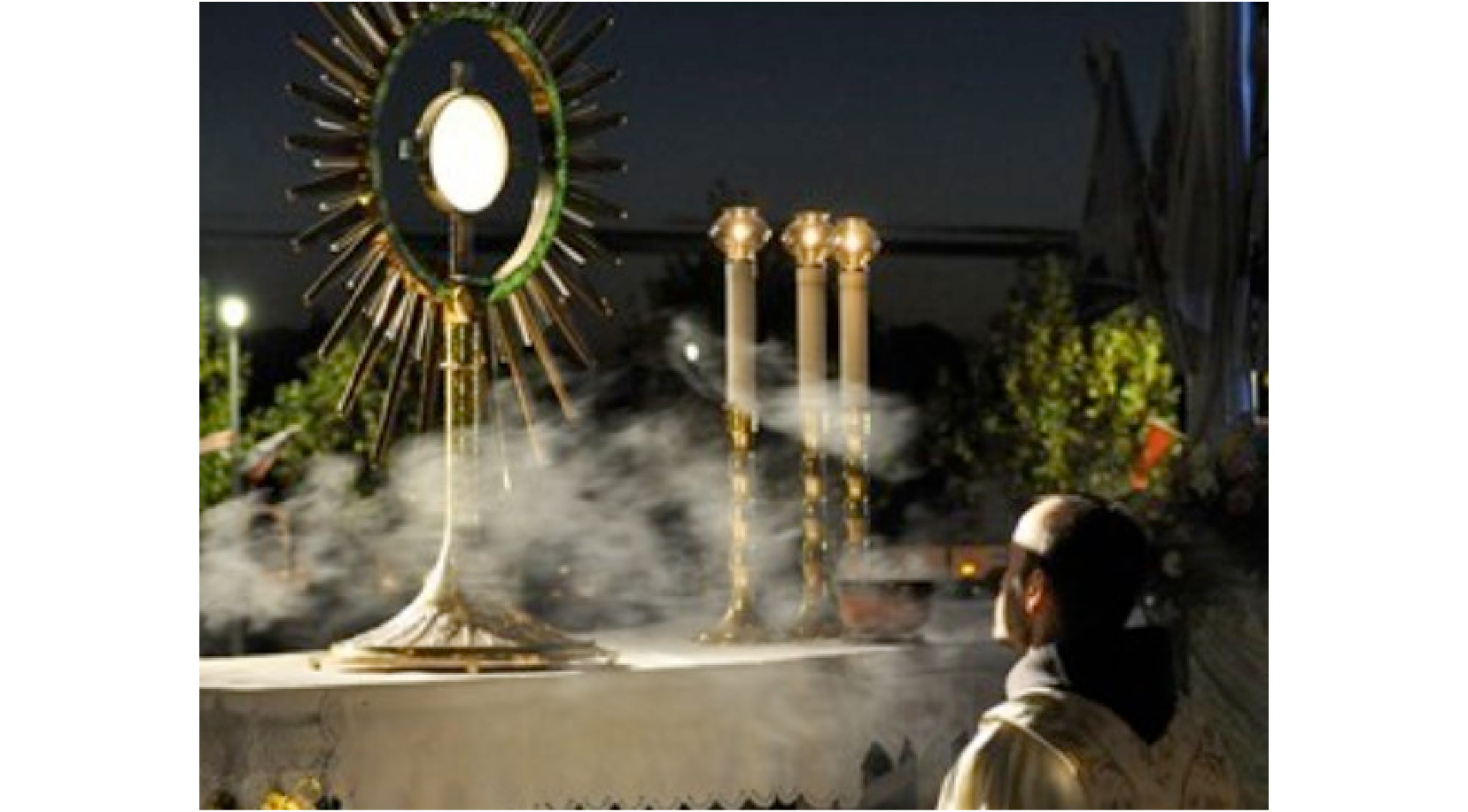
«55. The Blessed Sacrament should be reserved in a closed tabernacle or pyx. Under no circumstances may it be exposed in a monstrance.
«The place where the tabernacle or pyx is situated must not be made to resemble a tomb, and the expression tomb is to be avoided: for the chapel of repose is not prepared so as to represent the Lord’s burial but for the custody of the eucharistic bread that will be distributed in communion on Good Friday.
«56. After the Mass of the Lord’s Supper, the faithful should be encouraged to spend a suitable period of time during the night in the church in adoration before the Blessed Sacrament that has been solemnly reserved. Where appropriate, this prolonged eucharistic adoration may be accompanied by the reading of some part of the gospel of Saint John (ch. 13-17).
«From midnight onward, however, the adoration should be made without external solemnity, for the day of the Lord’s passion has begun.
57. After Mass, the altar should be stripped. It is fitting that any crosses in the church be covered with a red or purple veil, unless they have already been veiled on the Saturday before the fifth Sunday of Lent. Lamps should not be lit before the images of saints.»
As No. 55 clearly states, there should be no exposition in a monstrance; this is a position also found in other documents.
As Pope Benedict XVI said in a homily in 2011, Holy Thursday «ends with Eucharistic adoration, in memory of the Lord’s agony in the garden of Gethsemane.» This sets the atmosphere of meditation proper to this evening of prayer.
Eucharistic adoration is not synonymous with exposition in the monstrance. Christ is equally adored in the tabernacle and the pyx as in the monstrance. Adoration in the monstrance helps the adorers concentrate on the Eucharistic mystery but does not make the adoration essentially different from worship offered to Our Lord in the tabernacle.
Also, adoration in the monstrance usually unfolds into the joyous experience of Eucharistic Benediction whereas in the concrete case of Holy Thursday the essential theme is accompanying him during his agony; there is no Benediction.
The rule forbidding solemn adoration after midnight means that there should be no further public prayers at the altar of repose once Good Friday begins. This does not prohibit private prayer and private adoration at the altar of repose; these may continue until the beginning of the celebration of the Passion on Good Friday.
There may be some specific exceptions. For example, I believe that Poland, due to certain precise historical circumstances, has an indult from the Holy See that allows for adoration with a monstrance during the Easter triduum. I understand that a semi-transparent veil is used to veil the monstrance from the end of the Holy Thursday Mass and right through to the Easter Vigil. The current Roman Missal for Poland contains the details of the indult and its respective ceremonies. Similar indults allowing exceptions to the universal law may also exist in some other countries.
* * *
Follow-up: Veiling of Crosses
An attentive reader from Colombia, Missouri, requested clarifications on some points of our previous article on veiling crosses and images.
He first questioned my use of the word «universally required» to refer to the veiling or removal of images after the Mass of the Lord’s Supper. He said that the rubrics use terms such as: «It is fitting»; «If possible»; and «it is expedient.»
While my use of the word «required» was admittedly a tad too strong, the point I wanted to make was that, unlike the possibility of veiling after the Fifth Sunday of Lent in accordance with local tradition, this indication is applicable to the whole Church.
An expression such as «it is fitting» or «expedient», while not establishing a legal obligation, is still a bit stronger than «optional.» It is an indirect way of saying that «if you can do it, it’s better to do it.»
However, the legislator is also aware that it cannot create legal obligations that might be impossible to carry out in practice, which is another reason why it uses expressions such as «if possible.»
There are many churches where images and crosses are excessive in number or not readily accessible. Such would be the case, for example, of many Roman basilicas beginning with St. Peter’s itself. Veiling the many statues in this imposing edifice would require several cranes and perhaps a couple of acres of violet cloth. They are therefore usually left as they are.
The same reader also asked: «You wrote that, ‘Even if this large crucifix is veiled [referring to an altar crucifix), a processional or other altar cross should be used for Mass with the figure facing the celebrant.’ Why must the figure on the cross face the celebrant? You quoted GIRM 308 that, ‘Likewise, either on the altar or near it, there is to be a cross, with the figure of Christ crucified upon it, cross clearly visible to the assembled people.’ While there can certainly be a crucifix on the altar facing the celebrant, it seems that the crucifix referred to in this rubric should be facing the people. Or is that not correct?»
In the case I was discussing, we were presuming that the large crucifix behind or above the altar, which habitually serves as the altar crucifix, has been veiled on the Fifth Sunday of Lent. Since the altar is still being used for Mass, there is still a need for the presence of an altar crucifix. This may be the processional cross, or a smaller cross placed upon the altar. In this case the crucifix is usually placed in such a way that the figure of Christ faces toward the altar of celebration and not toward the people.
This would also be true if an altar crucifix or processional cross were habitually used as the principal cross for the celebration of Mass. GIRM 308 says that the cross is visible to the people. The figure, however, always faces the altar.
We attempted to explain the historical and canonical reasoning behind this practice in an earlier article on November 23, 2024.
* * *
Readers may send questions to zenit.liturgy@gmail.com. Please put the word «Liturgy» in the subject field. The text should include your initials, your city and your state, province or country. Father McNamara can only answer a small selection of the great number of questions that arrive.
Thank you for reading our content. If you would like to receive ZENIT’s daily e-mail news, you can subscribe for free through this link.