

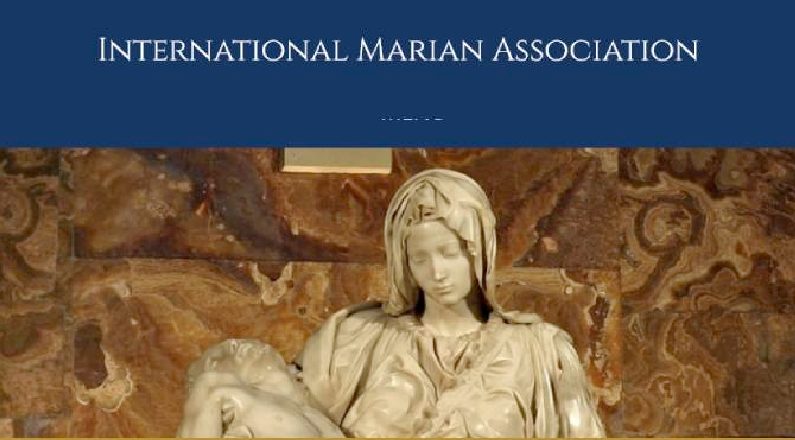
(ZENIT News / Rome, 03.26.2026).- An international body of prominent Mariologists is urging the Dicastery for the Doctrine of the Faith to formally address what they describe as serious doctrinal deficiencies in a recent Vatican text on the Virgin Mary.
At the center of the debate lies Mater Populi Fidelis (“Mother of the Faithful”), a doctrinal note issued on November 4, 2025, under the authority of Cardinal Víctor Manuel Fernández. The document sought to clarify the theological language surrounding Mary’s role in salvation, emphasizing that her cooperation must always be understood as entirely dependent on—and subordinate to—the unique mediation of Christ.
In practical terms, the note discouraged the use of certain traditional Marian titles, including “Co-redemptrix” and some formulations of “Mediatrix of all graces,” arguing that they can be pastorally misleading or theologically ambiguous if not carefully framed. While the document did not deny the underlying theological truths these expressions intend to convey, it advised against their use in official teaching and liturgy.
A coordinated theological response
The reaction from specialists in Marian theology has been both swift and unusually organized. The Theological Commission of the International Marian Association—an international network comprising more than 45 theologians, including figures such as Scott Hahn, Mark Miravalle, and Michael Sirilla—published a detailed 23-page critique on December 8, 2025, the feast of the Immaculate Conception.
That document, far from polemical in tone, framed its objections within what it called a “respectful synodal dialogue.” However, its substance was direct: the theologians identified what they considered omissions, minimizations, and even contradictions of prior Marian teaching, both before and after the Second Vatican Council.
Having received no official reply, the group escalated its request in a letter dated March 19, 2026—the solemnity of St. Joseph—and made public days later. In it, the theologians formally asked the dicastery to issue clarifications or corrections, arguing that the current text risks disrupting what they describe as a necessary “hermeneutic of continuity” in Marian doctrine.
Theological stakes: language or doctrine?
At first glance, the dispute may appear to concern terminology. In reality, it touches on deeper questions about the development of doctrine and the boundaries of theological expression.
Mater Populi Fidelis reflects a long-standing concern within the Church: ensuring that Marian devotion does not obscure the centrality of Christ’s redemptive role. This sensitivity has been particularly acute in ecumenical contexts, where certain Marian formulations have historically been points of contention with other Christian traditions.
Yet critics argue that the document’s approach risks flattening the richness of Marian theology. In their December commentary, they expressed concern that the note omits what they describe as the “redemptive value” of Mary’s unique cooperation in salvation history, and goes so far as to impose an “unnecessary prohibition” on the future use of the title “Co-redemptrix” in official contexts.
The concern is not merely devotional. For decades, some theologians have explored the possibility of defining new Marian dogmas related to these titles. While no such definition appears imminent, critics fear that the Vatican text could signal a doctrinal retreat or, at minimum, a cooling of that trajectory.
An unusual appeal to history
To reinforce their case, the theologians invoked a striking historical precedent: the evolution of the Church’s teaching on slavery. They pointed to an 1866 instruction of the Holy Office—predecessor of the current dicastery—which had stated that slavery was not inherently contrary to natural or divine law.
That position was later reversed by Pope Leo XIII in 1888 and definitively condemned as intrinsically evil by Pope John Paul II in Veritatis Splendor. The comparison is not intended to equate the issues, but to underscore a methodological point: doctrinal notes, even from authoritative bodies, have historically been subject to correction and development.
In making this argument, the theologians also cited Donum Veritatis, a Vatican document that explicitly affirms the duty of theologians to raise concerns with the Magisterium when they perceive ambiguities or problems in official teaching.
Signals from within the Vatican
Complicating the picture are informal remarks made by Cardinal Fernández shortly after the publication of Mater Populi Fidelis. In a November 2025 interview, he appeared to soften the document’s stance on the term “Co-redemptrix,” suggesting that its use is not intrinsically inappropriate, but rather unsuitable for official texts and liturgical usage.
While welcomed by the theologians as a constructive nuance, this clarification has not been formalized in any revised document—one of the reasons cited for their renewed appeal.
A test of synodality
Beyond its Mariological content, the episode offers a revealing glimpse into the evolving dynamics of doctrinal discourse in the Catholic Church. The theologians have consistently framed their intervention not as opposition, but as participation in a synodal process—one that includes dialogue, correction, and mutual listening.
Whether the dicastery will respond, and in what form, remains uncertain. What is clear is that the discussion has already moved beyond academic circles, touching on broader questions about authority, development, and the role of theological expertise in shaping the Church’s teaching.
In that sense, the controversy over Mater Populi Fidelis may prove less about Marian titles than about the mechanisms through which Catholic doctrine itself is clarified, contested, and ultimately refined.
Thank you for reading our content. If you would like to receive ZENIT’s daily e-mail news, you can subscribe for free through this link.

Publicaciones relacionadas:
 The norms for discernment of alleged supernatural phenomena explained by the Prefect for the Dicastery of the Faith
 The Six Possible Conclusions About Marian Apparitions According to the Vatican’s New Norms
 Third Vatican Pronouncement on Apparitions: Negative for “Our Lady of All Nations”
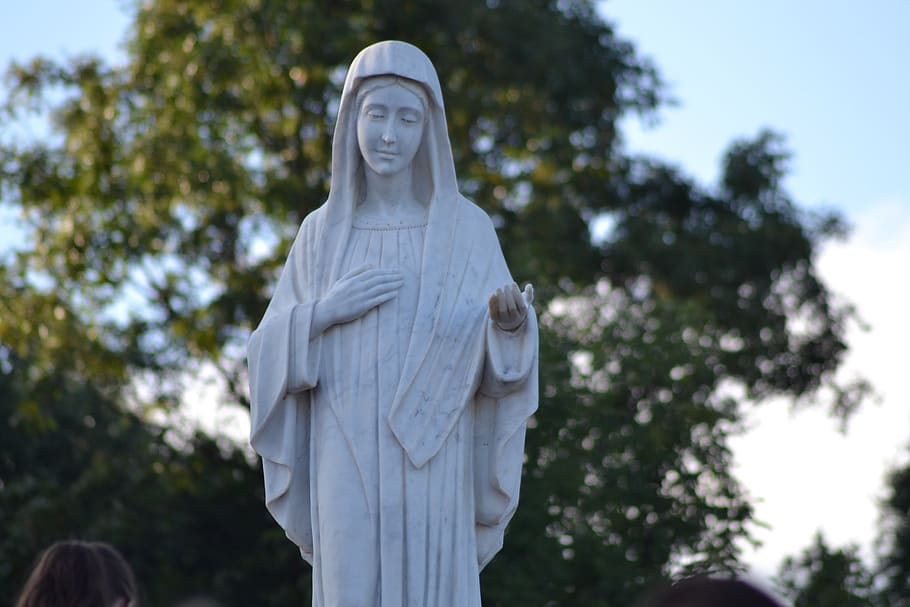 In defense of the Virgin Mary? International Marian Association against document by Cardinal Fernández and Congregation for the Doctrine of the Faith
