

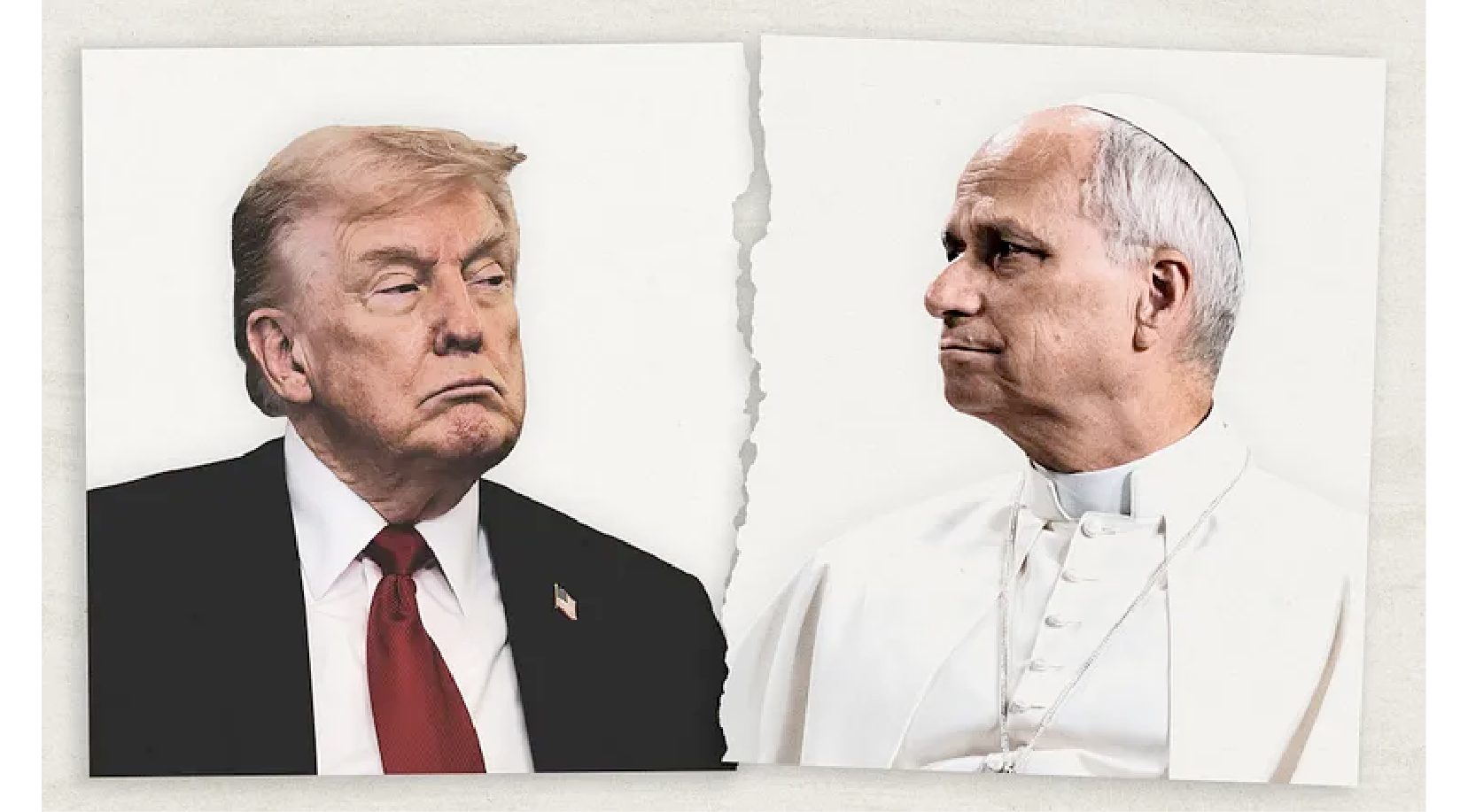
(ZENIT News / Rome, 04.10.2026).- What briefly appeared to be a serious rupture between the Holy See and the United States has, in a matter of days, been reframed by both sides as a case of media distortion layered over a real but far more routine diplomatic exchange. The controversy, triggered by a widely circulated report alleging that a Vatican diplomat had been summoned to the Pentagon and implicitly threatened, has exposed not only the fragility of perceptions in Church–state relations but also the deeper tensions shaping them.
At the center of the episode stands a meeting that did indeed take place on January 22, 2026, between Cardinal Christophe Pierre, then apostolic nuncio in Washington, and Elbridge Colby, the U.S. undersecretary of defense for policy. The encounter, confirmed by all parties, became the subject of sharply divergent narratives after claims emerged that it had involved a show of American military force and even historical allusions to the Avignon papacy as a warning.
Those claims have now been categorically rejected. Vatican spokesman Matteo Bruni stated that the account circulated in some media outlets was “completely false,” emphasizing that the meeting fell within the ordinary scope of diplomatic engagement and provided an opportunity to exchange views on matters of mutual interest. The apostolic nunciature in Washington had already preemptively described the encounter in similar terms, stressing its routine character.
On the American side, officials have been equally firm. The U.S. Embassy to the Holy See reported that Ambassador Brian Burch spoke directly with Cardinal Pierre, who dismissed the controversial version of events as fabricated. According to that account, the meeting was “frank but very cordial,” with no threats of any kind. The Pentagon itself described the exchange as “substantial, respectful and professional,” noting that discussions covered a wide range of geopolitical and ethical topics, including the moral dimensions of foreign policy, U.S. national security strategy, and regional issues spanning Europe, Africa, and Latin America.
Yet beneath these denials lies a more nuanced reality. While no credible source has substantiated the more dramatic allegations—such as explicit threats or references to medieval precedents—some Vatican insiders have acknowledged that the conversation was not devoid of tension. Descriptions of certain moments as “aggressive” or “intense” suggest that differences between the two sides were expressed candidly, even if within the bounds of diplomatic protocol.
These differences are not incidental. They reflect a broader and increasingly visible divergence between the foreign policy posture of Washington and the moral framework articulated by Pope Leo XIV. Since the beginning of his pontificate, the first pope born in the United States has repeatedly warned against what he has described as a renewed normalization of war in international relations. His critiques of a “diplomacy based on force” have been interpreted in some quarters as indirect but pointed commentary on American military actions, including recent operations linked to Iran and Venezuela.
Under Secretary of War for Policy Elbridge Colby @USWPColby had a substantive, respectful, and professional meeting with Cardinal Pierre, the then-Papal Nuncio, and his team on January 22, 2026. During the cordial meeting, they discussed a range of topics, including issues of… pic.twitter.com/McI0sB2wKC
— DOW Rapid Response (@DOWResponse) April 9, 2026
It was precisely such a speech—addressed to the diplomatic corps accredited to the Holy See—that reportedly prompted the January meeting. U.S. officials, seeking clarification of the Vatican’s position, engaged the nuncio in what they describe as a good-faith dialogue. From their perspective, the encounter was neither unusual nor confrontational: the Pentagon regularly meets foreign diplomats, and extending that practice to the Holy See was framed as a natural step in managing complex global issues.
However, analysts note that the symbolic weight of such a meeting is difficult to ignore. The Holy See, unlike other diplomatic actors, operates simultaneously as a sovereign entity and as the moral voice of a global religious community. When its positions intersect with contentious geopolitical questions, even routine contacts can acquire heightened significance.
The controversy also unfolded against a backdrop of already strained relations. Disagreements over migration policy, Latin America, and most recently military actions in the Middle East have contributed to a climate of mutual wariness. In this context, even unverified reports can resonate widely, particularly when they touch on historical sensitivities or suggest attempts to pressure the papacy.
Despite the turbulence, both sides have moved quickly to reaffirm the stability of their relationship. U.S. officials have insisted that ties with the Holy See remain “strong and productive,” while Vatican representatives have emphasized the importance of continued dialogue. Recent meetings between Ambassador Burch and Archbishop Gabriele Caccia, newly appointed nuncio to the United States, as well as Caccia’s audience with the pope, point to an effort to consolidate that message.
In the end, the episode reveals less about an actual diplomatic crisis than about the volatile intersection of perception, media amplification, and genuine geopolitical disagreement. The meeting at the Pentagon was real; the alleged threats were not. But the fact that such a narrative could gain traction so rapidly underscores how delicate the balance has become between two actors whose relationship, though longstanding, is increasingly shaped by divergent visions of global order.
For the Vatican, the priority remains clear: to articulate a moral critique of war without becoming entangled in partisan alignments. For Washington, the challenge is to engage that critique without allowing it to be construed as opposition. Between those positions lies a space where dialogue is both necessary and, as recent days have shown, easily misunderstood.
Thank you for reading our content. If you would like to receive ZENIT’s daily e-mail news, you can subscribe for free through this link.

Publicaciones relacionadas:
 3 key words of the missionary action of the Church and of the work of the Holy See’s diplomacy, according to Leo XIV
 A Church Against the Logic of War: Vatican Voices, Middle East Realities, and the Risk of a Vanishing Christianity
 Trump responds to Pope Leo XIV: I don’t want a ceasefire
 Ceasefire on the Brink: Pope Leo XIV, Global Powers and the Moral Battle Over War in the Middle East
