

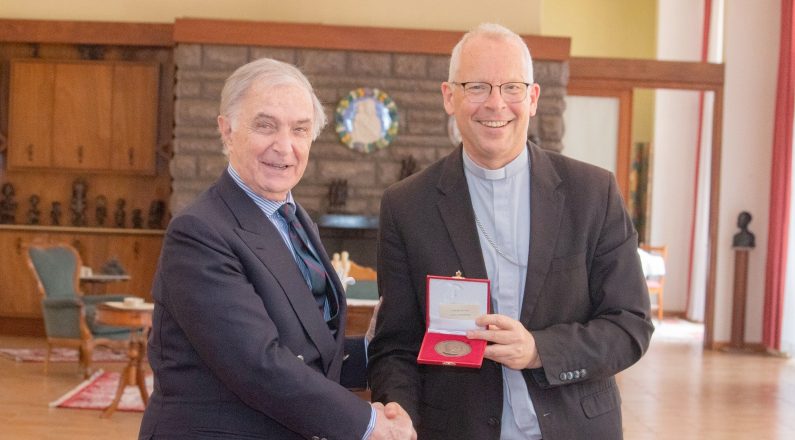
(ZENIT News / Berlin, 04.11.2026).- The appointment of Hubertus van Megen as the new apostolic nuncio to Germany marks more than a routine diplomatic reshuffle. It places an experienced Vatican envoy—honed in some of the world’s most volatile ecclesial and political environments—at the heart of one of the Catholic Church’s most sensitive internal debates: the evolving relationship between Rome and the German Church.
Announced on April 9 by Holy See, the nomination coincides with the acceptance of the resignation of the outgoing nuncio, Nikola Eterović, who steps down after more than twelve years in Berlin upon reaching the age limit. The transition comes at a moment when tensions, though often understated, continue to shape the dialogue between the Holy See and German bishops, particularly in relation to the controversial reform process known as the Synodal Path.
Van Megen, 64, brings with him a diplomatic career spanning three decades and multiple continents. Ordained a priest in 1987 for the Diocese of Roermond in the Netherlands, he entered the Vatican diplomatic service in 1994. His trajectory has included postings in Geneva, Israel, and Slovakia, but it is his long tenure in Africa that has defined his recent profile. Since 2019, he has served as nuncio in Kenya, with additional responsibilities in South Sudan—a country marked by chronic instability where the Vatican has invested significant moral and diplomatic capital in peacebuilding efforts.
That experience is not incidental. In South Sudan, the Holy See’s engagement reached a historic moment in 2019, when Pope Francis invited rival political leaders to the Vatican and, in an extraordinary gesture, knelt to kiss their feet in a plea for peace. Van Megen observed those efforts from close range, gaining firsthand exposure to the complexities of mediation in fractured societies. His diplomatic instincts were shaped in contexts where ecclesial authority intersects with fragile political realities—an expertise that, while forged far from Europe, may prove relevant in navigating Germany’s own ecclesial tensions.
The German context is, of course, different in nature but not devoid of complexity. The Synodal Path, launched as a reform initiative addressing governance, sexual morality, and clerical authority, has generated both enthusiasm and concern. While many German bishops and lay participants view it as a necessary response to the Church’s credibility crisis, officials in Rome have repeatedly warned against unilateral decisions that could affect universal doctrine or ecclesial unity. In this delicate landscape, the nuncio functions as a crucial intermediary: both the Pope’s representative to the local Church and a diplomatic bridge to the German state.
Van Megen’s linguistic fluency in German—reportedly without accent—may offer him an immediate advantage over his predecessor, who at times faced cultural and communicative barriers. Yet language alone will not resolve the deeper divergences. The role demands a capacity to interpret, translate, and, when necessary, temper the expectations of both sides.
His public record suggests he will not shy away from articulating clear positions. In recent years, he has voiced strong criticism of Western European secularization, describing trends such as abortion, euthanasia, and gender theory as indicators of a society that has “lost its compass.” He has contrasted what he perceives as the spiritual vitality of African Catholicism with what he characterizes as a weakening Church in the West. Such remarks, delivered during a 2025 episcopal ordination in Kenya, are likely to be scrutinized anew in light of his Berlin appointment.
At the same time, Van Megen has demonstrated awareness of the inherent tension between Rome and local Churches, acknowledging that divergences between papal teaching and pastoral practice are a recurring feature of Catholic life. For a nuncio, he has suggested, the essential task lies in navigating that tension—maintaining fidelity to the See of Peter while engaging constructively with local realities.
Initial reactions from Germany indicate cautious openness. Heiner Wilmer, president of the German Bishops’ Conference, welcomed the appointment by emphasizing continuity, dialogue, and mutual trust. He also acknowledged the role played by Eterović, who, despite maintaining a critical distance from aspects of the Synodal Path, remained personally engaged in the process.
The significance of this appointment extends beyond personalities. It offers an early indication of how Pope Leo XIV intends to approach one of the most closely watched fault lines in contemporary Catholicism. By selecting a diplomat shaped in demanding environments, with a reputation for clarity and a capacity for mediation, the Vatican appears to be opting for engagement rather than confrontation—yet without abandoning its doctrinal concerns.
In Berlin, Van Megen will encounter a Church seeking reform and a Holy See intent on preserving unity. His success will depend not only on diplomatic skill but on his ability to sustain a conversation that, for now, remains unresolved.
Thank you for reading our content. If you would like to receive ZENIT’s daily e-mail news, you can subscribe for free through this link.

Publicaciones relacionadas:
 Who is the person appointed bishop by the Pope who also becomes prince of a country?
 China recognizes first bishop appointed by Pope Leo XIV for a Chinese diocese
 Andorra will approve abortion despite the fact that its head of state is a Catholic bishop
 Holy Land: Cardinal Pizzaballa Says Palm Sunday Mass Ban in Jerusalem Was a Misunderstanding
