

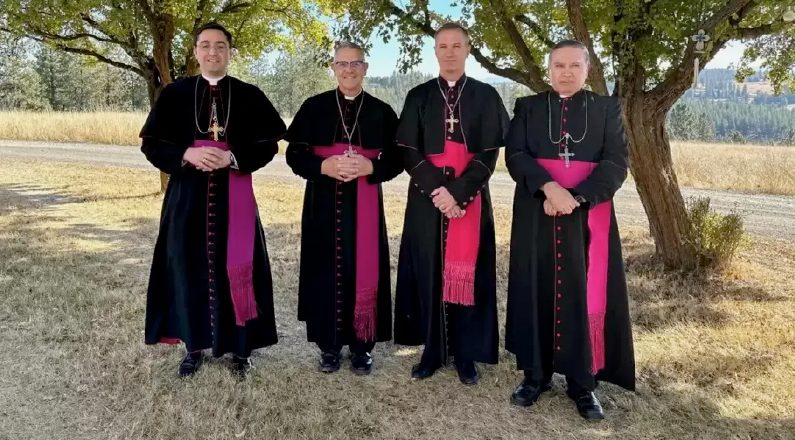
(ZENIT News – Porta Luz / Zamora, 07.02. 2026). – Although the followers of Archbishop Marcel Lefebvre garner the most media attention, they are not the only traditionalist movement currently heading down a schismatic path.
Other factions, even smaller in number, go further by adopting a strictly sedevacantist stance. While the Lefebvrists recognize the Bishop of Rome — although paradoxically they disobey him systematically –, others maintain that the Chair of St. Peter is vacant. Among the latter, a particular group is currently active online, seeking to convene a «Council» to appoint a new «Pope.»
What is the «Imperfect General Council»?
The promoters of this curious event — who group themselves under the name «Unam Sanctam» (the first two notes the Creed applies to the Church of Christ) — maintain an official website where they justify, in various languages, what they call their «holy intention.» This intention is based on «the current crisis affecting the head of the Church,» which they aim to resolve, arguing that Catholics «are obliged to act so that the Holy See is occupied.»
To this end, they decided to convene an «Imperfect General Council.» All the Church’s Bishops are invited (hence it is «general»), but it lacks papal authority (hence it is «imperfect» and, as they acknowledge, «legally defective»). According to them, holding it «responds to an emergency.» It is not a conclave, but rather «an extraordinary recourse for an extraordinary emergency.»
What ideas do they uphold?
The theoretical framework of this «Council» comprises a list of the most significant ideas of sedevacantist traditionalism, without any originality. The main basis is that Vatican Council II was a «revolution» that broke with Tradition, «substantially changing the holy doctrine of the Church.» Consequently, they speak of the current Catholic community as a «new Church» governed by «papal claimants» (not true Popes), questioning whether it might actually be «a new sect, totally alien to the Church of God.»
According to the promoters, this has led to the scattering of the faithful flock (the few traditionalists who have chosen various paths for survival), and «the Church must remedy it. Without daring to affirm categorically that the Roman See is vacant — a strategy intended to secure broader support from various traditionalist sectors –, they believe it is necessary to «shed light on the current situation,» as soon as possible.
And if the Chair of Saint Peter is declared vacant, the election of a new Pope would be a «primary obligation.» Since one cannot expect direct divine intervention of a miraculous nature, «the solution . . . should come from the Catholic clergy» (the adjective is important: they consider only traditionalists to be Catholic). «We must pray, but we must also act,» they insist. And for this reason, pastors aware of this dramatic situation must gather to resolve the problem.
Spokesmen for God
When it comes to convening their own «Council,» they do not view it as a private or ill-timed initiative. On the contrary: «We firmly believe that Divine Providence necessarily wills that the Church be led by a true Successor of Peter.» In other words: what they desire corresponds directly to God’s will. There is not a trace of self-criticism, nor an ounce of humility.
Furthermore, they clearly reject those who do not share their convictions: they are «the clergy who remained faithful to the faith,» the representatives of «true Christianity,» and they have identified the adversary in the battle, not an external enemy, but one that has infiltrated the institutions of the Catholic Church. They immediately add: «The Church has a duty to expel heretics from its midst.»
Self-servingly applying the writings of Saint Robert Bellarmine and Saint Alphonsus Liguori regarding truly grave cases, they insist on the «Council» as an «extraordinary remedy,” convened by faithful bishops, to restore the legitimate papacy and the unity of the Church. It is worth noting, once again, their intention to «gather all faithful Catholic bishops.» And by «faithful,» we repeat, they refer only to those who hold their own positions.
A gathering of false bishops and their sects?
Yet their rhetoric appears open and inclusive, even guaranteeing a plurality of viewpoints, such as when they insist that the call for bishops to attend be «as universal as possible.» What do they mean by this? That the question of the validity of received Orders should not, in the context of the General Council, be an obstacle to their participation.”
Herein lies the great trap: since, according to the promoters of this absurdity, «in this era of universal chaos… practically all priestly and episcopal lines are subject to suspicions of invalidity,» their proposal is that «a reasonable claim to having been ordained a priest or consecrated a Bishop is the best criterion for acceptance, and that, for the moment, each individual should be treated according to the title he believes he holds, provided he can reasonably justify it.»
In this way, they legitimize the participation of anyone claiming to be a bishop or priest, turning that «Imperfect General Council» into a tempting lure for the legions of false Catholic ministers who have spent decades parading their miters, crosiers, rings, and vestments from place to place, despite having received Holy Orders that lack legitimacy and are of highly dubious validity.
An act of self-affirmation and exclusion
It would be the new «pope» emerging from such a «Council» who would have to settle disputes regarding lines of episcopal succession (that is, establishing which bishops are genuine and which are not), thereby closing the circle: the false bishops themselves would end up legitimizing one another once one of their own was elected to wear the white robes of the papacy. For, furthermore, it is the «Council» itself that would determine who the legitimate electors are. Preposterous.
This is not a twisted interpretation of their claims, but something that follows clearly from what they say. Their intentions were made evident when the «Unam Sanctam» movement published a clarification on April 30, in which its representatives stated that «only those signatories who clearly belong to a non-Catholic organization, that is, a group that openly professes errors against the faith, especially errors condemned prior to Vatican Council II, are rejected.» Consequently, they directly exclude clergy in communion with the current Catholic Church.
Who are they, and what do they really want?
According to their own figures, as of today, this «Council» is supported by 13 bishops, 53 priests, and 86 men religious (no figure is given for the laity, who presumably do not matter much to them). They add: «we will regularly update these figures to highlight the will of Providence,» insisting on that prophetic or messianic sentiment. Yet, not a single individual name is provided. In this vein, they guarantee confidentiality to those who join, as «the website is managed by clergy accustomed to secrecy,” a typical resort to the fear of reprisals.
However, the key figure behind this farcical venture is well-known in traditionalist circles: the Canadian Pierre Roy, a former member of the Society of Saint Pius X (the organization founded by Lefebvre). He was ordained a priest within the Society in 2011 but left in 2016, deeming it too close to Rome. His definitive schismatic step occurred in 2024, when he was «consecrated bishop» by the Brazilian «fake bishop» Rodrigo Ribeiro da Silva (who had himself been «consecrated» by another «fake bishop,» the American Daniel Dolan).
According to the researcher who shares information about sedevacantist movements on the social network X (formerly Twitter) under the pseudonym Ngo Dinh Thuc (@contrathuc) thus adopting the name of the famous Vietnamese bishop who caused such trouble for the Church by conferring Holy Orders on highly unsuitable individuals and filling the world with schismatic clerics), «this new attempt involves Pierre Roy’s followers, as well as Rodrigo da Silva, Frei Tiago (a well-known European sedevacantist), and others not mentioned, such as a traditional old Catholic group.»
A troubling and uncertain development
@contrathuc adds another concerning detail: Pierre Roy was interviewed about his «Council» by YouTuber Stephen Kokx, who is very close to former Catholic Archbishop and former Nuncio Carlo Maria Viganò—whose latae sententiae excommunication was declared by the Holy See in 2024 after he was found guilty of the canonical crime of schism. Furthermore, Roy himself cited Viganò in the video calling for his assembly of clerics; thus, «Viganò is also in the picture, albeit not directly, though I consider there to be tacit and direct support.»
While this participation, or at least support, remains a hypothesis for the moment, the fact is that the groups and individuals involved in this attempted Council are being joined by entities that, until recently, feigned communion with the Holy See (albeit a critical one). In reality, however, they were maintaining a double standard, harboring a schismatic attitude disguised as obedience. This is the case with the Transalpine Redemptorists, a congregation of diocesan right (approved in a Scottish diocese) that, having originated in 1998 within Lefebvrist circles, fully joined the Catholic Church in 2008.
However, in October 2025, they published a letter rejecting the papal magisterium and Vatican Council II, thereby placing themselves once again in an openly schismatic position. It has recently come to light that these Transalpine Redemptorists have declared the Roman See vacant and, consequently, support the convocation of an «Imperfect General Council,» as stated by their Superior General, Father Michael Mary Sim. Furthermore, the latest reports indicate that Sim is to be «consecrated bishop» on July 25 by the false prelate Pierre Roy — the driving force behind this counterfeit schismatic Council.
These are sad and troubling developments, adding the actions of these individuals and groups to the challenge already posed by the Saint Pius X Priestly Fraternity. Some of these parties clearly lack right intention, seeking only their own sectarian interests and employing ruses and deceit to fanatically impose their messianic ideal. Prayer, humility, and steadfastness are the attitudes the faithful should adopt to face this situation, aiming to achieve the peace and unity within the Catholic Church to which Pope Leo XIV has dedicated his pontificate.

Publicaciones relacionadas:
 Bringing about a culture of prevention and care ti prevent sexual abuse
 A practical guide for confessors: between psychology and pastoral care. What helps and hinders the experience of forgiveness?
 Faith on screen: Why is religion winning back American audiences, according to a study?
 The Church Has Fallen: Chapnin Declares Moscow Patriarchate “No Longer Christian”
