

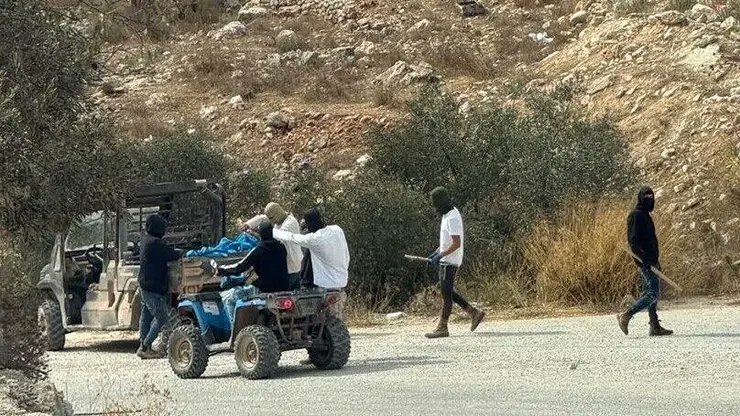
(ZENIT News / Jerusalem, 10.20.2026).- As violence against Palestinian farmers intensifies during the 2026 olive harvest in the occupied West Bank, the Christian village of Taybeh is confronting a threat that reaches far beyond lost income. Damaged trees, restricted access to farmland and mounting insecurity are undermining the ability of families to remain on their ancestral land. For the village’s Catholic parish priest, Father Bashar Fawadleh, the crisis is both an economic emergency and a struggle to protect a community’s historical roots.
The scale of the violence became particularly visible on Friday, October 16, when Israeli settlers attacked at least eight Palestinian villages, according to local officials and the Palestinian Red Crescent. Cars and trees were set on fire, residents were beaten, and Washington Post photographer Heidi Levine was hospitalized after being assaulted while covering the harvest in Abu Falah. The Israeli military condemned the violence and acknowledged that a journalist had been injured. The newspaper and the Foreign Press Association called for those responsible to be brought to justice.
The incidents have intensified concerns about the safety of Palestinian civilians during one of the most important periods of the agricultural year.
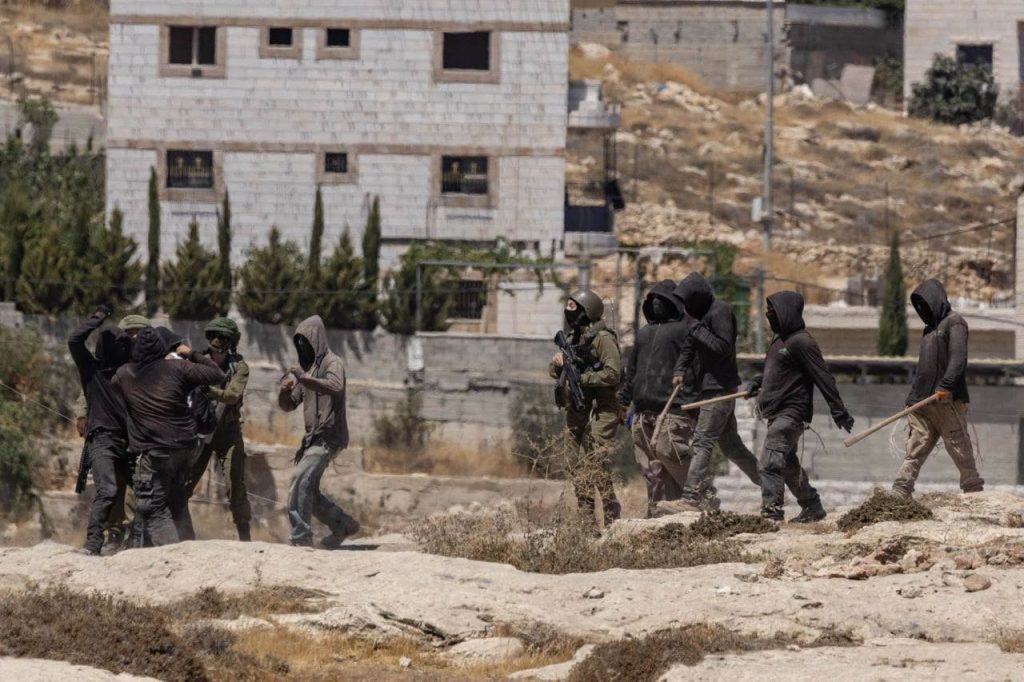
An agricultural harvest increasingly out of reach
Olive cultivation sustains tens of thousands of Palestinian families. According to Abbas Milhem of the Palestinian Farmers Union, approximately 110,000 families depend on privately owned olive groves for income, while the harvest also provides seasonal employment for tens of thousands of agricultural workers.
This year, however, farmers face both violence and restrictions on access to their land. New rules governing the harvest have prevented Palestinians from working in areas designated as Area C, which falls under Israeli security control and contains much of the West Bank’s agricultural land. Approximately two-thirds of Taybeh’s territory lies in Area C, leaving many families particularly exposed to the restrictions.
Father Fawadleh has reported stolen olives and damaged trees, warning that some households will produce less olive oil than they need for their own consumption. For families already struggling financially, the loss of a harvest threatens not only their earnings but also their ability to maintain their homes and continue living on their land.
Palestinian health authorities reported that at least four Palestinians had been killed and more than 100 injured since the beginning of the harvest season. The United Nations Office for the Coordination of Humanitarian Affairs recorded more than 1,600 settler attacks across the West Bank between January and August 2026. The figures underline the wider context in which the harvest is taking place, although individual incidents and allegations of responsibility must be assessed on their specific evidence.
In Abu Falah, accounts of what happened after Israeli troops arrived differed sharply. Residents said a village council member, Abdel Jaber Hassan, was shot while unarmed and carrying harvesting tools. The military said soldiers fired because an individual was running toward them with a sharp object. The competing accounts have added to calls for a credible investigation.
Israeli human rights organization Yesh Din has accused the authorities of failing to adequately prevent settler attacks and prosecute those responsible. The Israeli government, meanwhile, has rejected portrayals that it considers unfairly damaging to the wider settler population. Prime Minister Benjamin Netanyahu condemned the violence in Abu Falah but disputed how the confrontation had been characterized.
The violence is also unfolding ahead of Israel’s October 27 election, amid heightened tensions over settlement policy and the conduct of the government.
Israeli settlers herding sheep on private property in the Christian village of Taybeh in the West Bank, damaging olive groves and preventing residents from accessing their land.
https://t.co/QiOAbofNdn https://t.co/SfaIlr86zM— Ihab Hassan (@IhabHassane) June 1, 2026
Taybeh’s struggle to remain a living Christian community
For Taybeh, the consequences extend well beyond agriculture. Known as the last Palestinian village whose population remains entirely Christian, it is home to families determined to preserve their presence in the land associated with the origins of Christianity.
Madees Khoury, who runs her family’s brewery, describes daily life as a succession of obstacles. Military checkpoints and movement restrictions can make journeys to work, school and hospitals unpredictable, while commercial controls complicate the transport of goods. Although the brewery exports to 17 countries, sending its products to the nearby port of Haifa can take at least three days, despite the journey appearing to require only about an hour and a half on a map.
The company employs 15 people from Taybeh and neighboring villages. Production and sales have declined over the past three years, Khoury says, but the family has continued operating rather than abandoning its business.
She also describes a deterioration in the security environment around the village, including the burning of cars, threatening graffiti and attacks on farmers. Taybeh is now surrounded by seven settler outposts, according to her account, and residents have become increasingly fearful of moving around their own community.
“We want to live in peace, with dignity and in freedom,” Khoury says, expressing a desire that should not be extraordinary in any society. Her insistence on remaining is a declaration of attachment to home, but it also highlights how difficult it has become for Palestinian Christians to sustain ordinary family and economic life.
Maya Street, Middle East programme manager for CAFOD, the Catholic aid agency for England and Wales, says its local partners have repeatedly raised the alarm over escalating violence and restrictions. She describes the situation in Taybeh as part of a broader pattern threatening Palestinian land, livelihoods and heritage. The British government announced new sanctions against violent settlers and restrictions on trade with settlements last month.
Why the olive tree carries a meaning beyond its price
The destruction of olive trees has a significance that cannot be measured in agricultural losses alone. Across the Mediterranean, the tree represents continuity between generations, nourishment, peace and belonging. In Palestinian communities, centuries-old groves can embody the connection between families and land that remains central to their identity.
Italian theologian and biblical scholar Rosanna Virgili has drawn attention to the olive’s spiritual significance in both Christianity and Islam. In the Bible, the olive branch carried by the dove after the flood becomes a sign of renewed life and peace. Psalm 133 compares fraternal unity to precious oil poured upon the head. In the Quran, the olive is associated with blessing, nourishment and divine light.
For Catholics, olive oil also has a place in sacramental life. The sacred oils used in baptism, confirmation, ordination and the anointing of the sick signify different dimensions of Christian life, from initiation into the faith to spiritual strengthening and care at the end of life. The destruction of an olive grove does not itself destroy these sacraments, but the tree’s religious symbolism deepens the significance of what is being lost.
The olive tree also recalls Gethsemane, where Jesus prayed on the night before his crucifixion. In Christian reflection, that garden evokes vulnerability, suffering and the failure of others to remain beside someone in danger. The image offers a powerful lens through which to consider the predicament of families who fear that their land and homes are being left unprotected.
Such symbolism should not obscure the immediate realities: a damaged tree means lost income, food and years of agricultural labor. Nor should religious identity determine whose rights deserve protection. Palestinian Christians, Muslim farmers and other civilians are entitled to security, freedom of movement and protection from violence regardless of their faith.
Tonight, the Israeli army escorted settlers as they stormed the village of Deir Jarir in the West Bank.
The raid followed false accusations by settlers that Palestinians from the Christian village of Taybeh and Deir Jarir had stolen sheep.
Instead of arresting the settlers who attacked foreign diplomats in Taybeh yesterday, Israeli forces are escorting settlers as they enter Palestinian villages.
— Ihab Hassan (@IhabHassane) October 19, 2026
A call for protection, not abandonment
In his open letter, Father Fawadleh has appealed for solidarity, prayer and action. He is asking those with influence to help ensure safe access to farmland, protect agricultural workers and prevent further destruction. His appeal reflects a basic principle: communities should not be forced to choose between personal safety and the ability to cultivate their own land.
The responsibility to protect civilians rests with the authorities exercising control, and allegations of violence must be investigated impartially. Attacks on farmers, the destruction of property and assaults on journalists cannot be justified by political tensions or collective accusations. Those responsible should face accountability under the law.
The future of Taybeh matters beyond its immediate boundaries. The continued presence of Palestinian Christians is part of the living diversity of the Holy Land, not merely a remnant of its past. Preserving that presence requires more than expressions of concern about disappearing Christian communities. It requires conditions in which families can work, children can attend school, businesses can survive and farmers can harvest what they have planted.
If families cannot reach their trees or safely gather their fruit, the damage reaches from household finances to cultural memory and the possibility of remaining on ancestral land.
Thank you for reading our content. If you would like to receive ZENIT’s daily e-mail news, you can subscribe for free through this link.

Publicaciones relacionadas:
 53 Humanitarian Organizations Denounce «False Narratives» to Sabotage Those Saving Lives in Palestine
 Between Drones, Settlers and Classrooms: How Violence and Administrative Israeli Pressure Are Reshaping Palestinian Life
 A besieged Easter: Lebanon’s Christians between bombardment, blocked aid, and a fragile hope
 A cigarette in the mouth of a statue of the Virgin Mary: the controversial act of an Israeli soldier in Lebanon
