

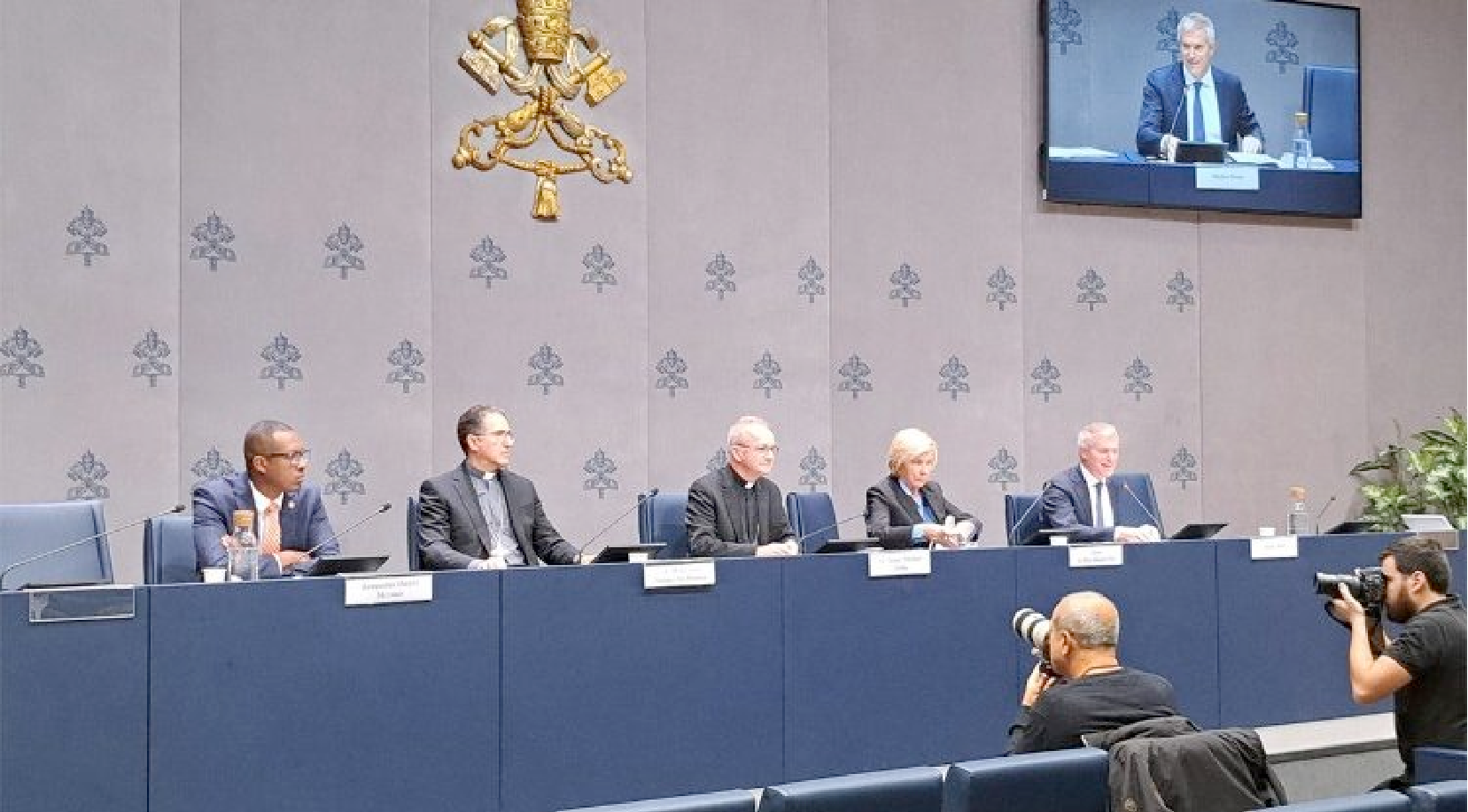
(ZENIT News / Rome, 10.18.2025).- The Vatican’s second Annual Report on Policies and Procedures for the Protection of Minors and Vulnerable Adults, presented on October 16, marks a determined shift in the Catholic Church’s long and painful journey toward accountability. The document, released by the Pontifical Commission for the Protection of Minors, takes the form of a practical handbook designed not merely as a set of instructions but as a moral roadmap—one that moves from listening to survivors to offering material, psychological, and spiritual forms of reparation.
At the center of the report lies the notion of “informed listening,” a principle rooted in the experience of survivors themselves. The Commission describes this as the starting point of a broader process that includes access to case information, financial assistance for medical and psychological care, and transparent public acknowledgment of harm. In his presentation, Archbishop Thibault Verny, appointed by Pope Leo XIV in July as president of the Commission, described the Church’s effort as a “perpetual pilgrimage” of conversion and reform—an acknowledgment that protection is not a policy to be achieved once and for all, but a mission that must never cease.
This second report builds on the structure of last year’s inaugural edition but goes further, both in scope and tone. Developed through consultation with survivor groups from four continents, as well as with non-ecclesial organizations, it exposes enduring gaps: the absence of clear structures for reporting, the unevenness of procedures between dioceses, and the persistent sense among many survivors that the Church still struggles to truly listen.
The first section focuses on restorative measures. Communities are urged to establish “safe spaces” for survivors to speak directly with Church leaders and pastoral agents. The report insists that reparations are not limited to individual gestures of compensation, but must involve the whole community in fostering what the «Dilexit nos» calls “a culture of mutual care and respect.” The Commission calls for official Church statements that explicitly recognize wrongdoing and publicly assume responsibility.
Support, according to the guidelines, must be sustained and multidimensional: professional counseling, long-term spiritual accompaniment, and financial aid to cover the tangible costs of trauma. The handbook also demands firm sanctions against those who commit, enable, or conceal abuse—underscoring that victims should never remain uncertain about accountability.
Information transparency is presented as a “fundamental right” of survivors and an essential element of healing. To that end, the report proposes awareness programs for clergy, religious, and lay faithful, aiming to build a collective process of restoration rather than isolated gestures of remorse.
A particularly forceful section of the report recommends simplifying the procedure for removing bishops and superiors who, through action or negligence, contributed to further harm. It also calls for the clear public communication of the reasons behind removals and for an independent evaluation of local Churches’ progress in implementing protection measures. One proposed innovation is the creation of a global academic network linking Catholic universities specialized in human rights, child protection, and canon law, to gather and analyze reliable data across regions.
The Commission also advocates for a “systemic and mandatory reporting mechanism” that could be used uniformly across dioceses and ecclesiastical institutions—a response to what it calls a continuing “deficit of coherence” in the Church’s handling of abuse cases. The report reaffirms the importance of apostolic nuncios as key actors in monitoring and supporting local Churches in this ministry of protection.
In its country assessments, the report highlights examples of progress, notably in Italy, where the Bishops’ Conference has developed a multi-level system of diocesan and inter-diocesan safeguarding services, with more than a hundred listening centers. Yet disparities remain, especially between regions, and the absence of a centralized office for case management continues to hinder consistency.
Globally, the picture is uneven. While Churches in parts of Europe, the Americas, and Oceania show increasing commitment, the report warns against an overreliance on financial compensation as a substitute for comprehensive healing. Many regions in Africa, Asia, and Latin America still lack resources for long-term survivor care. Nonetheless, the document cites creative local efforts—from Tonga’s Hu Louifi communal healing practice to Kenya’s revision of safeguarding guidelines and the “Courage to Look” truth-telling initiative in northern Italy—as examples of how culture and faith can converge to confront abuse.
Within the Roman Curia, the report points to an evolving interdicasterial approach. The Dicastery for Evangelization, particularly its section for First Evangelization and New Particular Churches, is credited for assisting over a thousand local Church jurisdictions in integrating safeguarding measures into daily governance.
In its final pages, the report reviews the progress of the Memorare Initiative, launched in 2022 to fund protection efforts in under-resourced regions of the Global South. Twenty local agreements have already been signed, with another dozen underway, supporting projects from Rwanda to Tonga, from the dioceses of Mexico City and Mombasa to the ecclesiastical provinces of Chubut, Paraná, and Santa Fe in Argentina.
If last year’s report reflected a Church learning to face its wounds, this new edition suggests one beginning to build structures of accountability and healing that reach beyond individual cases. Yet the Commission’s tone remains sober: the pilgrimage continues, and the distance between words and deeds—though narrower—has not yet vanished.
Thank you for reading our content. If you would like to receive ZENIT’s daily e-mail news, you can subscribe for free through this link.

Publicaciones relacionadas:
 What Effect Will Dobbs Have in the International Debate on Abortion?
 Vatican Will Investigate French Cardinal Self-Accused of Abuse
 Statement of Slovenian Jesuits’ Provincial About Father Mark Ivan Rupnik, S.J.
 Vatican Media Uses Rupnik Image Again Despite Cardinal Sean O’Malley’s Request Not To Do So
