

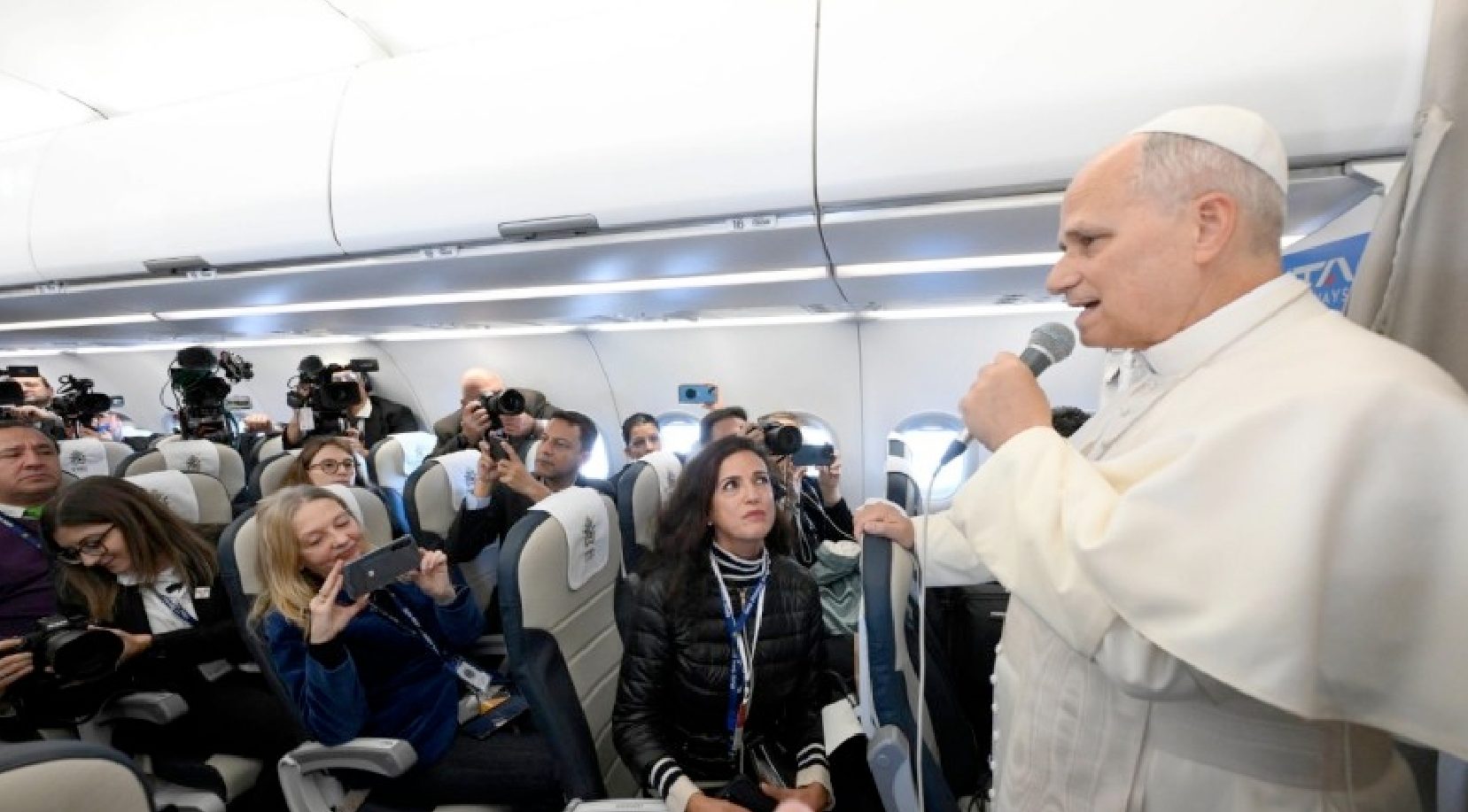
(ZENIT News, Istanbul, 11. 30. 2025) – Below is the press conference given by Pope Leo XIV during his flight from Turkey to Lebanon.
* * *
Matteo Bruni (Spokesman for the Holy See): Good afternoon, everyone. Welcome back. We have completed this first part of the trip and we thank the Holy Father for his presence among us and for this first stage of the journey, which has given us the opportunity to continue with him. I don’t know if you would like to say a word… Then there are some journalists who have prepared… [a few questions].
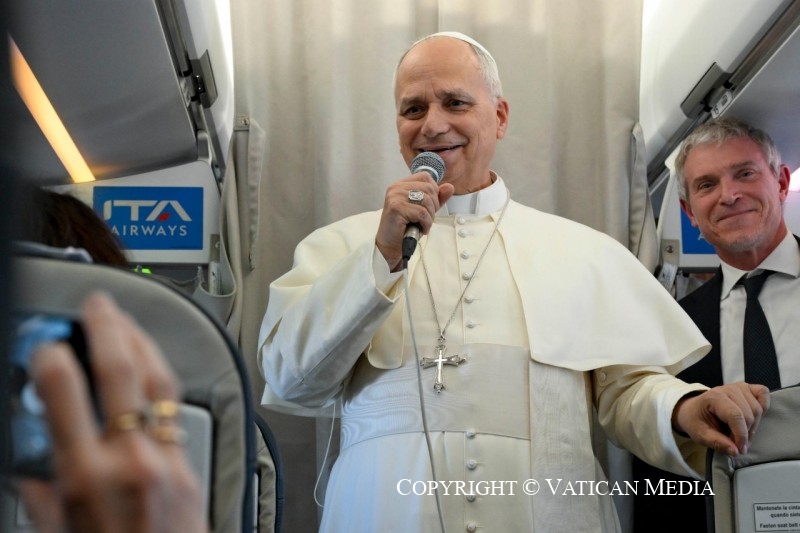
Pope Leo: Good afternoon, everyone. I will speak in English to begin; I think most of you understand. I am happy to greet you. I hope you have enjoyed your stay in Turkey as much as I have; I think it has been a wonderful experience. As you know, the main reason for coming to Turkey was the 1700th anniversary of the Council of Nicaea. We had that magnificent celebration, very simple and yet very profound, on the site of one of the ancient Basilicas of Nicaea, to commemorate the great event of the agreement of the entire Christian community and the profession of faith, the Nicene-Constantinopolitan Creed.
Besides that, of course, there were many other events we celebrated. Personally, I want to express my gratitude to all of you for all the work involved in planning the visit, starting with the Nuncio, the staff, the entire team in Rome, of course, who organized everything; but especially to the Government of Turkey, to President Erdogan, and to the many people he made available to us to ensure the trip was a complete success: his personal helicopter, numerous means of transport, organization, etc., the presence of Ministers at various points during the trip; so I believe it was a great success.
I was very happy with the various meetings we had with the different Churches, with the diverse Christian communities, with the Orthodox Churches, culminating this morning with the Divine Liturgy with Patriarch Bartholomew. It was a wonderful celebration, and I hope you all shared that same experience. Thank you. I don’t know if there are any questions or comments, just a couple, because they are waiting for more photos.
* * *
Matteo Bruni: We have a first question from Baris Seçkin, a Turkish journalist from the Anadolu Agency:
Baris Seçkin (Anadolu Agency): Thank you very much. At the beginning of your papal trip, you referred to world and regional peace. In this regard, what is your comment on Turkey’s role in achieving and maintaining world and regional peace, and what did you discuss with President Erdoğan on this matter? Thank you.
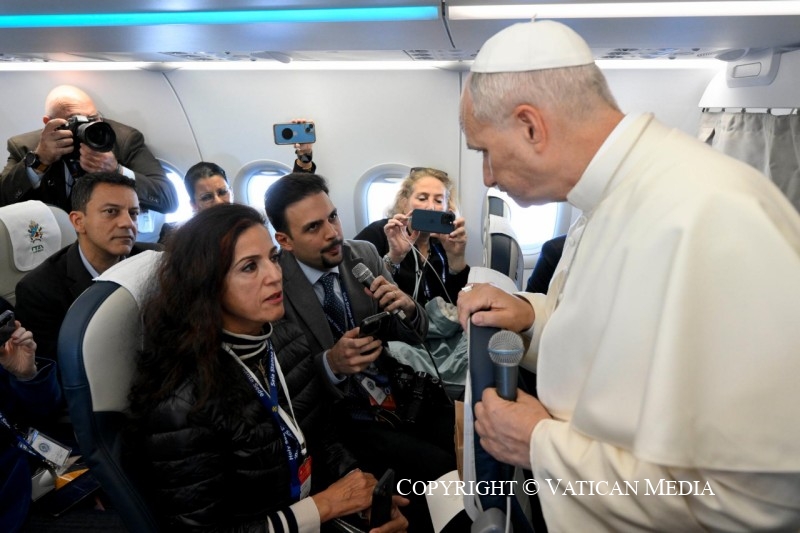
Pope Leo XIV: Having come to Turkey, and of course now to Lebanon on this trip, had, if you will, a special purpose: to be a messenger of peace, to want to promote peace throughout the region. Turkey has, so to speak, several qualities: it is a country whose vast majority is Muslim, and yet it has numerous Christian communities, albeit a very small minority, and still people of different religions can live in peace. And that is an example, I would say, of what we all seek in the world.
To say that, despite religious differences, despite ethnic differences, despite many other differences, people can live in peace. Turkey itself has, of course, had various moments in its history when this was not always the case, and yet, having experienced that and having been able to talk to President Erdogan about peace was an important element, a valuable aspect of my visit.
Matteo Bruni: Thank you Baris, thank you, Holiness. The next question comes from Seyda Canepa, of Turkish television:
Seyda Canepa: Your Holiness, beyond the official statements, did you and President Erdogan discuss the situation in Gaza, given that the Vatican and Turkey share the same vision regarding the two-state solution? And regarding Ukraine: the Vatican, on more than one occasion, has emphasized Turkey’s role, beginning with the opening of the grain corridor at the start of the conflict. So, do you see any hope for a truce in Ukraine and a faster peace process in Gaza at this time? Thank you very much.
Pope Leo XIV: Thank you! We certainly discussed both situations. The Holy See has publicly supported the two-state solution proposal for several years. We all know that Israel does not yet accept this solution, but we see it as the only one that could offer — let’s say — a way out of the ongoing conflict. We are also friends of Israel and try, with both sides, to be a mediating voice that can help bring us closer to a just solution for all. We discussed this with President Erdoğan; he certainly agrees with this proposal. Turkey has an important role to play in this.
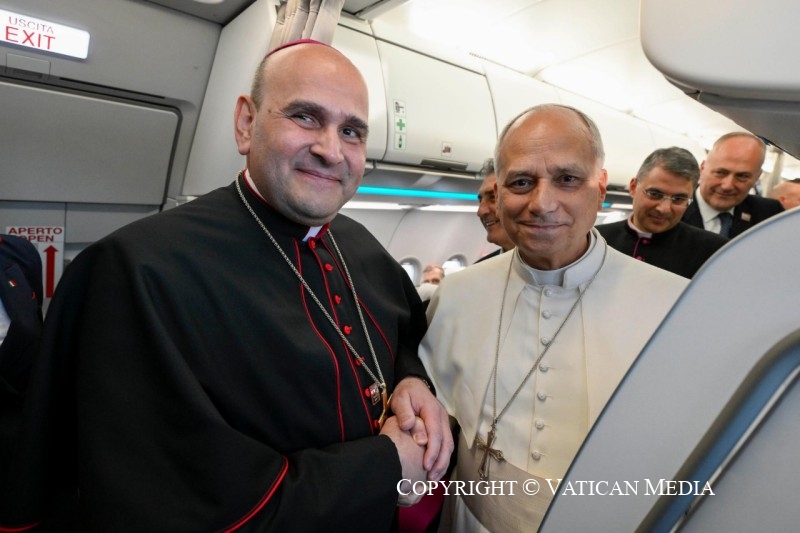
The same applies to Ukraine. A few months ago, with the possibility of dialogue between the Ukrainian and Russian sides, the President was very helpful in bringing both sides together. Unfortunately, we still haven’t seen a solution; but today, once again, there are concrete proposals for peace. And we hope that President Erdogan, with his relationship with the Presidents of Ukraine, Russia, and the United States, can help in this regard to promote dialogue, a ceasefire, and find a way to resolve this conflict, this war in Ukraine. Thank you.
Greetings to all. Have a good trip!
* * *
Matteo Bruni suggests I say a word about the important ecumenical meeting in Nicaea.
Yesterday morning we discussed possible future gatherings. One could be in 2033, the two-thousandth anniversary of the Redemption, of the Resurrection of Jesus Christ, which is clearly an event that all Christians want to celebrate. The idea was well received; we haven’t sent out invitations yet, but there is a possibility of celebrating this great event of the Resurrection, for example, in Jerusalem in 2033. There are still years to prepare. But it was a very beautiful meeting, because Christians from diverse traditions were present and were also able to participate in that moment.
Thank you! Thank you all.

Publicaciones relacionadas:
 Cardinal of Iran arrives at the Vatican and meets with Pope Leo XIV after the bombing of the country and days without news of him
 Pope Leo XIV summons bishops to Rome to discuss the reimplementation of the controversial Amoris Laetitia
 The account of the resurrection of Lazarus and the symptom of a longing for the infinite, as reflected upon by Leo XIV
 Pope Leo XIV to the French episcopate: Seek inclusive solutions for Catholics who use the Old Missal
