

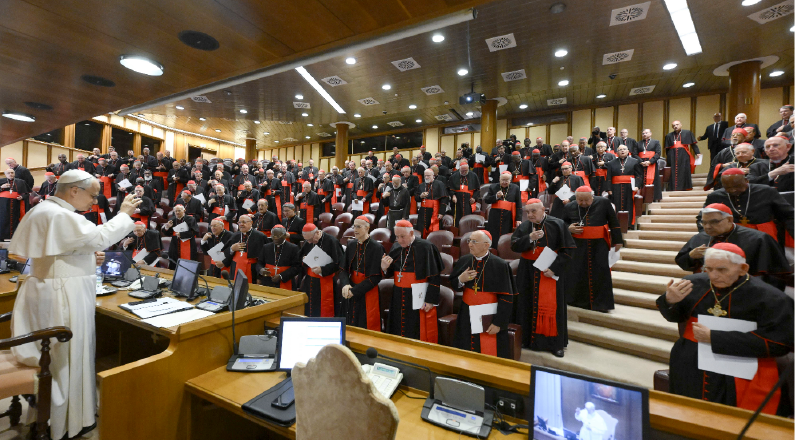
(ZENIT News / Rome, 11.10.2025).- Pope Leo XIV is preparing to summon an extraordinary consistory of cardinals for January 7 and 8, 2026 — the first such gathering of his young pontificate. Though the topic remains undisclosed, the announcement, revealed by veteran Vatican journalist Edward Pentin through internal correspondence, has already sparked wide speculation about the direction Leo intends to set for his papacy.
The brief note, sent to members of the College of Cardinals earlier this month, described the Pope’s intention to convene the extraordinary meeting “to address matters of particular importance to the Church.” No agenda has been circulated, and Vatican spokesman Matteo Bruni declined to confirm the letter’s authenticity, remarking that announcements of this kind are rarely made so far in advance. Even so, several cardinals privately acknowledged receiving notice — a sign that preparations are indeed underway.
Extraordinary consistories are among the most significant moments in the life of the Church. Unlike the ceremonies where new cardinals receive their red hats, these closed-door gatherings bring together the entire College to discuss urgent global or ecclesial challenges. Historically, they have served as turning points in papal governance, moments when a pontiff consults his closest advisors on questions that test both the faith and the unity of the Church.
The upcoming assembly will be the first of its kind since August 2022, when Pope Francis brought together the world’s cardinals to examine the implications of Praedicate Evangelium, the reform of the Roman Curia. That meeting, though framed as a moment of renewal, was also marked by muted discontent over the limited opportunity for open discussion. Many cardinals later complained that the atmosphere had grown increasingly centralized, with fewer occasions for genuine collegial dialogue.
For that reason, Leo XIV’s decision to reconvene the College in such a format is being interpreted as a deliberate gesture — an attempt to restore a sense of fraternity and shared responsibility that some felt had waned in recent years. The 70-year-old pontiff, elected earlier this year in a conclave that itself exposed deep divisions within the hierarchy, now faces the delicate task of knitting together a Church weary from ideological polarization.
If the new Pope seeks inspiration, he need only look to his predecessors. St. John Paul II convened six extraordinary consistories, using them to address everything from curial reform to threats against human life and the challenges of evangelization in the modern world. In contrast, Benedict XVI preferred more informal gatherings on the eve of his ordinary consistories, while Francis, in his twelve years as Pope, called only two — the first in 2014 to prepare for the Synod on the Family, and the second in 2022 to discuss Church governance.
That 2014 assembly remains etched in memory for the intervention of Cardinal Walter Kasper, whose proposal to extend Communion to divorced and remarried Catholics provoked intense debate and reshaped the pastoral conversation for years to come. Whether Leo XIV’s meeting will carry comparable weight is uncertain, but many within the Vatican expect it to mark a defining moment for the new papacy’s tone and priorities.
With the College of Cardinals currently numbering 128 electors — eight more than the traditionally recommended limit — few expect this gathering to include new appointments. Instead, attention has turned to the possible themes. Some speculate the Pope may wish to address the moral credibility crisis following decades of abuse revelations; others point to the reform of episcopal conferences, the future of synodality, or even the Vatican’s strained relations with China and parts of Africa.
The meeting’s timing, coming so early in the calendar year and less than a year into Leo XIV’s pontificate, suggests urgency. It may also reflect the Pope’s desire to imprint his leadership style on a Church navigating both internal fatigue and global instability. Unlike his predecessor’s more cautious approach to convening such assemblies, Leo appears intent on reviving the old rhythm of dialogue that once characterized the Church’s universal governance.
Observers note that the young pontiff has spoken frequently about his vision of a “listening Church,” one that acts neither as an ideological fortress nor as a mere humanitarian agency. If that vision is to take shape, the extraordinary consistory could serve as its testing ground — a place where the world’s cardinals measure the balance between authority and communion, reform and tradition.
The coming weeks are likely to bring clarification, perhaps even the first hints of the agenda. For now, what remains is the sense of expectation: that the Church, under a new shepherd, might once again speak to itself with honesty and unity.
Thank you for reading our content. If you would like to receive ZENIT’s daily e-mail news, you can subscribe for free through this link.

Publicaciones relacionadas:
 Leo XIV to Personally Bestow Palliums in Return to Historic Ritual: A Subtle but Symbolic Shift in Papal Style
 Pope Leo XIV: yes to synodality, but without undermining the authority of the bishop
 Cardinals will return to Rome for a new Consistory in June 2026 requested by Pope Leo XIV
 Pope Leo XIV accepts resignation of bishop whom Pope Francis appointed cardinal, but who “did not want” to receive the appointment
