

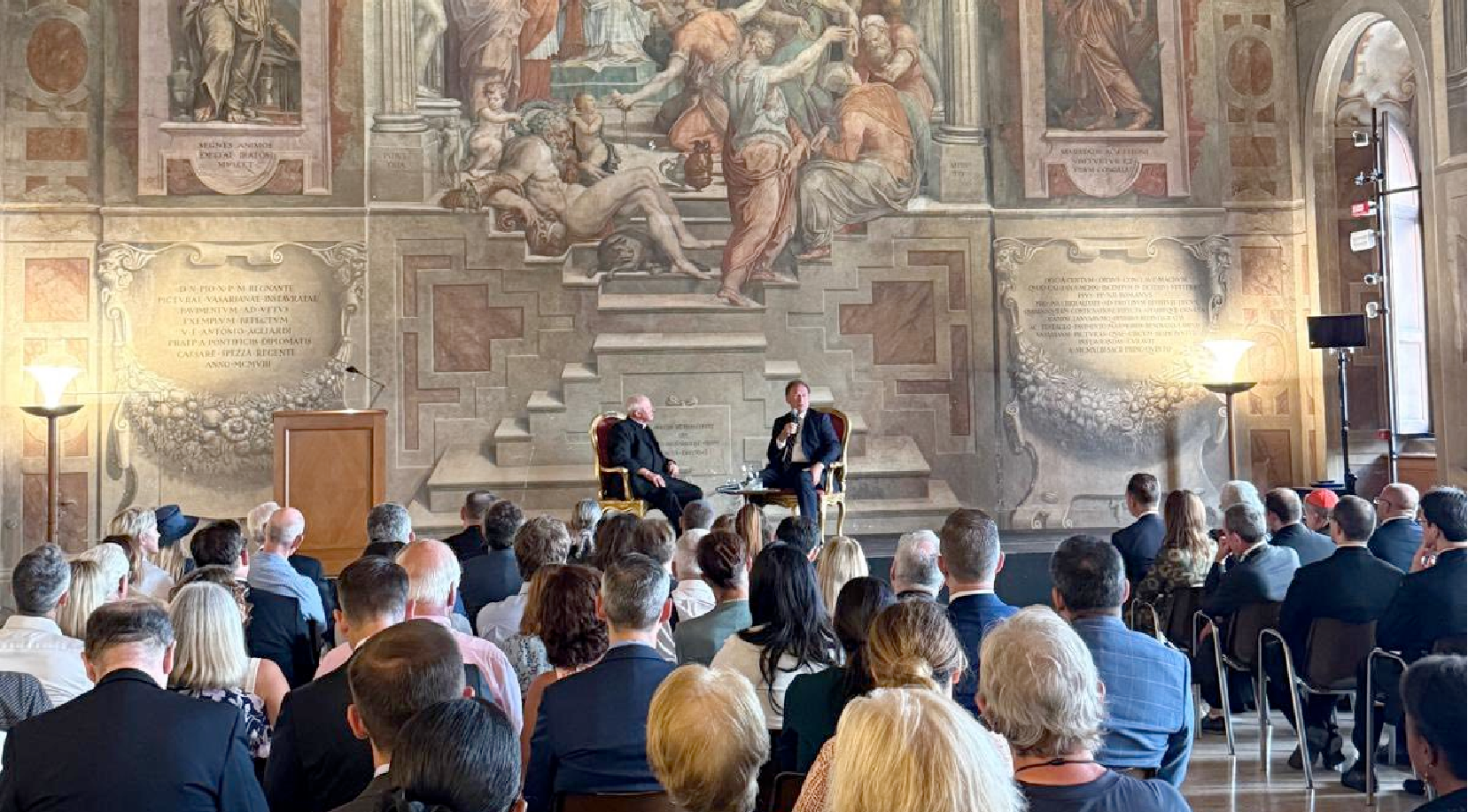
(ZENIT News / Rome, 09.23.2025).- In the Renaissance halls of the Palazzo della Cancelleria, home to the Vatican’s highest tribunals, U.S. Supreme Court Justice Samuel A. Alito Jr. offered a meditation on the uneasy but essential dialogue between justice and mercy. His remarks came during the Vatican’s Jubilee of Justice, part of the Holy Year of Hope, in an evening conversation that drew jurists, clergy, and diplomats.

The discussion, hosted by the U.S. Embassy to the Holy See in collaboration with the Dicastery for Evangelization and the U.S. bishops’ conference, placed Alito opposite Monsignor Laurence Spiteri of the Roman Rota. Newly appointed U.S. ambassador Brian F. Burch introduced the exchange, praising the justice’s long record in the defense of religious freedom.
Alito, a practicing Catholic who has served on the Supreme Court since 2006, spoke candidly of a paradox that has vexed lawmakers and theologians alike. “Justice is what everyone is owed,” he said, “while mercy is what none of us can claim as a right. Reconciling the two fully—perhaps only God can achieve that.” Still, he argued, legal systems should carve out spaces for clemency at every level: in legislation, enforcement, and sentencing. Laws that are too rigid risk crushing the very human dignity they are meant to safeguard.

Pressed on the challenges facing believers, Alito contrasted the courtroom battles over conscience rights in the United States with the brutal violence endured by Christians in parts of the Middle East and Africa. “We must be honest about the scale of what is at stake,” he urged, suggesting that American debates, however heated, exist within a context of relative security.
The justice also fielded questions on the structure of the Supreme Court itself. Calls to expand its size, he noted, are not new. The framers left its membership unfixed, but nine justices, he argued, offer a balance of diversity and manageability. Sharp disagreements, he admitted, are part of the Court’s daily reality—but he stressed they remain professional, not personal. “Better decisions,” he said, “come when people of good faith argue firmly, but generously.”
Throughout the evening, Alito returned to themes that echoed the words of Pope Leo XIV earlier that day, when the pontiff described justice as the protection of the weak and the healing of communities. Alito drew a parallel between civil law and canon law: one rooted in constitutional authority, the other in divine mandate, yet both relying on precedent to preserve stability while allowing room to correct past errors.

Among those present were Vatican officials such as Cardinal Raymond Burke and Bishop Juan Ignacio Arrieta, alongside Catholic lawyers on pilgrimage for the Jubilee. They listened as Alito conceded that in human courts, perfect harmony between mercy and justice is unattainable. But that, he suggested, should not deter judges, lawmakers, or attorneys from striving to approximate it.
In a polarized age, his closing counsel resonated beyond the ornate marble chamber. Legal systems and societies alike, he insisted, work best when citizens “communicate in a civilized and rational way.” It was, in the end, less a jurist’s conclusion than a civic prescription—offered from Rome, but aimed at a world too often deaf to both justice and mercy.
Thank you for reading our content. If you would like to receive ZENIT’s daily e-mail news, you can subscribe for free through this link.

Publicaciones relacionadas:
 Pope Francis calls on rich countries to forgive the debt of the poor on occasion of Jubilee 2025
 Cuba responds to the Pope by releasing half a thousand prisoners in the context of Jubilee 2025
 Justice and its function: a reflection by Pope Leo XIV before judges from around the world on the occasion of the Jubilee
 Planned Parenthood, the Abortion Multinational, Carries Out 1,200 Abortions a Day
