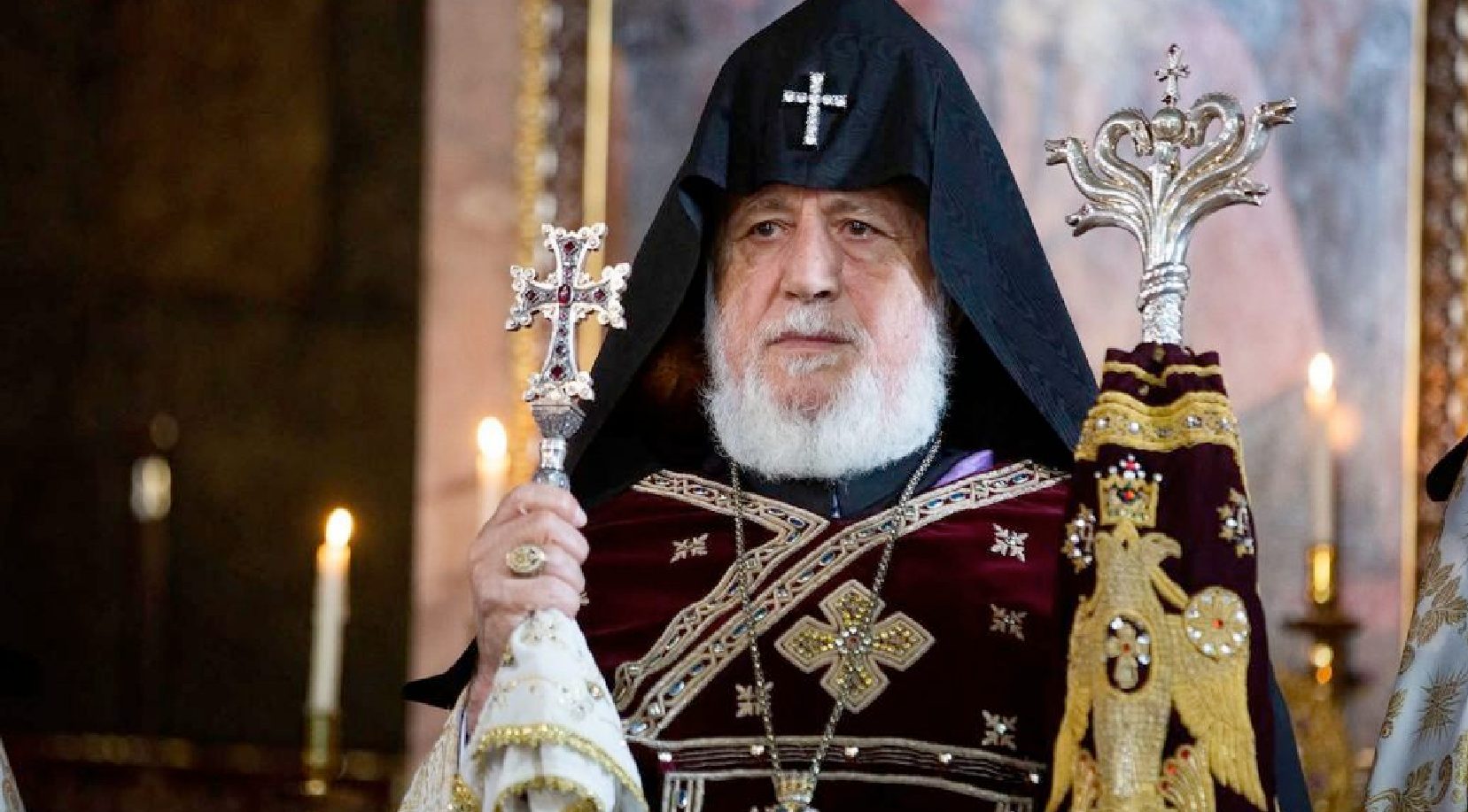
(ZENIT News / Rome, 02.21.2026).- The latest escalation in Armenia’s deepening Church–state confrontation unfolded on February 14, when prosecutors opened a criminal case against Karekin II, Supreme Patriarch and Catholicos of All Armenians, and barred him from leaving the country. Within hours, a dispute that had simmered for months crossed into a new and volatile phase: the head of a Church that predates most European states now faces judicial proceedings initiated by the government of the republic that regards it as its national spiritual cornerstone.
Karekin II, who has led the Armenian Apostolic Church since 1999, had been scheduled to travel to Austria from February 16 to 19 to preside over a meeting of the Church’s Synod of Bishops. The gathering was to take place in St. Pölten. He did not go. The travel ban made that impossible.
Prosecutors accuse him of obstructing justice. Church officials reject the charge outright, describing it as a direct intrusion into ecclesiastical self-governance. For them, the issue is not merely legal but constitutional and theological: who has authority over the internal discipline of a Church that defines itself as both ancient and national?
To grasp the stakes, one must understand the singular position of the Armenian Apostolic Church. Headquartered in Echmiadzin — often referred to as the “Vatican of Armenia” — it belongs to the family of Oriental Orthodox Churches, a communion of roughly 70 million faithful that also includes the Ethiopian Tewahedo and Coptic Orthodox Churches. These communities parted ways with the churches of Rome and Constantinople after the Council of Chalcedon in 451, over formulations concerning the nature of Christ. In recent decades, theologians from both sides have acknowledged that the dispute was largely one of language rather than substance.
That rapprochement found expression in 1996, when Pope John Paul II and Catholicos Karekin I signed a joint declaration affirming a shared faith in Christ’s divinity and humanity. Full communion remains distant, however — a point underscored by Pope Leo XIV during a November 2025 address at the Armenian Apostolic Cathedral in Istanbul.
Armenia itself occupies a distinctive place in Christian history. In 301 A.D., it became the first state to adopt Christianity as its official religion. The modern Republic of Armenia, by contrast, dates only to 1991, following independence from the Soviet Union. The country — landlocked, about the size of the U.S. state of Maryland, and home to roughly three million people — lies between Turkey, Georgia, Azerbaijan and Iran. Around 95 percent of its population belongs to the Armenian Apostolic Church; Catholics account for approximately 0.6 percent.
Yet the Church’s total global membership is closer to nine million, meaning that most Armenian Apostolic faithful live in the diaspora. That transnational dimension complicates any attempt to confine the Church’s leadership to purely domestic political dynamics.
Armenia’s Constitution describes the state as secular and mandates separation between religious organizations and government. At the same time, it explicitly acknowledges the Armenian Apostolic Church’s “unique mission” in the spiritual life of the people, in the development of national culture and in the preservation of identity. The resulting arrangement is inherently delicate: formal separation coexists with a recognition of the Church as a foundational national institution.
That equilibrium began to wobble visibly on January 4, 2026. Prime Minister Nikol Pashinyan — in office since 2018 and leader of the centrist Civil Contract party — released a video setting out what he termed a “roadmap” for reform of the Church. The document called for the removal of Karekin II, the election of a new Catholicos, and the introduction of mechanisms to ensure financial transparency and moral integrity within the clergy. Eight bishops signed the text at the prime minister’s residence; two others endorsed it in absentia.
For critics, the optics were startling: a sitting head of government publicly proposing structural reform of a constitutionally separate Church and hosting bishops to formalize it. For Pashinyan’s supporters, the move was framed as necessary corrective action.
The personal dimension of the conflict predates the roadmap. In June 2025, Pashinyan accused Karekin II of fathering a child, offering no public evidence. The allegation further strained relations between the government and the ecclesiastical hierarchy.
Tensions intensified on January 6, the Armenian celebration of Christmas, when Pashinyan led a procession in Yerevan from St. Gregory the Illuminator Cathedral to the Church of the Holy Mother of God of Katoghike. Addressing supporters, he accused the Church’s “de facto head” and his inner circle of acting with a sectarian mentality and declared that the national Church must be “returned to the people.”
The immediate legal trigger for the current crisis was the case of Bishop Gevorg Saroyan, head of the Diocese of Masyatsotn and one of the roadmap’s signatories. On January 10, Karekin II removed him from office, citing abuse of authority. Four days later, a civil court declared the dismissal invalid and ordered Saroyan’s reinstatement. The Church refused and, on January 27, laicized him. Authorities now argue that this refusal constitutes obstruction of justice — an accusation extended to other bishops and ultimately to the Catholicos himself.
Pashinyan went further, alleging that the Austrian meeting was part of a plan to establish a “puppet catholicosate” outside Armenia. He vowed a harsh response, warning against external actors “with their eyes on the treasures of Echmiadzin.”
Church leaders have characterized the prosecutorial steps as unconstitutional interference. Observers within Armenia note growing pressure on religious freedom. The Austrian Bishops’ Conference had already voiced concern in November 2025 over the detention of bishops, citing potential violations of the rule of law and human rights.
The Holy See maintains cordial relations with both sides. Pope Leo XIV received Karekin II in private audience at Castel Gandolfo on September 16, 2025. On October 20 of the same year, he granted a private audience in the Vatican to Prime Minister Pashinyan. The content of both meetings remains undisclosed.
Could Rome serve as mediator? In theory, the Vatican possesses diplomatic experience and historical precedent. In practice, such an offer would likely be rebuffed. Armenia is a small and cohesive nation, wary of external arbitration. Moreover, segments of Armenian public opinion suspect that the Holy See has drawn too close in recent years to Azerbaijan, Armenia’s regional adversary, diminishing perceptions of neutrality.
For now, that prospect appears remote. The confrontation has evolved into a test of institutional endurance and political will. At issue is not only the fate of a bishop or the travel plans of a patriarch, but the definition of boundaries in a republic where faith and national identity have been intertwined for seventeen centuries.
Thank you for reading our content. If you would like to receive ZENIT’s daily e-mail news, you can subscribe for free through this link.