

(ZENIT News / Orange, Ca., 11.20.2025).- When visitors step onto the campus of Christ Cathedral in Garden Grove, they soon discover that the towering glass sanctuary is no longer the only structure drawing curiosity. Just upstairs in the cathedral’s cultural center, an entirely new world has opened—built not of stained glass and marble, but of animation, projection, and the enduring questions surrounding one of Christianity’s most enigmatic artifacts.
This week marked the public debut of “The Shroud of Turin: An Immersive Experience,” a museum unlike anything previously attempted in the United States. Created over three years at a cost of five million dollars, the 10,000-square-foot installation blends historical reconstruction with cinematic storytelling, while placing visitors face-to-face with the mysteries of the famed linen some believe once wrapped the body of Christ.
Housed in three expansive projection theaters and a series of adjoining galleries, the exhibition invites its audience on a 90-minute journey that begins not with the Shroud itself, but with the life of Jesus—from the hill country of Galilee to the darkness of Calvary. The producers wanted to make clear that the Shroud is not an isolated curiosity but part of a larger human and spiritual narrative.
The project is the result of a collaboration between Papaian Studios, the Diocese of Orange and Othonia, Inc., a research initiative connected to the Pontifical Athenaeum Regina Apostolorum, of the Legionaries of Christ in Rome. Othonia has already developed Shroud exhibitions in several countries, but this is its most ambitious attempt, combining scientific material, devotional art and immersive media on a scale inspired by contemporary blockbuster exhibitions like those dedicated to Van Gogh or King Tut.
Jason Pearson of FiveHive Studios—whose credits include work on Mel Gibson’s “The Passion of the Christ”—oversaw much of the digital production. A convert to Catholicism and longtime volunteer guide at a previous Shroud center in the diocese, Pearson helped envision scenes that allow visitors to feel as though they are entering the world of the Gospels. The effect is deliberately disorienting: Jesus striding across the Sea of Galilee, shaded Jerusalem alleyways, the stillness of the tomb—these sequences unfold across the walls, ceiling and even the floor, surrounding viewers with an intimacy not possible in traditional museum settings.
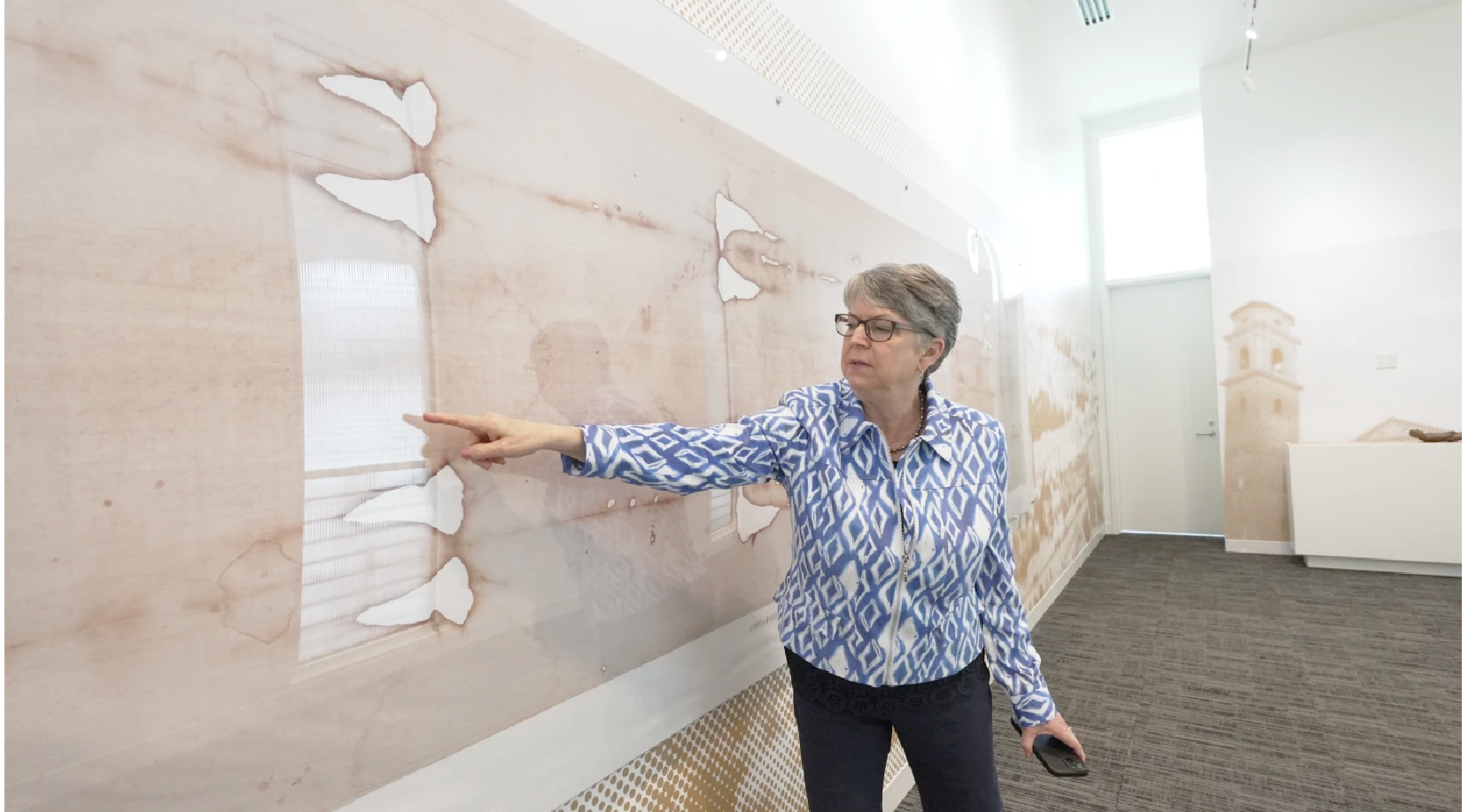
Yet the turning point of the experience comes when the Shroud itself appears—not the original, which remains secured in Turin, but a meticulously produced full-length reproduction mounted along an entire wall. The faint, ghostlike image of a man crucified, scourged and pierced has fascinated scientists for decades. Although radiocarbon tests once dated the cloth to the Middle Ages, proponents of its authenticity—including some researchers of significant standing—argue that contamination or insufficient sampling may have skewed results. Others note the presence of pollen traces or ancient weaving styles. The Church maintains a measured position: the Shroud is a profound sign pointing to the passion of Christ, but its authenticity has never been formally declared.
What distinguishes the California museum is its determination to present both faith and science without forcing visitors toward a predetermined conclusion. Interactive kiosks allow guests to question Father Robert Spitzer, the Jesuit thinker whose work bridges astrophysics and theology. An AI reconstruction introduces them to Secondo Pia, the nineteenth-century photographer whose negatives first revealed the Shroud’s startling detail. Other stations compare the image with the Sudarium of Oviedo or with centuries of Christian iconography, inviting reflection on how the face of Jesus has been imagined—and perhaps revealed—through time.
The Resurrection sequence, however, is the emotional culmination. Guests find themselves seated within a digital tomb, watching the burial cloth collapse in a burst of light. This is not offered as historical proof but as a contemplative tableau, an invitation to consider what might have taken place between death and dawn.
Many of those involved in the project arrived at the Shroud through personal curiosity. August Accetta, a physician, encountered the artifact nearly three decades ago and credits it with his conversion from agnosticism to Catholicism. His early fascination eventually helped inspire the new museum, building on the work of scientists from the 1978 Shroud of Turin Research Project—men like physicist John Jackson and researcher Rudy Dichtl, who insisted the image could not be explained through known physical processes. Some have proposed that only an intense burst of radiation could mark linen fibers without scorching them; others admit that no theory fully accounts for the image’s precision at the microscopic level.
The museum does not dwell solely on theories. It also presents the human dimension of the artifact. Auxiliary Bishop Timothy Freyer, who was instrumental in bringing the exhibition to Christ Cathedral, notes that for him one of the most striking displays is the reconstruction of the crown of thorns—not the circlet familiar in Western art, but a cap-like structure more consistent with Roman instruments of torture. The bishop hopes the museum will spark spiritual curiosity in believers and nonbelievers alike.
The curators have a particular eye on younger generations. Many of the museum’s creators say they often encounter teenagers and young adults who know little about Jesus or the stories surrounding him. At a previous Shroud center, Pearson witnessed two young visitors moved to tears, asking why no one had ever told them about the figure whose suffering the Shroud may depict.
For Nora Creech, part of the Othonia leadership team, this is precisely the point. The Shroud may raise countless questions, but it also opens a path to the deeper reality of Christ’s life, death and resurrection. In her view, curiosity about the cloth can become curiosity about the person—and ultimately, the faith—at its center.
The museum is expected to remain in place at least until 2030, giving Southern California abundant time to absorb one of the most technologically advanced religious exhibitions in the country. Nestled just miles from Disneyland, it stands as a reminder that wonder is not limited to theme parks. Sometimes it is found in a linen image whose secrets continue to resist explanation—and in the enduring question that every visitor is invited to carry home:
Who is the man of the Shroud?
Thank you for reading our content. If you would like to receive ZENIT’s daily e-mail news, you can subscribe for free through this link.

Publicaciones relacionadas:
 Pope Leo calls on Catholics in Gaza; more than 500 Catholic priests announce march in support of Gaza in Rome
 From Castel Gandolfo, Pope Leo XIV Calls for Peace Amid Gaza’s Agony and UN Genocide Allegations
 This is what the Pope’s trip to Turkey, Lebanon, and Latin America would look like: more details and even dates are emerging
 Leo XIV, China and attention to communities suffering for their faith
