

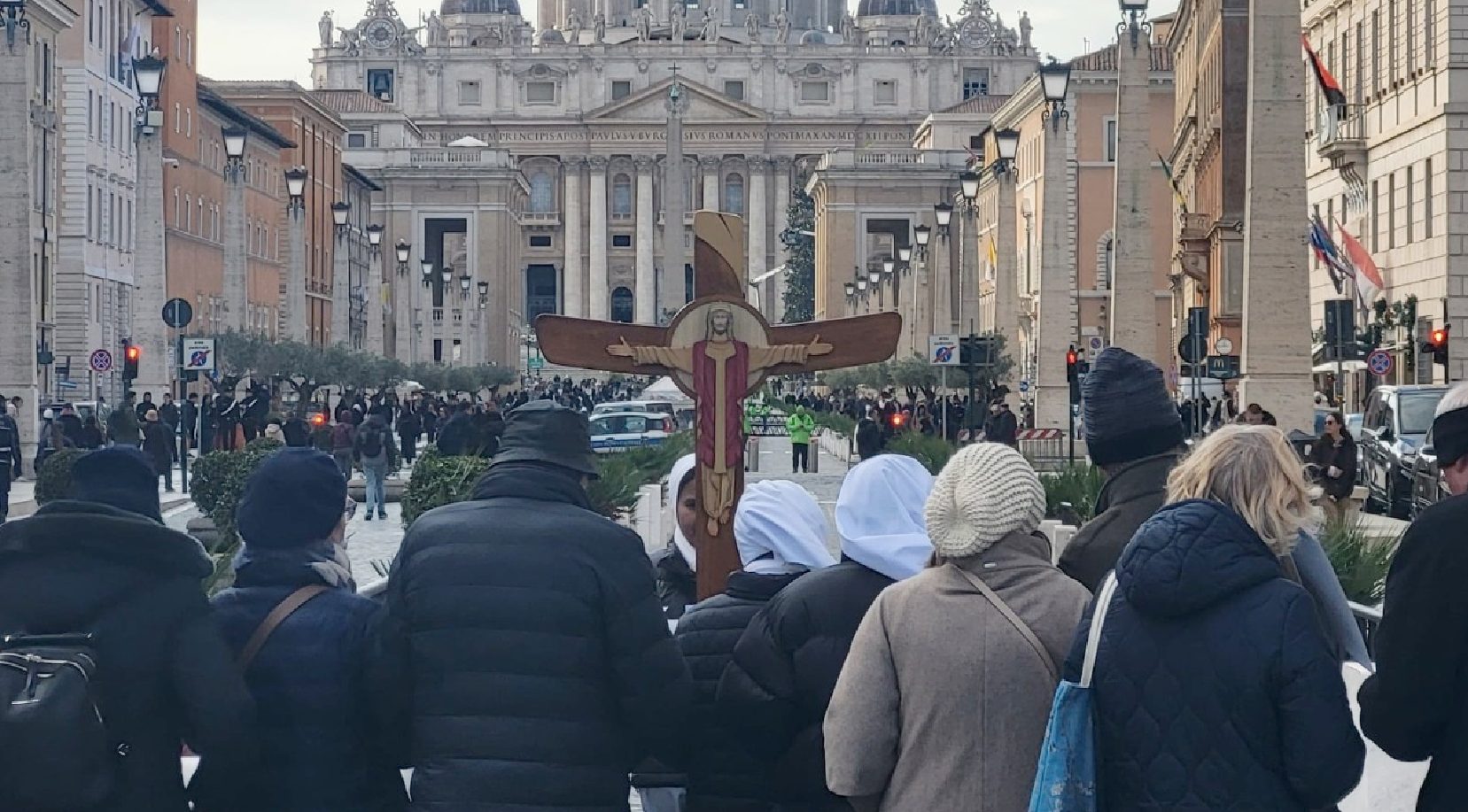
(ZENIT News / Roma, 09.06.2025).- Eight months into the Jubilee of Hope, Rome has already seen the arrival of 24 million pilgrims, transforming the Eternal City into the beating heart of Catholic devotion and renewal. The figures, released by the Vatican’s Dicastery for Evangelization, confirm what church officials had predicted at the beginning of the Holy Year: that the city would become a crossroads of faith, drawing more than 32 million visitors before the celebrations conclude.
The Jubilee was inaugurated on Christmas Eve 2024, when Pope Francis, in one of his final great liturgical gestures before his death, opened the Holy Door of St. Peter’s Basilica. That symbolic act, rooted in centuries of tradition, set in motion a year-long pilgrimage marked by prayer, penance, and extraordinary gatherings. In the first two weeks alone, half a million pilgrims poured into Rome—an early sign of the momentum that has carried through the summer.
What has made this Holy Year striking is not only the scale of participation but also its breadth. The streams of pilgrims have been remarkably diverse: journalists and communications professionals, police forces, athletes, deacons, the sick, volunteers, people with disabilities, Catholic influencers, and over a million young people have already made their way to the tombs of the apostles. The Jubilee has functioned as a stage where every vocation and circumstance of life has found a place.
Upcoming celebrations show the pastoral imagination behind the Jubilee’s design. On September 15, the Vatican will host the Jubilee of Consolation, dedicated to those enduring suffering—through illness, bereavement, violence, or abuse—together with their families and friends. Days later, on September 20, judges and jurists will gather for the Jubilee of the Administrators of Justice, followed by the Jubilee of Catechists at the month’s end. Each gathering reflects an effort to connect faith with lived human realities, weaving the Church’s liturgical rhythm into the social fabric of the world.
Beyond its devotional character, the Jubilee has also reshaped the life of Rome. Pilgrim routes are alive with song and prayer, the city’s parishes and religious communities are extending hospitality, and volunteers are working tirelessly to accompany visitors. The influx has brought not only spiritual energy but also logistical challenges, as transportation networks, security services, and local communities strive to accommodate the steady tide of arrivals.
The Holy Year is scheduled to conclude on January 6, 2026, when Pope Leo XIV will solemnly close the Holy Door at St. Peter’s, bringing to an end the passage of grace that began under his predecessor. Until then, significant jubilees remain on the calendar, including gatherings for migrants, missionaries, consecrated men and women, the poor, and prisoners—each one highlighting a different face of the Church’s mission.
For Rome, this Jubilee has become more than an event; it is a living pilgrimage, one that continues to draw people from every corner of the globe into an encounter not just with a city, but with a tradition that spans centuries. Twenty-four million journeys already testify to that enduring pull. By the time the final pilgrim crosses the threshold of the Holy Door, the Jubilee of Hope may well stand among the most memorable chapters in the Church’s modern history.
Thank you for reading our content. If you would like to receive ZENIT’s daily e-mail news, you can subscribe for free through this link.

Publicaciones relacionadas:
 Michael’s Pietà in the Vatican Basilica: security work completed to better admire it
 Vatican: the ceremony of the recognitio that sets up the Holy Door for the Jubilee in St. Peter’s Basilica
 1.3 million pilgrims have already passed through the Holy Door of St. Peter’s in the first weeks of the Jubilee
 Italian police confiscate 13 million unauthorized religious articles sold around the Vatican
