

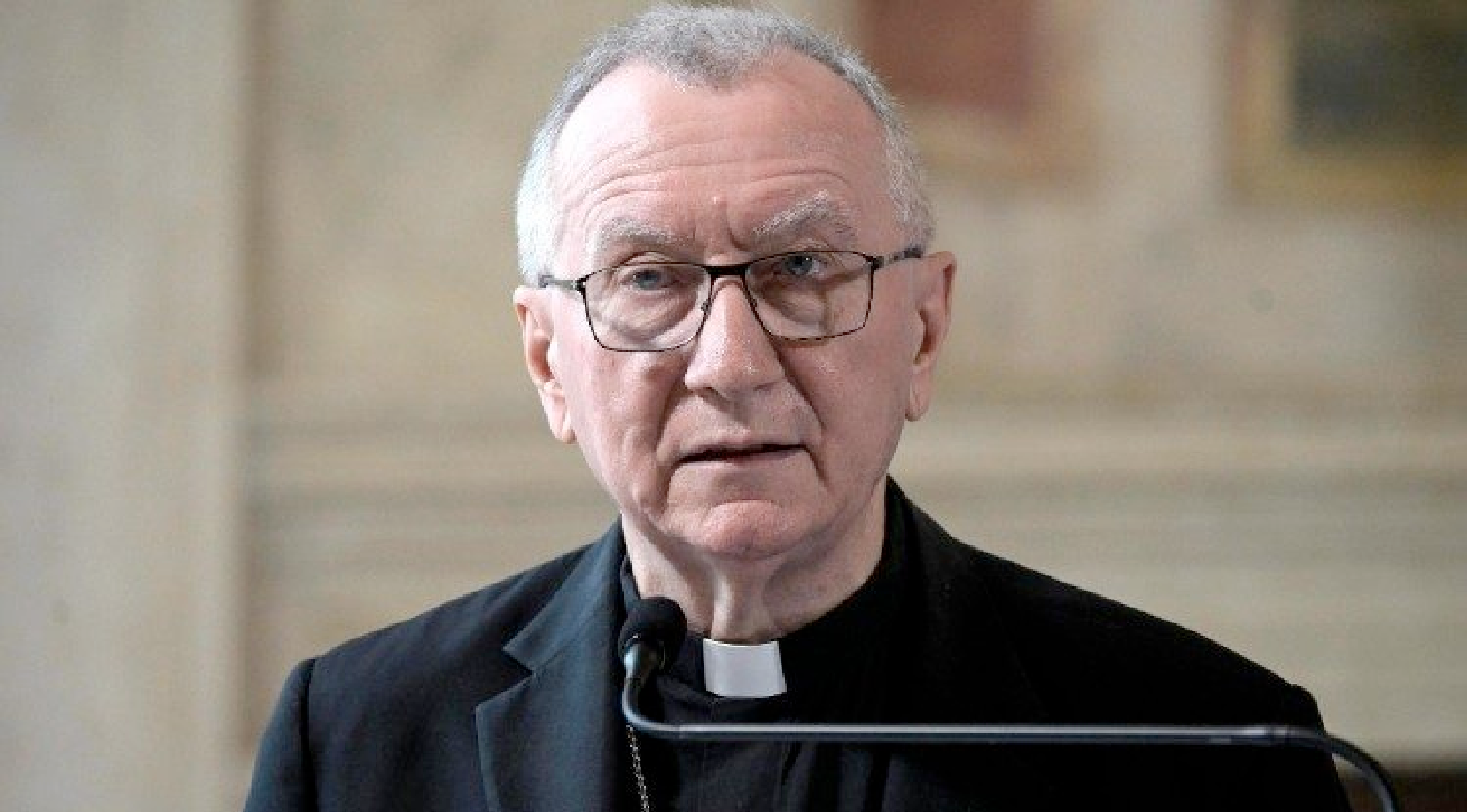
(ZENIT News / Roma, 08.28.2025).- During a Mass honoring Saint Monica at the Basilica of Saint Augustine, Cardinal Pietro Parolin once again voiced the Holy See’s concern over the worsening crisis in Gaza. The Vatican Secretary of State recalled Pope Leo XIV’s recent appeal, issued during Wednesday’s general audience, which echoed the urgent plea of Christian leaders in the Holy Land: an end to the war and a firm rejection of any forced displacement of Gaza’s civilian population.
Speaking to journalists after the liturgy, Parolin lamented that genuine solutions to the conflict remain within reach but are continually thwarted. “There are many possible ways to end this situation,” he noted, “but they are obstructed by interests—political, economic, and hegemonic—that weigh far more heavily than the suffering of the people.” His words underscored a recurrent Vatican theme: the conviction that peace is less a question of possibility than of will.
Concerns for Christians on the ground remain acute. Parolin acknowledged that after Israeli authorities ordered evacuations, local Church leaders—including Orthodox Patriarch Theophilos III of Jerusalem—urged their communities to leave. Yet the cardinal admitted the choice is agonizing. “Each person will decide what to do,” he said, “but staying behind is an act of courage. How that choice can be carried out under such control of the territory remains unclear.”
On the diplomatic front, Parolin confirmed that the Holy See is keeping direct channels open with the United States through its embassy. He expressed cautious hope that recent talks in Washington, involving Israel’s foreign minister Gideon Sa’ar, might lead to steps toward de-escalation. “We expect what the Pope has asked for: a ceasefire, safe humanitarian access, respect for international humanitarian law. These are essential if collective punishment is to be avoided,” he emphasized.
Asked about Israel’s stance on Gaza evacuations, Parolin conceded that no shift has yet been observed. “Perhaps there is little hope of reversal,” he said, while insisting that the Holy See will not relent in pressing for change.
The Vatican’s position, consistent across decades of Middle Eastern turmoil, once again highlights a tension familiar in Catholic diplomacy: the Church’s insistence on the dignity of every person set against the entanglements of geopolitical power. In Parolin’s words, the cost of those entanglements is measured in human lives—lives the Holy See continues to defend with the tools of prayer, diplomacy, and moral persuasion.
Thank you for reading our content. If you would like to receive ZENIT’s daily e-mail news, you can subscribe for free through this link.

Publicaciones relacionadas:
 “We return from Gaza with broken hearts”: Cardinal Pizzaballa at press conference in Jerusalem
 Vatican questions “preventive” war in Iran as Leo XIV intensifies diplomatic calls for peace
 A Phone Call in Times of War: Pope Leo XIV Answers a Call from the President of Palestine
 A Church Against the Logic of War: Vatican Voices, Middle East Realities, and the Risk of a Vanishing Christianity
