

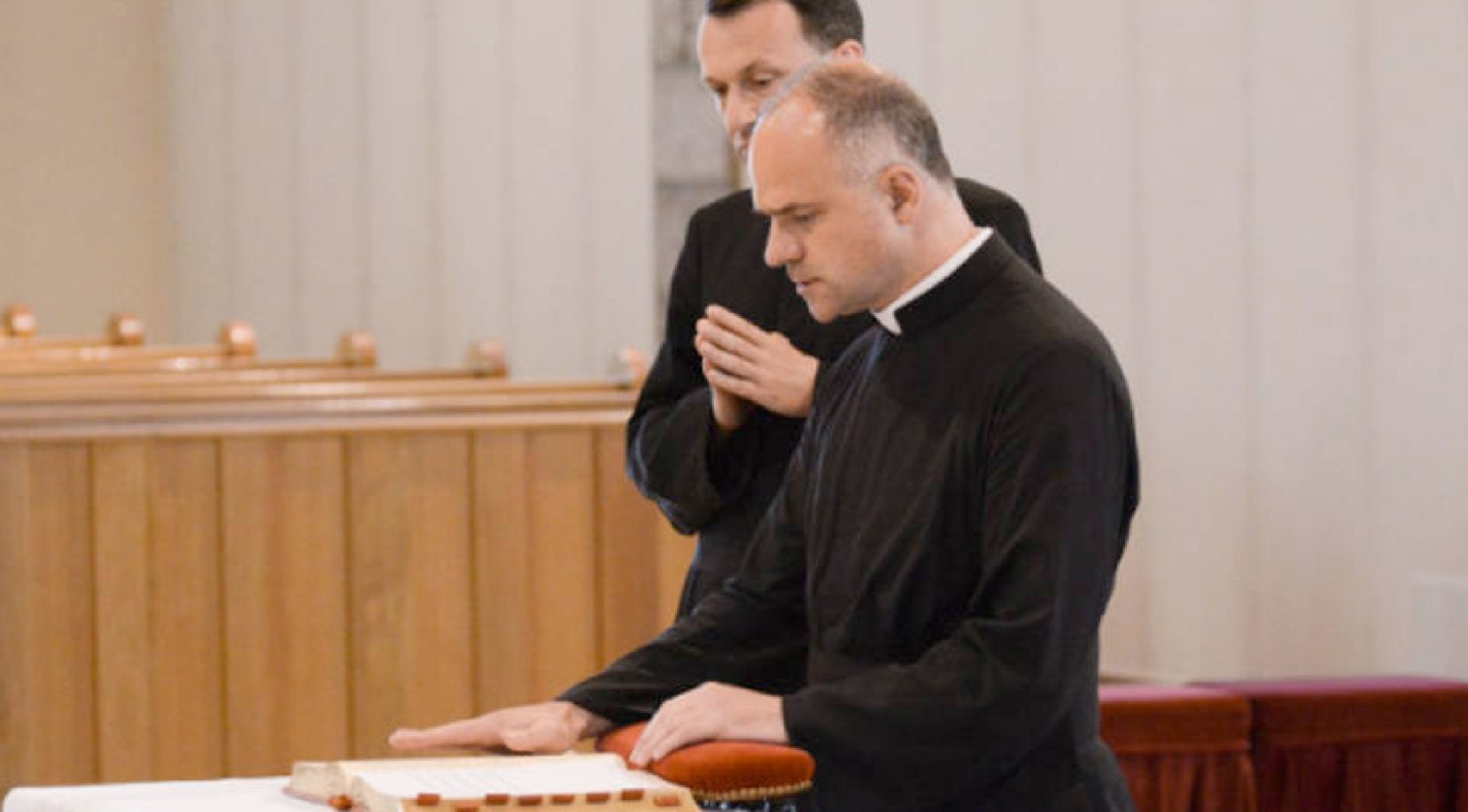
(ZENIT News / Rome, 02.21.2026).- A fresh rupture is looming between Rome and the Priestly Fraternity of St. Pius X. In a letter dated 18 February 2026 and made public the following day, the Superior General of the Society, Father Davide Pagliarani, informed Cardinal Víctor Manuel Fernández, Prefect of the Dicastery for the Doctrine of the Faith, that the fraternity will not enter the specifically theological dialogue proposed by the Holy See—and will proceed, as planned, with episcopal consecrations on 1 July 2026 without papal mandate.
The decision follows a meeting held at the Vatican on 12 February between Pagliarani and Cardinal Fernández. After that encounter, the prefect described the conversation as cordial and sincere, and publicly suggested launching a structured theological exchange aimed at clarifying unresolved doctrinal questions. Crucially, Rome asked the fraternity to suspend the episcopal ordinations announced on 2 February, warning that consecrating bishops without papal approval would constitute a decisive rupture of ecclesial communion—schism—with grave consequences for the entire body.
Pagliarani’s reply, signed by the five members of the Society’s General Council, accepts neither condition. While expressing satisfaction at what he called a “new openness” to dialogue—recalling that he himself had proposed a doctrinal discussion in January 2019—the superior insists that a theological process cannot succeed if the interpretive framework is already fixed. In his assessment, the texts of the Second Vatican Council are not open to correction, nor is the legitimacy of the post-conciliar liturgical reform subject to debate. Therefore, he argues, no common determination of the “minimum conditions” for full communion is realistically achievable.
The crux of the dispute remains the reception of the Second Vatican Council (1962–1965). The fraternity, founded in 1970 by French Archbishop Marcel Lefebvre, emerged in explicit opposition to aspects of the Council and subsequent reforms, particularly in liturgy and ecumenism. In his letter, Pagliarani underscores that for sixty years the Council has been interpreted and implemented by successive popes along definite doctrinal and pastoral lines. He cites major papal documents—from Redemptor hominis to Ut unum sint, from Evangelii gaudium to Amoris laetitia—as evidence that the post-conciliar trajectory is coherent and settled. He also references Traditionis custodes, which reasserted papal authority over the use of the pre-conciliar Roman liturgy, as an expression of that same interpretive continuity.
For Rome, episcopal consecrations without papal mandate strike at the heart of Catholic ecclesiology. The Code of Canon Law (canon 1387, as cited in the debate) foresees automatic excommunication for such acts. The historical precedent is 2 July 1988, when Archbishop Lefebvre ordained four bishops without approval from John Paul II. In response, John Paul II issued the apostolic letter Ecclesia Dei, declaring that the act constituted a schismatic gesture and establishing structures to assist those wishing to remain attached to the older liturgical forms while in full communion with Rome.
The present situation carries echoes of that moment. According to sources cited in Italian reporting, as many as five bishops could be consecrated on 1 July. The Holy See has not yet issued a formal response to the fraternity’s latest letter, but the doctrinal and canonical stakes are unambiguous: episcopal ordination in Catholic theology is not merely administrative. A bishop shares in the fullness of the sacrament of Holy Orders and exercises authority in communion with the Bishop of Rome. To confer that office independently is to challenge the visible principle of unity embodied in the papacy.
Pagliarani’s argument is not framed as rebellion but as necessity. He describes the planned consecrations as a concrete and short-term need for the “survival of Tradition.” At the same time, he rejects postponing the July date, stating that intellectual honesty and priestly fidelity prevent him from accepting the premises under which the Dicastery proposes renewed dialogue.
Notably, the fraternity’s letter also discloses earlier correspondence: a 17 January 2019 letter from Pagliarani to Archbishop Guido Pozzo, then Secretary of the Ecclesia Dei Commission, outlining possible doctrinal topics; and a 26 June 2017 letter from Cardinal Gerhard Müller to Bishop Bernard Fellay, which set out conditions for restoring communion. Those conditions included acceptance of the 1988 Profession of Faith, recognition of the documents of Vatican II according to the degree of assent owed to them, and acknowledgment of the validity and legitimacy of the reformed liturgy—requirements the fraternity has consistently resisted.
There is also a strategic dimension to the exchange. Pagliarani invokes the pastoral flexibility promoted during the pontificate of Francis, emphasizing listening, discernment, and a non-mechanical application of canon law. Under Francis, priests of the fraternity were granted faculties to validly absolve sins in confession, and local ordinaries were authorized to permit SSPX priests to assist at marriages under certain conditions. These concessions were interpreted by some as gestures of pastoral pragmatism, by others as signs of an incremental rapprochement.
Yet the fraternity now appears to seek recognition of its sacramental and apostolic life without formal canonical regularization. In effect, it proposes coexistence without doctrinal convergence. Rome, by contrast, maintains that communion cannot be detached from shared adherence to the Church’s magisterial teaching, including the Council and its authoritative reception.
The impasse thus returns to a fundamental ecclesiological question: is unity primarily juridical, doctrinal, or pastoral—and can any of these be isolated from the others? By confirming the 1 July consecrations, the Society of St. Pius X signals that it sees no viable path to agreement under the current parameters. Whether this leads to a repetition of 1988 or to an unexpected last-minute intervention remains to be seen.
What is clear is that the unresolved legacy of Vatican II continues to shape the Church’s internal fault lines. Six decades after the Council, the debate over its interpretation is no longer academic. It is poised to produce tangible, episcopal consequences.
Thank you for reading our content. If you would like to receive ZENIT’s daily e-mail news, you can subscribe for free through this link.

Publicaciones relacionadas:
 These Are the Six New Dispositions that the Pope Asks of Opus Dei
 Vatican’s Positive Statement About “Mary Mystical Rose, After Study of Marian Revelations”
 A New Phase in the Leonine Pontificate: Pope Reshapes His Inner Circle with a Surprising Appointment
 Pope Leo XIV to publish new document on Catholic education and declare Newman co-patron of Catholic education
