

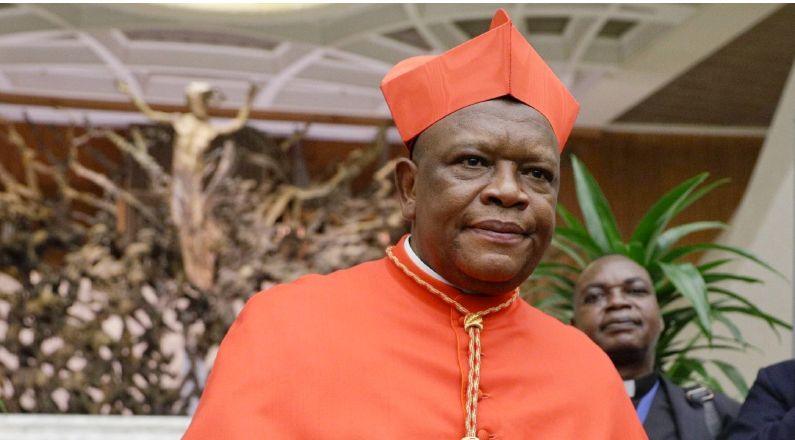
(ZENIT News / Rome, 09.18.2025).- In Gniezno, the Polish city where Christian unity has often been celebrated across centuries, Cardinal Fridolin Ambongo Besungu spoke with a candor that is becoming increasingly characteristic of African Catholic leaders. For the Congolese prelate, president of the Symposium of Episcopal Conferences of Africa and Madagascar (SECAM), the controversial Vatican declaration «Fiducia supplicans» remains a wound that cannot simply be ignored.
Ambongo, who serves as archbishop of Kinshasa, did not hesitate to describe the text—authorizing the possibility of blessing same-sex couples—as “a bad chapter” in the pontificate of Pope Francis. What troubled him most, he told OSV News during the September 11–14 Meeting of Gniezno, was not only the content but also the process: a document released in the middle of the Synod on Synodality, without open discussion among bishops, clergy, or faithful.
Reactions in Africa were immediate and fierce. From lay Catholics to bishops, Ambongo recalled “indignation and anger” spreading across the continent. “I realized I had to act,” he said. Rather than encouraging emotional outbursts, the cardinal asked each episcopal conference to study the text carefully and present reasoned responses. The fruit of that labor was a seven-page document that Ambongo carried himself to Rome. Pope Francis received him, he explained, listened to his concerns, and granted permission for the African bishops’ response to be published—firmly stating “No to the blessing of homosexual couples in African churches.”
Ambongo insists this was not rebellion, but fidelity to the Pope’s own responsibility as guardian of Catholic unity. “The Pope is not here to create doubts, but to confirm the faith and to be the prophetic voice of the Church in a world without values,” he stressed. Asked if Francis regretted the publication of «Fiducia supplicans», Ambongo chose discretion, citing confidentiality, yet hinted that the authorization to publish the African bishops’ rejection spoke volumes.
The cardinal’s remarks align with those of another African prelate, Cardinal Robert Sarah, who earlier called «Fiducia supplicans» “a document to forget.” Their convergence highlights a broader trend: Africa’s Catholic leadership is unafraid to speak firmly, even when it challenges decisions emanating from Rome.
Yet Ambongo’s visit to Poland was not limited to controversy. It was also deeply personal. As he noted, his intellectual and spiritual formation was marked by Saint John Paul II, whose social encyclicals and support for the Solidarity movement left a lasting impression on a generation of African clergy. “For me, coming to Poland was a homecoming of sorts,” Ambongo said.
The cardinal also spoke of the paradox of his homeland: a nation endowed with extraordinary natural wealth yet plagued by war and exploitation. “The tragedy of Congo is its richness,” he lamented. “Everyone wants to appropriate our minerals and forests, while our people continue to suffer.” The Church, he added, has sought to counter this spiral of violence through a Social Pact for Peace and Coexistence, an initiative backed by Pope Leo XIV.
Ambongo’s words reveal both the struggles and the strength of the African Church. Unlike Western Catholicism, which he sees often cornered into silence or caricatured as outdated, the Church in Africa, he declared, “raises its head, without complexes, and speaks with a prophetic voice.”
For the Congolese cardinal, that prophetic role is urgently needed not only in Africa but also in Europe, where debates on faith and modernity remain unresolved. And in the wake of “Fiducia supplicans”, his message to Rome was clear: true unity cannot be built on ambiguity.
Thank you for reading our content. If you would like to receive ZENIT’s daily e-mail news, you can subscribe for free through this link.

Publicaciones relacionadas:
 Sessions of the Pope’s Council of Cardinals Conclude: these were the topics covered
 Jubilee 2025 to welcome LGBT pastoral groups for the first time in history
 On benedicence: a great reflection by the Pope for cardinals of the Roman Curia useful for every Catholic
 Bishop Who Visited the Pope in Hospital Talks About the Pope and the Church’s Prayer of Intercession for Him
