(ZENIT News / Rome, 02.17.2026).- In the halls of Palazzo Borromeo on 17 February 2026, the anniversary of the Lateran Pacts unfolded against a geopolitical backdrop far less ceremonial. While diplomats recalled the agreements signed on 11 February 1929 between the Kingdom of Italy and the Holy See—documents that still regulate relations between the two entities and are explicitly referenced in Article 7 of the Italian Constitution—the conversation quickly turned from history to the circumstance of the present.
The Vatican delegation was led by Cardinal Pietro Parolin, Secretary of State of the Holy See, accompanied by Archbishop Paul Richard Gallagher, responsible for relations with states and international organizations. Among those present were Italian Prime Minister Giorgia Meloni, President Sergio Mattarella, and Cardinal Matteo Zuppi, head of the Italian Bishops’ Conference (CEI).
The commemoration paid tribute to the Lateran Pacts—comprising a treaty, a financial convention and a concordat—revised in part in 1984, yet still foundational in defining the legal and institutional architecture between Church and State in Italy. But if the agreements of 1929 symbolized resolution after decades of estrangement, the diplomatic exchanges in 2026 reflected certainty in a world marked by war and fragile multilateralism.
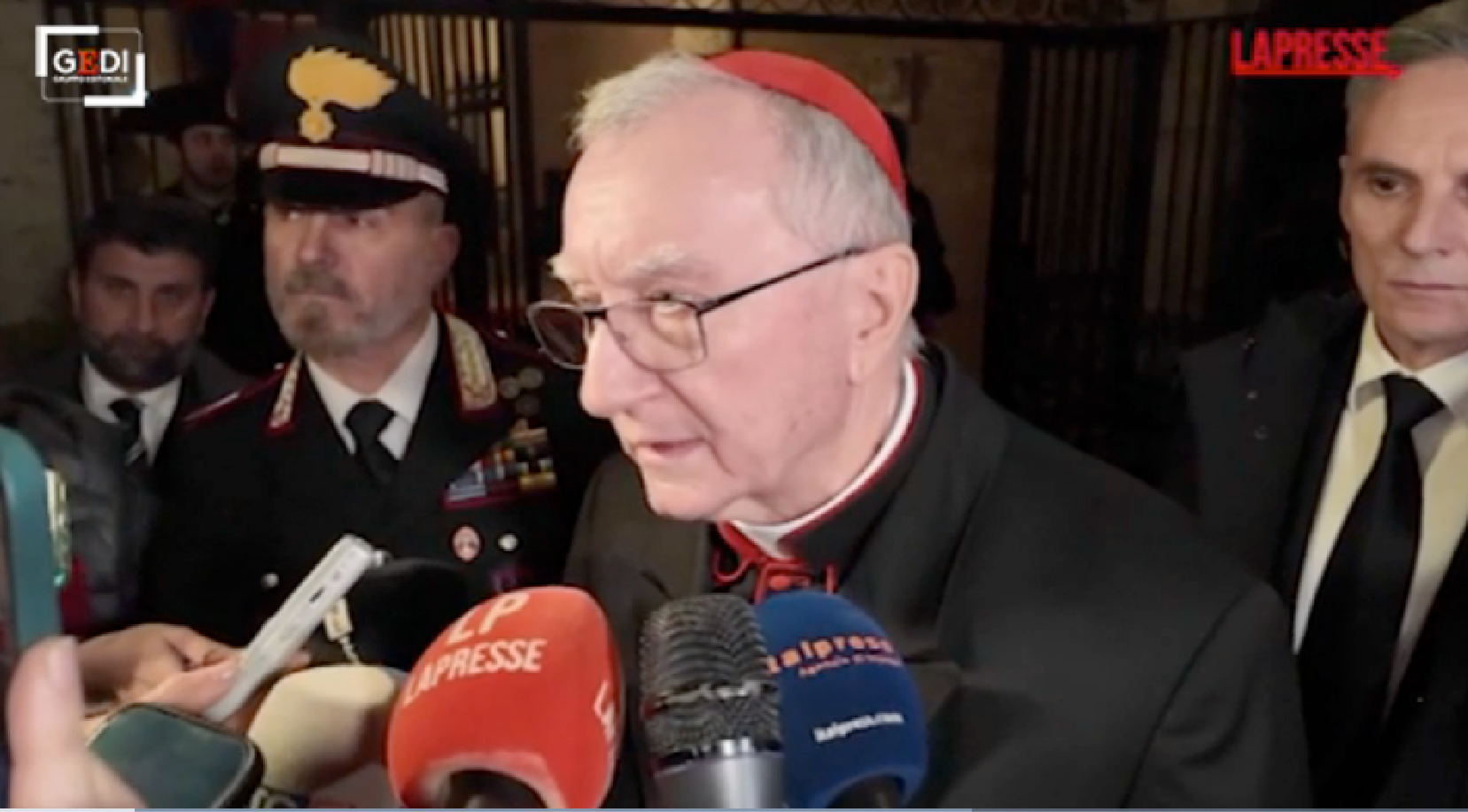
At the margins of the bilateral meeting, Cardinal Parolin clarified that the Holy See will not join the so-called “Board of Peace.” While Italy intends to participate as an observer, the Vatican has chosen to abstain, citing the distinct nature of its international personality. The Holy See does not operate as a conventional state actor, and its diplomatic engagement often privileges moral authority and mediation over institutional alignment.
Parolin acknowledged that the initiative seeks to respond to ongoing crises, yet he indicated that certain aspects raise reservations and require clarification. One concern, he explained, relates to the architecture of global crisis management. From the Vatican’s perspective, the United Nations should remain the primary forum for addressing international conflicts. For the Holy See, multilateral legitimacy—however strained—remains a cornerstone of any durable peace process.
This cautious stance came as the war in Ukraine approaches its fourth anniversary. The conflict, which erupted nearly four years ago, continues to devastate civilian life and infrastructure. Recent heavy bombardments targeting energy facilities in Kyiv and other cities underscore the persistence of hostilities at a time when fatigue and frustration are evident on all sides.
Cardinal Parolin did not conceal his bleak assessment. There is, he said, considerable pessimism regarding prospects for peace, and little evidence of substantive progress in negotiations. The tragedy, in his words, lies not only in the violence itself but in the passage of time: after four years, the parties remain entrenched, and expectations for breakthrough appear limited. Hopes are placed in dialogue, yet optimism is scarce.
The Vatican’s diplomatic doctrine traditionally insists on dialogue even in seemingly intractable conflicts, reflecting a long-standing commitment to incremental engagement rather than maximalist positioning. The Secretary of State’s remarks suggest that, while the Holy See continues to support channels of communication, it is under no illusion about the present impasse.
Beyond international crises, the bilateral meeting highlighted areas of cooperation between Rome and the Holy See. Parolin expressed gratitude for the Italian government’s attention to issues central to Catholic social teaching: family policies, education, disability inclusion and prison reform. Working groups, particularly those involving the CEI, have reportedly made progress in these domains. In this sense, the anniversary gathering was not merely symbolic; it also functioned as a checkpoint in ongoing policy dialogue.
The reception included a gesture rich in resonance. President Mattarella was shown a relic of Saint Francis of Assisi, patron saint of Italy, marking the 800th anniversary of his death. The object—a stocking worn by Francis after receiving the stigmata, still bearing traces of blood—served as a reminder of a spiritual legacy that continues to shape Italy’s cultural and religious identity.
In declining to join the Board of Peace while reaffirming the centrality of the United Nations, the Vatican signals a preference for established multilateral frameworks over newly configured coalitions. Whether that strategy will prove effective in a world where consensus is increasingly elusive remains an open question.
Thank you for reading our content. If you would like to receive ZENIT’s daily e-mail news, you can subscribe for free through this link.