

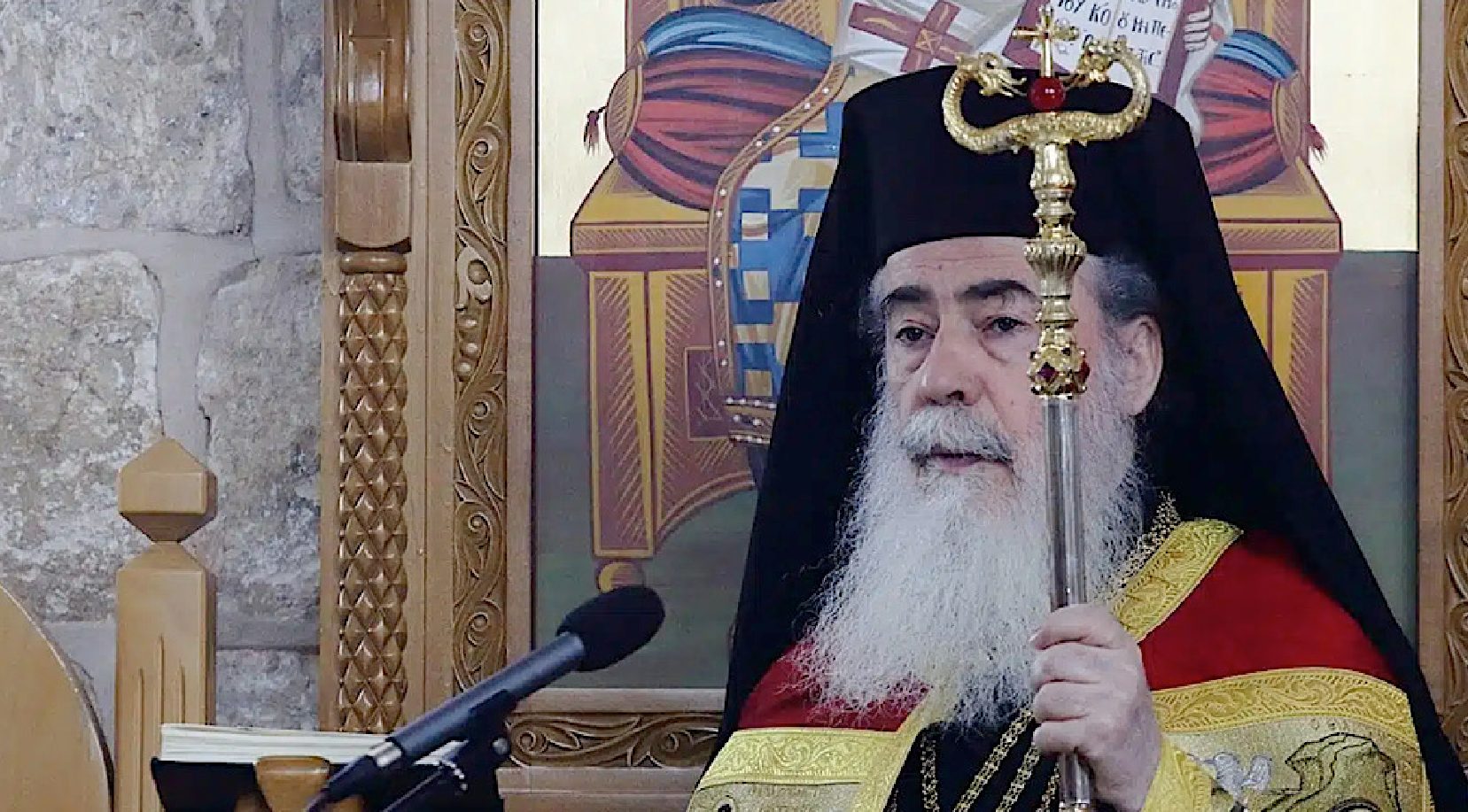
(ZENIT News / Jerusalem, 08.20.2025).- The decision by Jerusalem’s municipality to freeze the bank accounts of the Greek Orthodox Patriarchate has thrust one of the Holy Land’s oldest churches into financial paralysis, intensifying a long-running dispute over property taxes and exposing once more the fragile standing of Christians in the region.
The measure, imposed on August 6, prevents the Patriarchate from paying clergy, teachers, and employees across its schools, monasteries, and charitable institutions. It also aggravates the decades-long struggle over land ownership, taxation, and the political weight carried by churches whose roots predate the modern State of Israel by centuries.
At the heart of the confrontation lies “Arnona,” Jerusalem’s property tax. For generations, churches had been shielded from such levies, a status quo respected by Ottoman, British, Jordanian, and Israeli authorities. That understanding began to fracture in 2018, when city officials sought millions of shekels in back taxes for properties not used strictly for worship or religious instruction. Guesthouses, cafeterias, and service facilities for pilgrims were suddenly treated as taxable assets. The resulting standoff grew so severe that the custodians of the Church of the Holy Sepulchre closed its doors in protest, a dramatic gesture that forced then-Prime Minister Benjamin Netanyahu to intervene.
This time, however, the Patriarchate has received no such reprieve. City hall argues that patience has run out: years of notices were ignored, and the church failed to meet its obligations. “Administrative enforcement procedures were initiated,” municipal officials said, describing the step as unavoidable.
The Patriarchate, led by Patriarch Theophilos III, denounces the freeze as an assault on religious institutions that sustain not only Christian life but also broader social needs. Through its schools, clinics, and welfare programs, the church often fills gaps left by the state, it argues. Theophilos, together with Armenian Patriarch Nourhan Manougian and Latin Patriarch Pierbattista Pizzaballa, co-leads the advocacy group Protecting Holy Land Christians, which insists that the imposition of municipal taxes undermines centuries of precedent and weakens the Christian presence in Jerusalem.
The dispute unfolds against a backdrop of rising hostility. The Rossing Center for Education and Dialogue, a Jerusalem-based interfaith institute, documented 111 attacks on Christians in Israel in 2024, up from 89 the previous year. Clergy in religious dress were particular targets, suffering assaults ranging from spitting and pepper spray to outright beatings. The majority of incidents were attributed to members of ultra-Orthodox and nationalist-religious Jewish movements.
Meanwhile, in the West Bank, settler violence has taken on an increasingly sectarian edge. In July, radicals attacked the majority-Christian village of Taybeh, torching a fifth-century church and drawing condemnations from both local patriarchs and American political figures traditionally aligned with Israel’s right wing. Senator Lindsey Graham and former U.S. ambassador Mike Huckabee both urged accountability for the perpetrators, describing the acts as sacrilegious.
The Greek Orthodox Church’s difficulties extend beyond taxation. In Jericho, settlers recently invaded monastic lands, prompting a diplomatic protest from Athens, which regards the protection of Orthodox heritage sites—from the Monastery of St. Catherine in Sinai to the shrines of the Holy Land—as part of its national responsibility. The Armenian Patriarchate also faces a looming legal battle with Jerusalem’s municipality over its own properties in the Old City.
For many Christians of Jerusalem—most of them Arabs of East Jerusalem with only permanent resident status—the financial freeze is more than a bureaucratic dispute. It symbolizes the erosion of their already tenuous foothold in a city where they cannot vote in national elections and risk losing residency if they leave for too long. “Our very continuity feels at stake,” said Armenian activist Levon Kalaydjian. “This isn’t just about land. It’s about identity, tradition, and the heartbeat of a community that has endured centuries.”
In his Assumption Day homily at Abu Gosh, Cardinal Pizzaballa echoed that sentiment, reminding the faithful that amid war and destruction, Christians are called to “sow life” even when the “dragon” of evil seems overwhelming. His words underscored the paradox of a church struggling to meet payroll while also being asked to carry the weight of hope in a land scarred by conflict.
Thank you for reading our content. If you would like to receive ZENIT’s daily e-mail news, you can subscribe for free through this link.

Publicaciones relacionadas:
 53 Humanitarian Organizations Denounce «False Narratives» to Sabotage Those Saving Lives in Palestine
 Between Drones, Settlers and Classrooms: How Violence and Administrative Israeli Pressure Are Reshaping Palestinian Life
 Israeli Jewish army causes death of Catholic priest in Lebanon and displaces thousands of Catholics from southern Lebanon
 Lebanon requests diplomatic mediation from the Vatican to prevent Israel from attacking or displacing Catholic communities in the south of the country
