

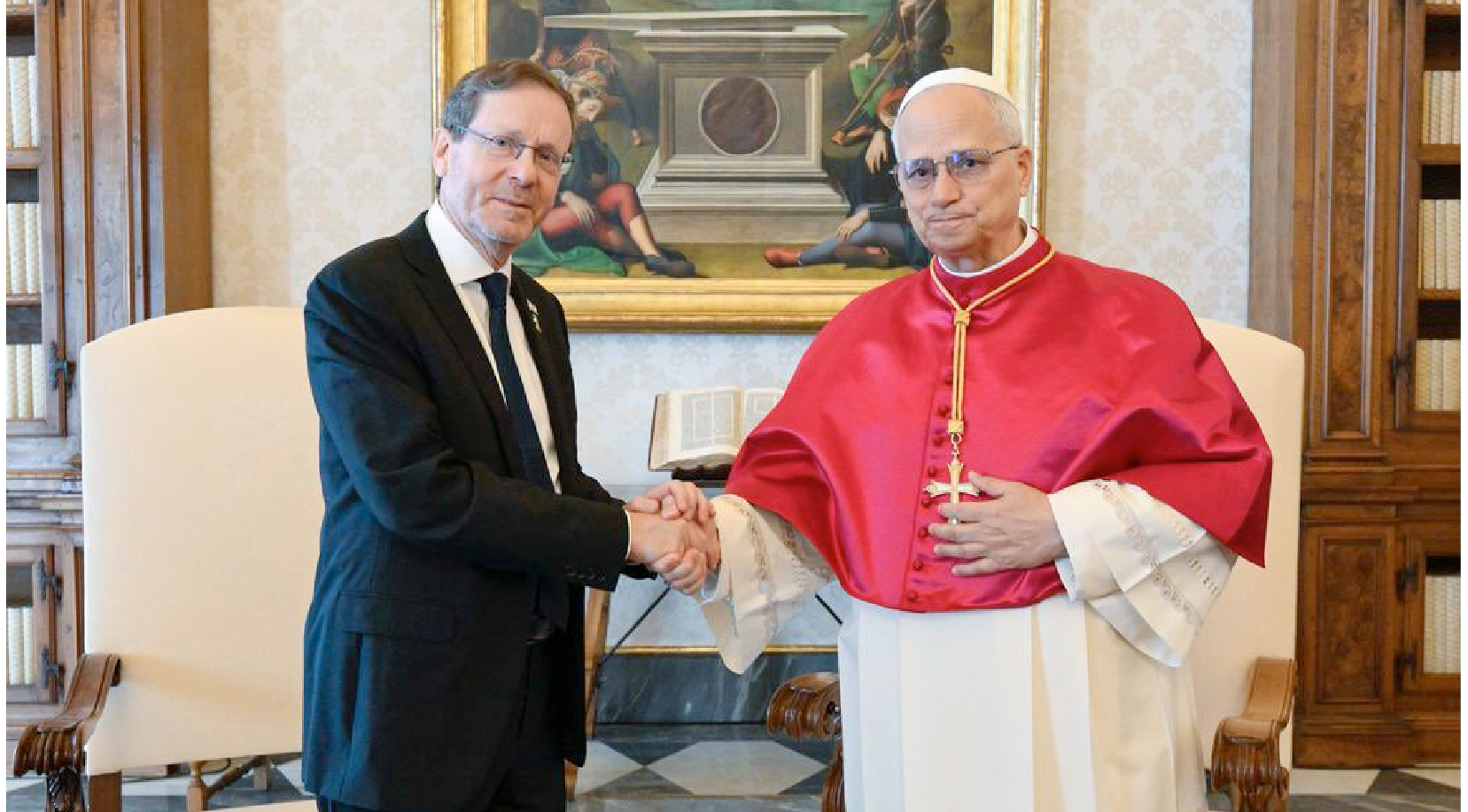
(ZENIT News / Vatican City, 09.06.2025).- On September 4, 2025, the Vatican became the stage for one of the most closely watched encounters of the year. Pope Leo XIV welcomed Israeli President Isaac Herzog for a private audience that stretched beyond protocol into the heart of one of the world’s most intractable conflicts.
The meeting came at a volatile moment. Gaza bleeds under a war that has claimed countless lives, Jerusalem remains a city of unresolved tensions, and Christian communities in the Holy Land feel increasingly fragile. Into this landscape, the Pope reaffirmed a principle that has long guided the Holy See’s vision: the two-state solution remains the only viable road toward peace.

The Vatican’s unusually detailed communiqué underscored the urgency. It spoke of hostages whose freedom cannot wait, of a permanent ceasefire that must be reached, and of humanitarian aid too often blocked at checkpoints of suspicion. The text echoed a familiar refrain of papal diplomacy—international law and human dignity must not be trampled in the dust of war.
For Herzog, the visit was not merely symbolic. His office emphasized Israel’s commitment to the safety of Christian communities, a point made more urgent by the July 17 strike on Gaza’s only Catholic parish, an incident that drew sharp condemnation from the Vatican and left three dead, among them parishioners who had sought refuge. The president’s promise to protect the faithful was a message directed as much to Rome as to Christians in Bethlehem, Jerusalem, and the broader region.
Yet the meeting was layered with complexities. Herzog does not command Israel’s war machine; that authority rests with Prime Minister Benjamin Netanyahu. Still, in recent months the president has tried to cast himself as a moral counterweight, voicing unease over renewed offensives even as he later defended Israel’s conduct as compliant with international law. His presence in Rome—just months after attending Leo XIV’s inaugural Mass—signals a desire to preserve and even reset ties with the Vatican, strained under Francis by disagreements over Gaza.

The timing of Herzog’s Vatican stopover carried another twist. On the same day, Israeli authorities lifted the freeze on the bank accounts of the Greek Orthodox Patriarchate of Jerusalem, imposed in a dispute over municipal property taxes. Though Vatican officials did not explicitly link the two events, the overlap pointed to the delicate balance between Israel’s fiscal policies and the Holy See’s defense of religious institutions in the Holy Land.
During his audience, Herzog extended a formal invitation to Pope Leo XIV to visit Israel, following in the footsteps of his predecessors. Such visits, rare and freighted with symbolism, have historically served as milestones in Vatican-Israel relations. Whether Leo accepts remains uncertain, but Herzog’s words left little doubt: Israel wants this Pope to walk the streets of Jerusalem, a city claimed by many and recognized by the Vatican as belonging not to one nation but to all humanity.
The president also pressed the Pope to meet the families of hostages still held in Gaza, urging stronger international efforts for their release. In his public statements afterward, Herzog cast the encounter as “a very important declaration,” proof of the enduring significance of Israel’s relationship with the Catholic Church.

For Leo XIV, the challenge is to maintain the Vatican’s prophetic voice without closing doors. His predecessors have treaded this line unevenly, sometimes provoking diplomatic rifts, other times offering words that opened narrow passages to dialogue. The Argentine Francis left a mixed legacy in this arena; his successor, still early in his pontificate, faces the same dilemmas magnified by ongoing violence.
The encounter on September 4 may not change the course of the war. Yet it offered a glimpse of the Vatican’s intent to stand firm on principles while engaging directly with those who shape the conflict’s future. And for Christians in the region, hearing both Pope and President speak of their protection was more than rhetoric—it was a reminder that, amid political calculations, the fate of small and vulnerable communities still matters.
Thank you for reading our content. If you would like to receive ZENIT’s daily e-mail news, you can subscribe for free through this link.

Publicaciones relacionadas:
 Israeli Prime Minister Calls Pope After Military Attack on Catholic Parish in Gaza
 Pope Leo XIV, the US-Iran war, and a forceful call in a Middle East on the brink of the abyss
 A Phone Call in Times of War: Pope Leo XIV Answers a Call from the President of Palestine
 A Church Against the Logic of War: Vatican Voices, Middle East Realities, and the Risk of a Vanishing Christianity
