

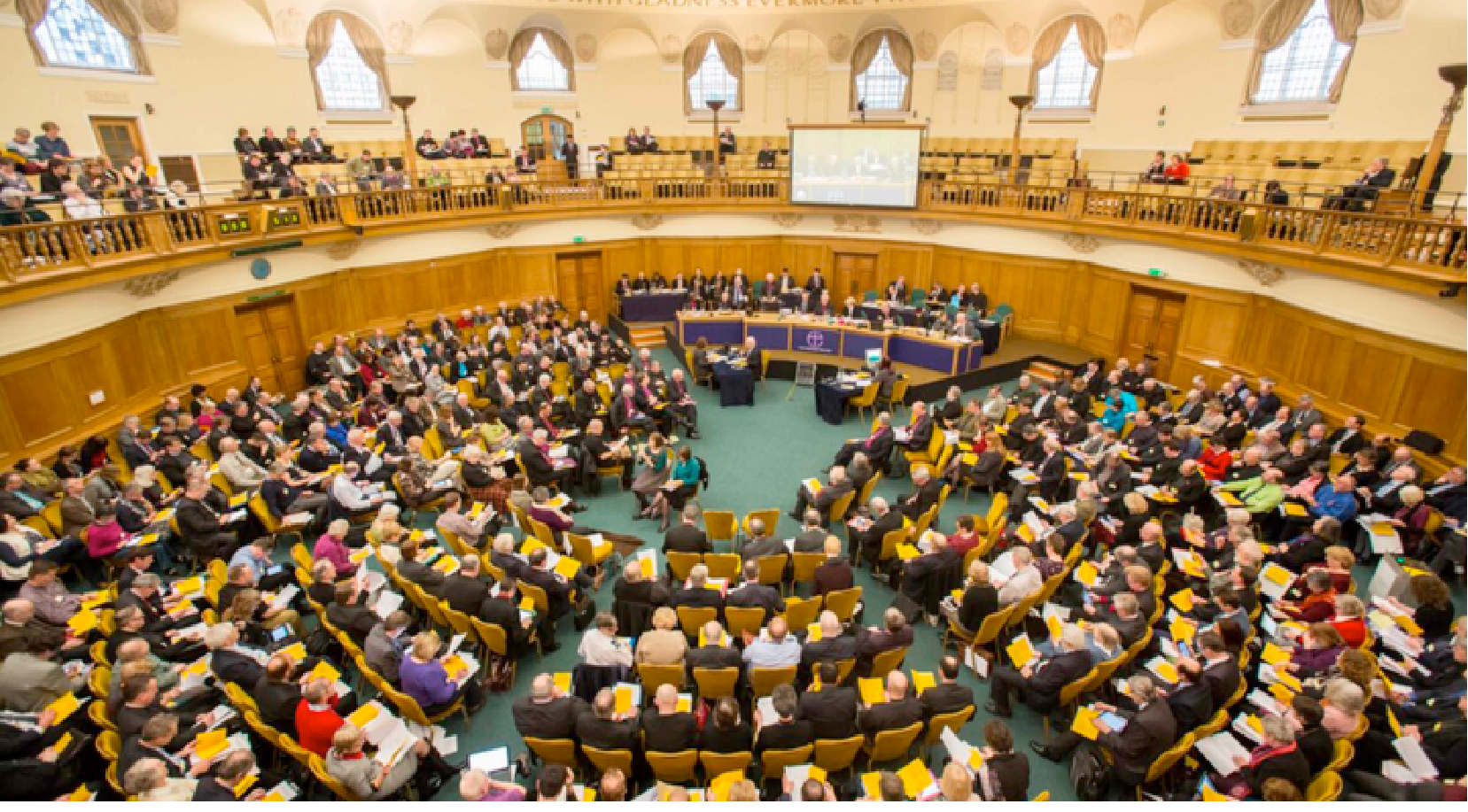
(ZENIT News / London, 02.17.2026).- After nearly a decade of study, consultation and increasingly strained debate, the General Synod of the Church of England (anglicans) has formally closed its “Living in Love and Faith” process, shelving proposals that would have introduced stand-alone services to bless same-sex couples.
The decision followed almost five hours of debate and a decisive vote: 252 in favor of ending the process as proposed by the bishops, 132 against and 21 abstentions. In the Synod’s separate houses, the bishops supported the measure unanimously with two abstentions, while both clergy and laity delivered clear majorities.
The outcome brings to a halt a «reform» effort launched in 2017 that, over the past three years in particular, had concentrated on whether the Church could authorize dedicated liturgical ceremonies for same-sex couples who are already legally married under civil law. Ultimately, the bishops concluded that theological and legal impediments make such authorization unviable.
The compromise reached preserves the current practice introduced in 2023: prayers of blessing may still be offered within regular worship services, but separate liturgical rites and church weddings for same-sex couples remain prohibited. In effect, pastoral accommodation continues within defined limits, while doctrinal and canonical boundaries remain intact.
The debate once again exposed the depth of division within Anglicanism in England and beyond. Eight proposed amendments failed. More liberal members pressed either to accelerate the introduction of formal blessing ceremonies or to continue the Living in Love and Faith framework. Conservative representatives, by contrast, called for sharper repudiation of previous episcopal actions or for the dissolution of successor bodies linked to the process. None of those proposals secured sufficient support. The bishops’ unamended motion prevailed.
Yet the closure of Living in Love and Faith does not mean the issue has vanished. Two new structures are to be established: a working group on “Relationships, Sexuality and Gender,” and a similarly named pastoral advisory group. Their mandate signals that dialogue will continue, albeit in a different format and without the immediate prospect of liturgical innovation.
Archbishop of York Stephen Cottrell did not conceal his disappointment. According to Church Times, he acknowledged that the Church had not reached the point he had hoped for when the Prayers of Love and Faith were first presented to the Synod three years ago. He cited flaws in the process, excessive ambiguity and an overemphasis on crafting institutional “agreements” among factions rather than cultivating deeper theological clarity.
Voices from across the spectrum made clear that no constituency feels fully vindicated. Several Synod members warned that many LGBTQ+ Christians will experience the decision as another rejection after years of sustained engagement. Some spoke of a painful erosion of trust and a repeated postponement of questions framed in terms of justice and inclusion.
Conservatives countered that those committed to the Church’s historic teaching on marriage — understood as a lifelong union between a man and a woman — also endure uncertainty and marginalization within the current climate. For them, the inability to introduce separate blessing rites represents a necessary safeguard of doctrinal continuity.
Representatives linked to churches in Africa and Asia, often referred to collectively as the Anglican “Global South,” emphasized that their perspectives had not been sufficiently integrated into the process. These provinces, many of which uphold traditional teaching on sexuality and do not permit same-sex blessings even within regular services, have long warned that doctrinal divergence in England could strain the bonds of the Anglican Communion. The Church of England’s internal decisions therefore carry global ramifications.
«Bishop» of London Sarah Mullally told the Synod, as reported by The Telegraph, that the Living in Love and Faith process has wounded both individuals and the institution itself. The debates, she said, have touched core theological convictions and the Church’s sense of identity. Even so, she urged continued engagement rather than deepening polarization.
Among clergy directly affected, frustration is palpable. The Revd Charlie Baczyk-Bell, an openly gay priest, remarked that while some LGBTQ+ believers may quietly drift away, ordained ministers are left questioning whether episcopal authority can override their conscience indefinitely. At the same time, the Church of England Evangelical Council reiterated that blessings for same-sex couples contradict biblical teaching, underscoring the theological fault line that runs through the Synod’s deliberations.
To understand the significance of the vote, one must consider the Church of England’s distinctive polity. Unlike the Roman Catholic Church, where doctrinal and liturgical authority ultimately rests with the Holy See, the Church of England operates through synodical governance. Bishops, clergy and laity vote separately, and major changes require majorities in all three houses. That structure both embodies Anglican comprehensiveness and ensures that contentious reforms face rigorous scrutiny.
For nine years, Living in Love and Faith functioned as an attempt to hold together sharply divergent convictions under one ecclesial roof. Its conclusion does not resolve the underlying theological disagreement over marriage and sexuality. Instead, it formalizes a cautious equilibrium: limited pastoral gestures remain possible, but structural and liturgical redefinition has been deferred.
Whether this balance proves durable is uncertain. For some, the vote represents a necessary pause that prevents deeper fracture within the Church of England and the wider Anglican Communion. For others, it signals institutional paralysis at a moment when cultural pressures and internal expectations continue to mount.
The question now is whether dialogue within newly created structures can rebuild trust in a communion where identity, authority and pastoral care remain profoundly contested.
Thank you for reading our content. If you would like to receive ZENIT’s daily e-mail news, you can subscribe for free through this link.

Publicaciones relacionadas:
 Victory Against Gender Ideology in Italy: Constitutional Court Denies Recognition of “Non-Binary” Gender
 Prefect of Dicastery for Doctrine of the Faith criticizes gender ideology in speech to German theologians
 European Court violates national laws and imposes recognition of same-sex unions in the European Union
 Brazil attacks influencer for criticizing the government for funding LGBT+ organizations
