

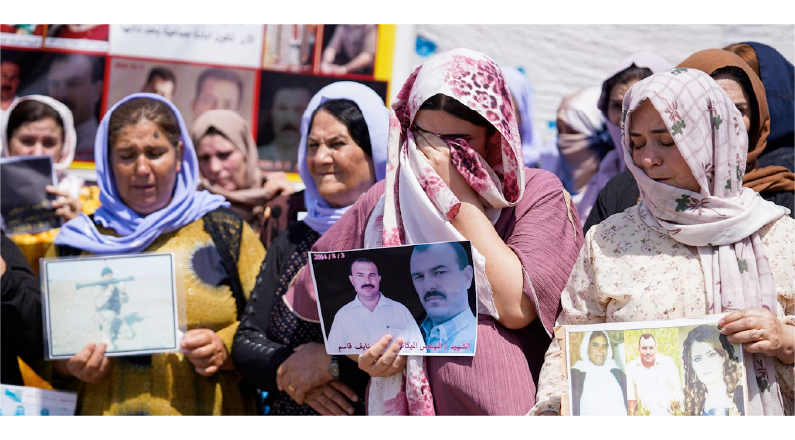
(ZENIT News / Abuya, 08.14.2025).- In the heart of West Africa, Nigeria’s Christian communities are enduring what many observers describe as a slow-motion genocide. A new report from the International Society for Civil Liberties and Rule of Law (Intersociety) paints a picture of relentless bloodshed: in just the first 220 days of 2025, at least 7,087 Christians were murdered, an average of 32 each day. Almost 8,000 others were abducted, targeted explicitly because of their faith.
The report, released on August 10, attributes the violence to roughly 22 jihadist factions embedded across the country. Their stated aim, according to Intersociety’s chairman Emeka Umeagbalasi, is nothing less than the eradication of Christianity from Nigeria within the next half-century—a chilling ambition reminiscent of the 19th-century Fulani jihad that forged the Sokoto Caliphate. Today, the Sultan of Sokoto remains Nigeria’s highest Islamic authority, and for many Christians, that history casts a long shadow.
Since 2009, the data suggest, 185,000 Nigerians have been killed in religiously linked violence—most of them Christians, but also tens of thousands of Muslims labeled “liberal” by extremists. The toll is staggering: 19,100 churches destroyed, over 1,100 Christian communities displaced, and tens of thousands of square miles of farmland seized. Clergy are not spared—more than 600 have been kidnapped, many murdered.
The central state of Benue has borne the brunt, with massacres that have left hundreds dead in single incidents. Survivors speak of attackers armed with machetes, burning villages, and leaving behind nothing but ashes and grief. “They are animals and barbarians,” said Fr. Moses Aondover, a Catholic priest in Makurdi, rejecting the idea that such horrors could ever be reduced to mere statistics. “These are wasted human lives.”
Critics say the Nigerian state is failing—if not outright complicit. Former government adviser Franc Utoo accuses elements of the military and political elite, many from Fulani backgrounds, of viewing the violence as a strategic opportunity to reshape Nigeria’s religious map. Such claims, though politically explosive, are echoed by clerics like Fr. Aondover, who lament years of unanswered pleas for international intervention.
The crisis has also become a diplomatic flashpoint. Under President Donald Trump, the United States designated Nigeria a “Country of Particular Concern” for severe violations of religious freedom—a move reversed by the Biden administration in 2021, despite continued violence. Human rights groups called that decision a “devastating blow,” arguing it removed vital leverage to pressure Abuja into protecting its citizens.
Intersociety’s report now urges Washington to restore that designation and tie U.S. aid to verifiable progress on safeguarding religious minorities. The Trump campaign has already signaled strong condemnation of the killings, framing religious freedom as both a moral imperative and a cornerstone of foreign policy.
Meanwhile, faith-based advocacy groups are calling for urgent African-led action: justice for victims, rebuilding of shattered communities, and deployment of security forces capable of shielding vulnerable villages. “For too long, the world has ignored the massacre of Christians,” said Henrietta Blyth of Open Doors UK and Ireland. On the ground, that neglect is felt most acutely by survivors who insist that condolences are hollow without real protection.
For Nigeria’s Christians, the struggle has become existential. As one local proverb warns, when your neighbor’s house is on fire, you must pour water on your own roof—because tomorrow, the flames may be at your door.
Thank you for reading our content. If you would like to receive ZENIT’s daily e-mail news, you can subscribe for free through this link.

Publicaciones relacionadas:
 USA: Transexual Woman Kills Three Children and Three Adults in a Christian School
 The 50 Countries that Persecute Christians the Most Today and The Role of Communism and Islamism
 Poland: half of the Catholic clergy have been attacked and/or assaulted in the last year
 Syria: in 14 years, the Christian presence has fallen by 84%: these are the numbers
