

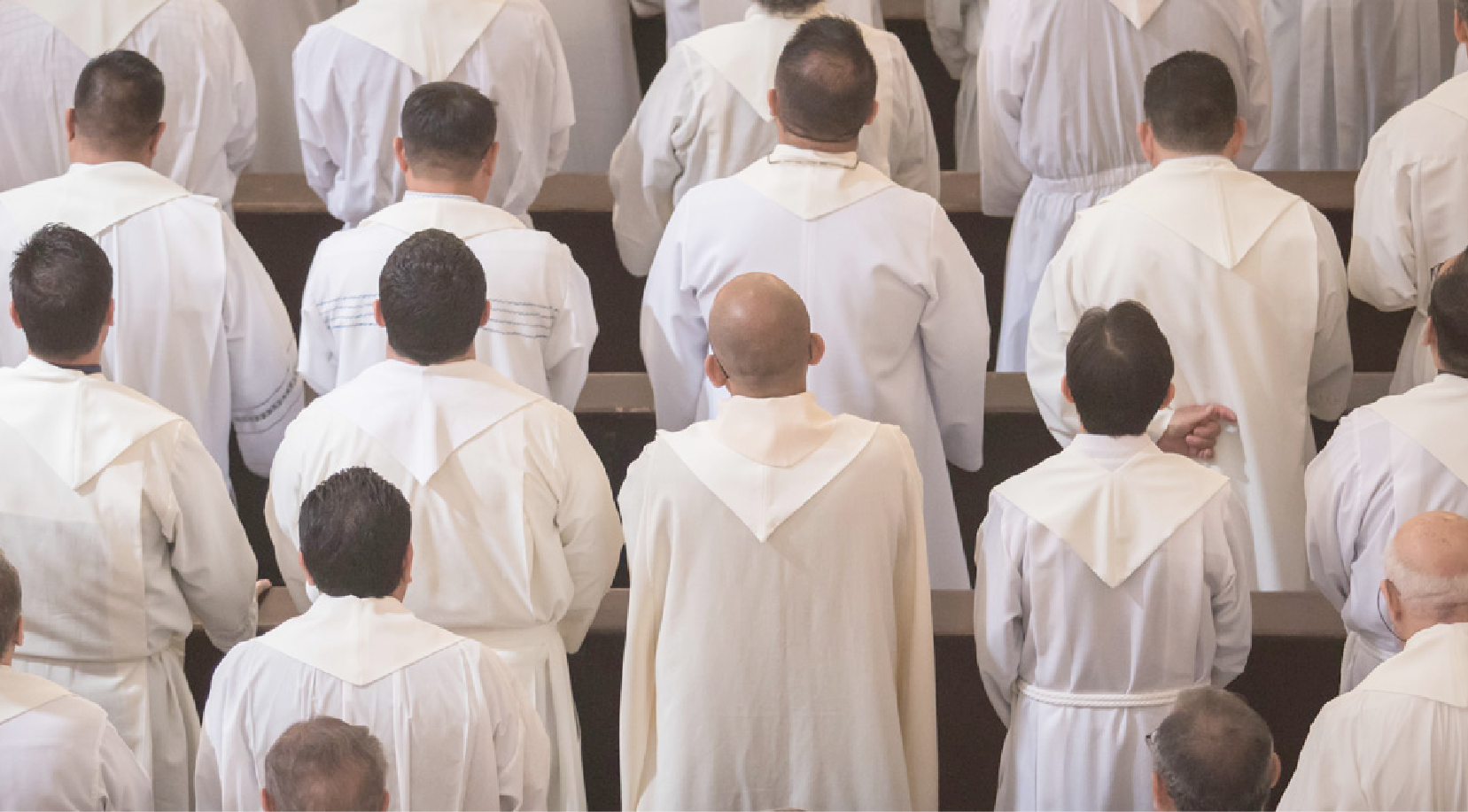
(ZENIT News / Madrid, 07.09.2025).- How many new Catholic priests will be ordained in Europe in 2025? It sounds like a straightforward question, but the answer is elusive. Europe is a mosaic of more than 40 nations, each with its own rhythm of church life, demographic realities, and transparency standards. Still, even incomplete numbers offer a window into something deeper: the spiritual temperature of the continent that once stood at the very heart of Catholicism.
While Europe is no longer the demographic engine of the Catholic Church—that distinction has long passed to the Global South—it remains the seat of the papacy and the headquarters of the Holy See. And yet, the continent is undergoing a profound vocational winter. According to the Vatican’s own «Annuarium Statisticum Ecclesiae», the number of priests in Europe declined by 1.6% in 2023 alone. That same year, Europe still held 38.1% of the world’s priests—but that share is steadily shrinking.
Zoom in closer, however, and the picture becomes more complex. This year’s ordinations reflect not only decline, but also resilience, surprising growth, and shifting patterns of clerical identity.
In Austria, for instance, a country often seen as emblematic of European secularization, at least 26 new priests are expected—up from 20 last year. Croatia may see around 40 new ordinations, though exact figures remain unpublished. France, still reeling from decades of dechristianization, expects 90 new priests in 2025. Notably, Paris marked a symbolic milestone with 16 ordinations in the newly restored Notre Dame Cathedral, its first since the devastating fire of 2019.
Poland, long the bulwark of Catholic Europe, anticipates 206 new priests—by far the largest number on the continent—but even that reflects a steady decline. Twenty years ago, Hungary had over 400 diocesan seminarians; today, fewer than 100. Germany, once fertile ground for priestly vocations, is now facing record lows, with fewer than 30 expected ordinations across 27 dioceses. Bavaria, traditionally its Catholic heartland, produced just five priests this year.
Elsewhere, trends point to a quiet shift in the global shape of European priesthood. In Luxembourg, two new priests—one Brazilian, one Vietnamese—were ordained. In Malta, among the three new priests was a Singaporean. In the Netherlands, where local vocations are scarce, about 30% of priests now come from abroad.
The stories emerging from smaller communities are equally telling. In Finland, a Vietnamese-born deacon is set to be ordained by the bishop of Helsinki. In Norway, a single ordination took place this year. In Ireland, 21 new seminarians began studies last fall, nudging the country toward a cautious optimism. Meanwhile, in Spain, while national data for 2025 are pending, diocesan reports point to an uptick in “late vocations”—older men discerning priesthood after careers or family life.
Even war-torn Ukraine is witnessing new ordinations. Despite a lack of official figures, priests are being ordained in both the Latin and Eastern Catholic rites. In May and June alone, several new priests were ordained in Lviv, Kyiv, and by Pope Leo XIV himself in St. Peter’s Basilica.
This scattering of numbers and anecdotes resists any simple narrative. Some nations—Germany, Slovenia, and the Czech Republic—appear to be in freefall. Others—Austria, Ireland, Slovakia—offer glimpses of modest recovery. Poland remains a keystone, not just for its own dioceses but as a provider of clergy to Western Europe, though this role may diminish if downward trends continue.
If one thing is clear, it is that the European priesthood is increasingly globalized. As vocations drop in historic strongholds, bishops are turning to Africa, Asia, and Latin America—not simply for support, but for continuity.
But statistics, as always, tell only part of the story. The formation of a priest involves not just numbers but discernment, sacrifice, and grace. In a time of crisis, a vocation is less likely to be inherited than discovered. These men are not entering a secure or socially prestigious role. They are stepping into a contested space—one where the Church is often countercultural, where pews are emptier, and where expectations are higher than ever.
To read the landscape of priestly ordinations in 2025 is to read a map of European Catholicism’s present condition: fractured, uneven, but not devoid of life. And beneath the institutional statistics lies a spiritual undercurrent that resists quantification—a quiet stirring in the hearts of men who, despite all odds, still hear a call to serve.
Thank you for reading our content. If you would like to receive ZENIT’s daily e-mail news, you can subscribe for free through this link.

Publicaciones relacionadas:
 Germany: research reveals that young clergy are conservative and opposed to ecclesiastical progressivism
 Which U.S. dioceses have vocational replacement, which do not and why? Study answers
 1 in 20 new priests by 2025 in the U.S. come from the military. Research reveals surprising facts
 The health (physical, mental, and spiritual) of Australian clergy in 2025: What interesting research reveals
