

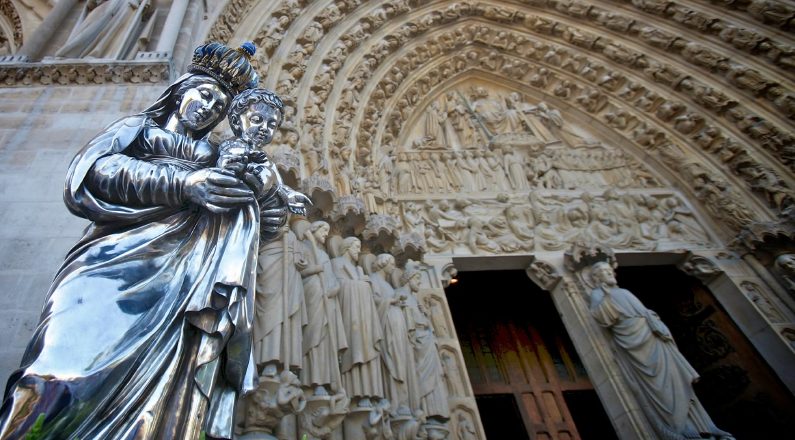
(ZENIT News / Paris, 07.13.2025).- It took less than seven months for Notre-Dame de Paris to reclaim its place at the heart of France’s cultural and spiritual landscape. Since reopening its doors on December 7, 2024, more than six million people have stepped back into the centuries-old cathedral that once stood on the brink of ruin.
By June 30, 2025, precisely 6,015,000 pilgrims, tourists, and the simply curious had entered the restored Gothic masterpiece—a number that has sent ripples through the country’s tourism sector. On average, 35,000 people now visit the cathedral each day, a flow of humanity that underscores both Notre-Dame’s enduring mystique and the deep emotional connection it holds across generations.
If this rhythm continues, the cathedral could reach an astonishing 12 million visits by the end of the year, eclipsing not only its pre-2019 attendance figures, but also surpassing the Eiffel Tower to become the most visited monument in France. This would mark a dramatic reversal of fortune for a building that, just a few years ago, was enveloped in smoke and uncertainty.
The fire that ravaged Notre-Dame on April 15, 2019, was a national trauma—a moment that stunned onlookers worldwide as flames consumed the spire, roof, and much of the wooden framework known as “the forest.” The aftermath triggered a vast, complex restoration project, supported by global fundraising and led by teams of artisans, engineers, and historians determined to honor the cathedral’s original soul while meeting the demands of modern conservation.
What visitors see today is a work still in progress. While the nave, transept, and much of the interior have been restored to full glory—many areas rendered even more luminous by meticulous cleaning and stone repair—the cathedral’s full resurrection won’t be complete until 2027.
Much remains to be done. Restoration of the chevet and flying buttresses is ongoing. The sacristy, originally designed by Eugène Viollet-le-Duc, will also undergo careful renovation. A new set of stained-glass windows, planned for 2026, promises to blend tradition and innovation, incorporating contemporary artistic vision within the cathedral’s timeless architecture. And the vast plaza outside the church—the parvis—along with its adjoining green spaces and walkways, is being reimagined as a more accessible and contemplative entry point for the millions who will continue to pass through.
Yet even in its partial state, Notre-Dame has regained something beyond stone and sculpture: its living presence. The cathedral is once again a place of prayer, of candlelight flickering under vaulted ribs, of whispered awe beneath rose windows that survived the inferno. Masses are being celebrated again. Choirs echo under high ceilings. And for many, the return of Notre-Dame marks more than a logistical reopening—it feels like a kind of homecoming.
France’s Minister of Culture recently described the cathedral’s revival not as a conclusion but as a renewal, pointing to the growing engagement of young people in cultural heritage, restoration, and liturgical life. The surge in visitors reflects not just nostalgia or curiosity, but also a hunger for beauty, continuity, and transcendence in a time marked by disruption.
Thank you for reading our content. If you would like to receive ZENIT’s daily e-mail news, you can subscribe for free through this link.

Publicaciones relacionadas:
 Pilgrimage Boom: Camino de Santiago Hits Record-Breaking Numbers in 2024
 The bells of two beautiful churches destroyed (and now restored) after the passage of Islamism in Iraq ring once again
 United States to Exhibit Largest Collection of Vatican Treasures Outside Europe
 City where Divine Mercy was born to welcome 5,000 pilgrims from across globe
