

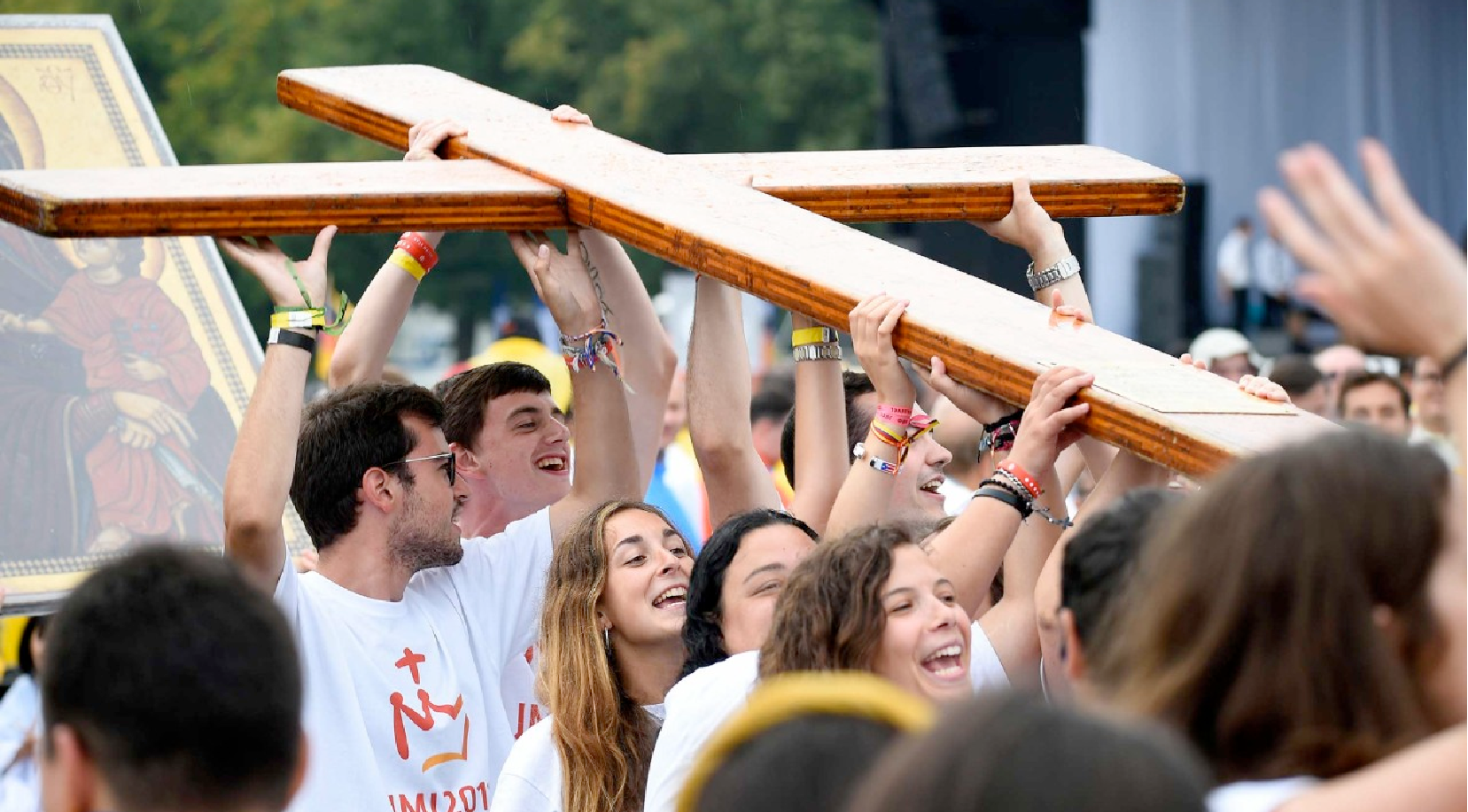
(ZENIT News / Rome, 07.13.2025).- As the Eternal City braces for a summer unlike any other, one word echoes through the narrow Roman streets and ancient basilicas: Jubilee. From July 28 to August 3, Rome will host an anticipated one million young people for the 2025 Jubilee of Youth, a global gathering that promises to be as spiritually charged as it is logistically monumental.
Organized by the Vatican’s Dicastery for Evangelization, the Jubilee is more than a festival or a religious conference—it is a pilgrimage of encounter, penance, celebration, and renewal. And it will culminate in two major events led by Pope Leo XIV: a Saturday night vigil and Sunday morning Mass at Tor Vergata, the wide esplanade that also hosted Saint John Paul II’s final World Youth Day in 2000.
The Vatican has already received over 500,000 requests for lodging, but organizers stress that this is only a fraction of the full crowd expected. Many groups from Italy, Europe, Latin America, and Asia have arranged their own accommodations or plan to attend only the weekend events. Pilgrims will include delegations from war-torn regions such as Ukraine, as well as representatives of other Christian traditions and non-Christian faiths, reflecting the Jubilee’s universal spirit.
In the lead-up to the central liturgies, young people will be immersed in a citywide mosaic of spiritual and cultural activities. Pilgrimages to St. Peter’s and St. Paul’s Basilicas, confessions at the Circus Maximus, artistic performances, late-night music, and moments of communal reflection are all woven into the weeklong tapestry of faith. The Holy Door of St. Peter’s will become a focal point for many, as thousands pass through in a symbolic gesture of spiritual renewal.
August 1 has been designated as the day of Reconciliation, with hundreds of priests and bishops expected to hear confessions in open-air settings across the city. Whether Pope Leo himself will hear confessions, as his predecessors have sometimes done, remains undisclosed. What is clear is the growing momentum behind the sacrament, which is expected to draw tens of thousands into a powerful encounter with God’s mercy.
The vigil on Saturday night will unfold as a crescendo of witness and worship. Internationally known Christian bands will provide music, and testimonies from young believers around the globe will punctuate the evening with stories of resilience, conversion, and hope. The design of the vigil is intended to reflect both the diversity and unity of the Church—a Church that breathes with many lungs, but marches in step toward the same goal: holiness.
To help navigate the intensity of the experience, each registered pilgrim will receive a carefully curated Pilgrim Kit. Beyond the practical—transportation passes, meal vouchers, and a detailed event schedule—the kit includes a custom-designed backpack, Jubilee-branded T-shirts, a cap for the Roman sun, a reusable water bottle, a rosary-bracelet, and a bandana used for group identification. These items are not just souvenirs but tools of participation—physical symbols of belonging to a global Church on the move.
The Jubilee Pass, a personalized credential that grants access to the major events, will become a familiar sight across Rome that week. With public transportation set to run at maximum capacity and hundreds of events scattered through dozens of locations, coordination is critical. Yet there is a certain beauty in the very chaos—a living sign that the Church is alive, and its youth are not spectators but protagonists.
The inclusion of a solidarity fund has also allowed youth from economically strained or politically unstable regions to make the journey. Many of these groups, often overlooked in international gatherings, will have a prominent place at the Jubilee. Whether they come from the slums of São Paulo, the villages of northern Nigeria, or the refugee camps of Eastern Europe, their presence will speak louder than any homily.
For many of these pilgrims, this will not be their first encounter with Rome—but it may well be their most transformative. The Jubilee is not simply a trip, but an invitation. An invitation to rediscover the sacraments, to meet Christ in others, to be challenged by the Gospel, and to return home as missionaries of hope.
And that, ultimately, is the heart of the Jubilee: not an event to be consumed, but a calling to be lived. As Rome prepares to open its arms to a generation of seekers, it also opens its soul. The Church may be ancient, but in moments like this, it beats with a young and vibrant heart.
Thank you for reading our content. If you would like to receive ZENIT’s daily e-mail news, you can subscribe for free through this link.

Publicaciones relacionadas:
 Jubilee 2025: Vatican Launches Photography and Sports Competition for Young People
 Pope Francis announces when Carlo Acutis and Pier Giorgio Frassati will be canonized
 Friendship, the call to goodness, and the ability to decide: 3 questions from young people answered by Pope Leo XIV
 The encounter with the risen Christ that changes existence and illuminates affections, desires, and thoughts: Leo XIV’s homily to young people
