

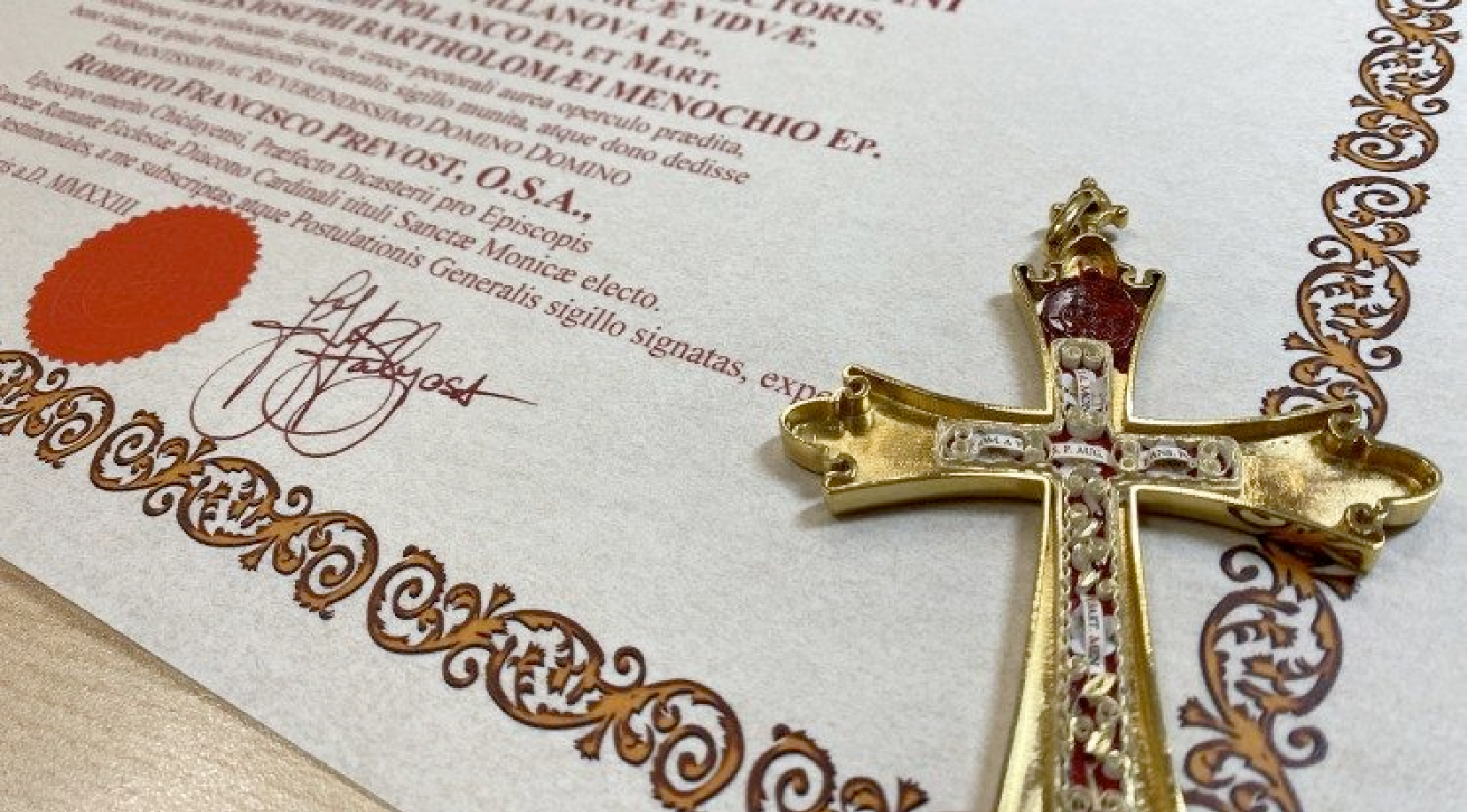
(ZENIT News / Rome, 14.07.2025) – On May 8, during the election at the Conclave, the newly elected Pope Leo XIV, until then Cardinal Robert Prevost, displayed for the first time a pectoral cross of great symbolic value. This cross, donated by the Circolo di San Pietro and redesigned by the goldsmith Antonino Cottone, houses bone fragments of four Bishops and a special relic of his namesake, Saint Leo the Great. The history of this cross begins before the Conclave, when the then Cardinal Robert Prevost, Augustinian and Prefect of the Dicastery for Bishops, received a special pectoral cross as a gift from his brothers in the Community on the day of his creation as a Cardinal, September 30, 2023.

Inside are placed five relics: Saint Augustine of Hippo, Doctor of the Church and Spiritual Father of the Order; Saint Monica, his mother, who represents conversion, tenacity and the spiritual bond between mother and son; Saint Thomas of Villanueva, Valencian Archbishop of the 15th and 16th centuries, religious reformer and protector of the poor and missionary; the Blessed Anselmo Polanco, Bishop of Teruel during the Spanish Civil War (1936-1939); and the Venerable Giuseppe Bartolomeo Menochio, Bishop and Sacristan of the Apostolic Sacristy (died 1823).

Father Josef Sciberras, Augustinian General Postulator, recalls that the then Cardinal Prevost was moved to receive this cross in a celebration at the College of Saint Monica. On the eve of the Conclave, Sciberras suggested that he wear it to feel protected by the Saints depicted on the crucifix, and he did: he wore it to the oath and to the balcony of the Vatican Basilica on the day of his election.
Following Prevost’s election as Successor to Saint Peter on May 8, he was asked to add the «reliquary» he already had to the silver papal pectoral cross that was presented to him on the day of his election to the Circolo di San Pietro, in addition to placing within it a relic more in keeping with the name he had chosen as Supreme Pontiff.

The creator of this sacred work of art was Antonio Cottone, who spent just two hours creating the small «reliquary.» He used Medieval techniques: gold paper filigree on moiré fabric and small floral motifs to contain the holy fragments.
A relic of Saint Leo the Great, the 44th Successor of Peter (4th-5th century), famous for his defense of the unity of the Church, his fight against heresies, and his affirmation of the Roman Primacy, was inserted. His presence on the cross symbolizes the apostolic guidance and power over the newly established pontificate. Father Silvestrini, Custos of the Apostolic Shrine, coordinated the insertion of the relics with the goldsmith Cottone.

On May 15, the Vatican published the first official photograph of Leo XIV. He appears with the reliquary cross hanging from his chest, bearing his name — «Leo PP. XIV» — and a shield with Augustinian symbols: a lily, a burning heart with an arrow, and a book, along with the keys of Saint Peter. Implicit in this image is his commitment to social justice — the reason for his choice of name — and his identity, deeply influenced by Augustinian spirituality.
This detail of inserting relics into a pectoral cross is not a simple ornamental detail, but rather a gesture laden with symbolism that communicates the mission of the pontificate: to renew the Church in the line of the Saints of the past, to defend the poor, to promote intellectual faith, to honor the legacy of the unity of the Church, and to remain faithful to the Gospel, even in the face of adversity.



Publicaciones relacionadas:
 A New Phase in the Leonine Pontificate: Pope Reshapes His Inner Circle with a Surprising Appointment
 From the poor to artificial intelligence: this is what Leo XIV’s first encyclical and apostolic exhortation would be like
 Nicolás Maduro asks the Pope for diplomatic mediation in conflict with Trump and the United States
 Pope Leo XIV to publish new document on Catholic education and declare Newman co-patron of Catholic education
