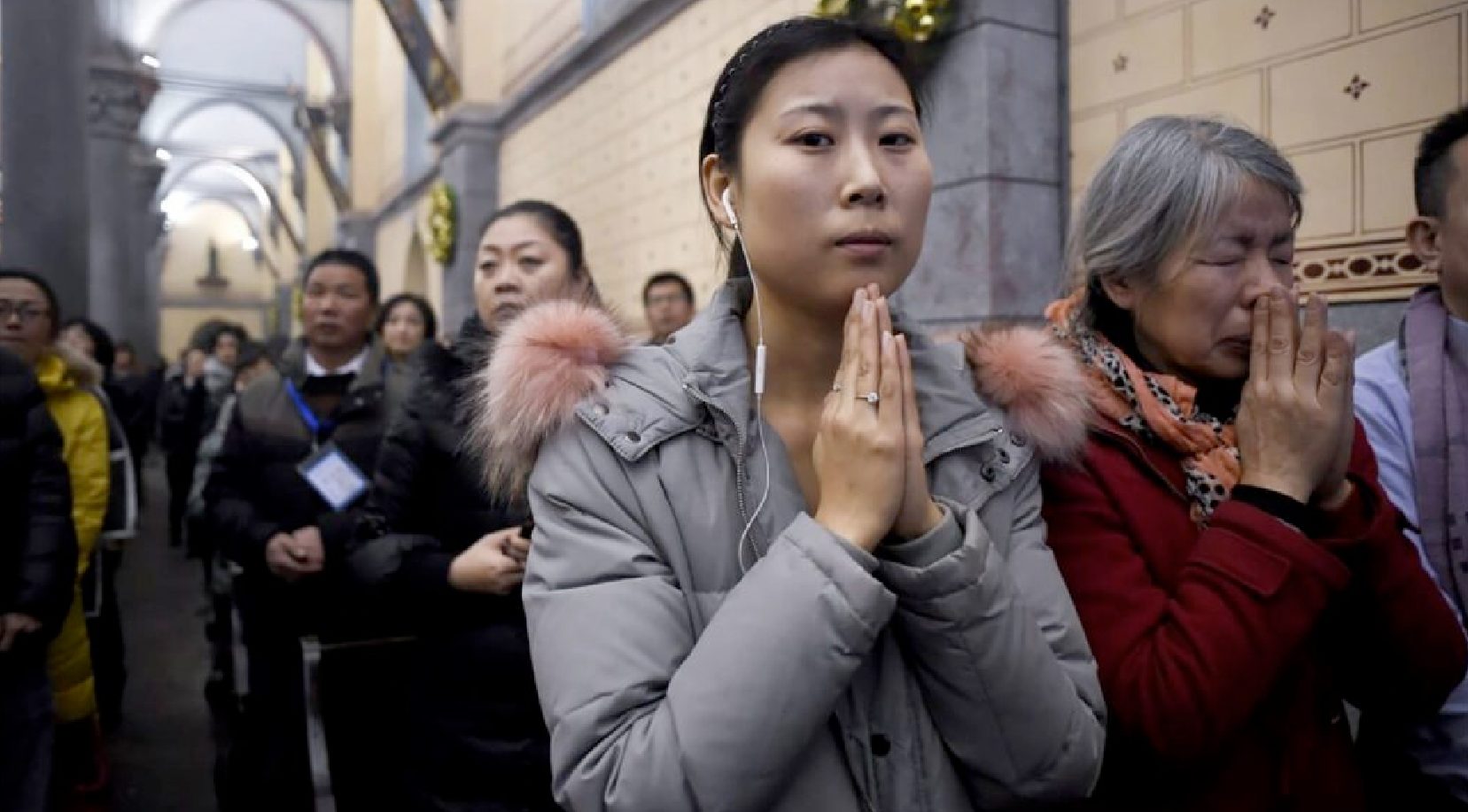
(ZENIT News / Rome, 07.19.2025).- A decade of shifting beliefs and demographic surges has left the religious map of the world profoundly altered. That’s the conclusion of a sweeping new report by the Pew Research Center, released June 9, which reevaluates global religious affiliation trends from 2010 to 2020. But while nearly all major religious groups saw growth, one country stands out not for its belief, but for its disassociation: China.
China, the world’s most populous nation, now also holds the title of the most religiously unaffiliated. According to Pew’s updated methodology, 90% of China’s population — some 1.3 billion people — reported no formal religious affiliation in 2020. This recalibration dramatically alters previous assumptions about the country’s spiritual landscape, and more broadly, impacts global statistics on religious identity.
What’s behind this shift? The change doesn’t lie in people’s hearts, but in how their beliefs are counted. For years, measuring religiosity in China has presented a thorny challenge for researchers. Earlier Pew studies drew on an eclectic mix of data, including personal beliefs, cultural practices, and spiritual self-descriptions — an approach that painted a more nuanced, though less standardized, picture. But in this new report, Pew adopts a stricter definition, relying solely on whether individuals formally self-identify with a religion using the Chinese term “zongjiao,” a legal and institutional classification of religious affiliation.
This linguistic pivot has major implications. Under the older framework, roughly half of Chinese citizens were considered unaffiliated. Now, using the narrower term, that estimate has jumped to nearly nine out of ten. The revision places China even further from the global mainstream and helps explain why its Christian population, previously rumored to be booming, remains outside the top ten globally — despite widespread media speculation that China could soon rival the United States in Christian numbers.
Still, Pew acknowledges the new model’s blind spots. Many Chinese engage in spiritual practices or identify with religious traditions without adopting the formal label of “zongjiao.” In a country where unregistered religious activity is often restricted, reluctance to disclose affiliation — particularly among underground Christian communities — may also skew results.
The decision to standardize comes with trade-offs. It improves consistency with international data but sacrifices some granularity. Yet this new clarity has global consequences. China’s revised classification significantly boosts the estimated number of unaffiliated people worldwide — now pegged at 1.9 billion, making them the third-largest group behind Christians and Muslims.
Globally, Muslims saw the most rapid growth over the decade, expanding by 347 million to represent 25.6% of the world’s population. Christians remain the largest group, with 2.3 billion adherents, though their share fell slightly to 28.8%, due in part to lower birth rates and rising religious disaffiliation, particularly in the West.
That disaffiliation trend is one of the report’s most striking findings. Pew found that for every adult who converted to Christianity, more than three left the faith. This net loss far outpaces that of other religions and underscores a broader global trend toward religious independence, especially among younger adults in North America, Europe, and parts of Asia.
Meanwhile, Christianity’s center of gravity has shifted dramatically. In 2020, only 22% of Christians lived in Europe, down from 66% a century ago. By contrast, 31% were in sub-Saharan Africa, driven by high birth rates and burgeoning youth populations. Latin America and the Caribbean accounted for another 24%. These shifts have turned the faith into an increasingly non-Western phenomenon — a transformation that is likely to deepen in the decades ahead.
Pew also tracked changes at the national level, identifying 41 countries where the Christian share of the population changed by at least five percentage points. All but one — Mozambique — experienced a decline. While religious switching plays a role, natural population growth remains the largest driver of religious demographics overall.
As for China, the future of religion remains hard to predict. Its spiritual life may be more vibrant than official numbers suggest, yet the opacity of state controls and social norms makes it difficult to fully assess. For now, at least on paper, China remains the global epicenter of religious non-affiliation — a fact that continues to ripple through the world’s religious balance.
Thank you for reading our content. If you would like to receive ZENIT’s daily e-mail news, you can subscribe for free through this link.