

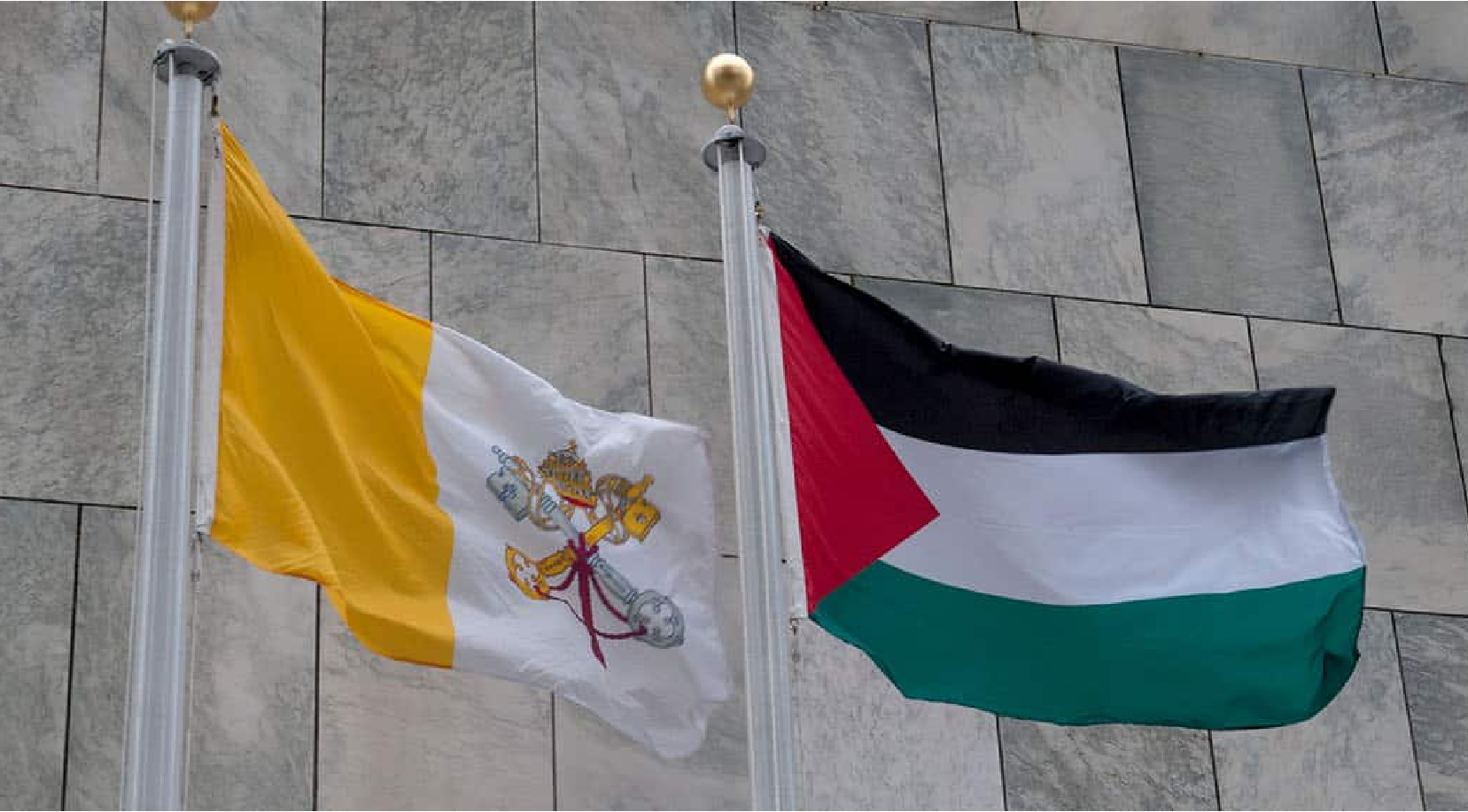
(ZENIT News / Santiago de Compostela, 23.07.2025).- The Holy See was one of the first European States to recognize the State of Palestine after the 1993 Oslo Agreements, legal basis that supports the Palestinians right to a State.The recognition of the State of Palestine by the Holy See reaffirms the Church’s support for a negotiated solution to the Palestinian-Israeli conflict, in accordance with the Comprehensive Agreement signed on June 26, 2015, between the Holy See and the State of Palestine.
That Agreement proposed the final solution of two States, Israel and Palestine, living peacefully together with equal dignity. The Agreement established freedom of religion and conscience, rights that the Palestinian State pledged to protect, guaranteeing the exercise of worship in the holy places of Christianity and the right of the local Catholic church to participate in social, charitable, and educational activities.
On December 30, 1993, the Fundamental Agreement was signed between the Holy See and the State of Israel, and before Hamas attacked Jewish citizens, in September 2023, Archbishop Paul Richard Gallagher, the lynchpin of Vatican diplomacy, advocated at the UN for a peace plan that would not be «detrimental to the local populations or the legitimate demands of Israelis and Palestinians.»
Following Hamas’s «inhumane» attack on Israel, the Vatican Cardinal Secretary of State Pietro Parolin agreed with Pope Francis that «those attacked have the right to defend themselves» and emphasized the two-state solution, «one that allows Palestinians and Israelis to live side by side in peace and security.»
Beyond diplomatic processes, on June 8, 2024, Pope Francis called for urgent humanitarian aid to reach the Palestinians in Gaza and for Israel and Hamas to accept the proposals for a ceasefire and the release of the hostages.
The Pope’s opposition to the Israeli offensive against Gaza led the Israeli authorities to respond tepidly to the news of his death. The Israeli Foreign Ministry removed the condolences from its official accounts and sent its Ambassador Yaron Sideman to the Pope’s funeral, the lowest-level representative possible at an event of this nature.
In this context, on July 1 a delegation from the United Nations (specifically the United Nations Office for the Coordination of Humanitarian Affairs) visited the parish of the Holy Family, a Latin Rite Catholic church in Gaza, where hundreds of Catholic, Orthodox and Muslim people displaced by the war are being housed.
The parish priest, Argentine Father Gabriel Romanelli, commented that «it was their first visit here to the parish. The delegation wanted to see our conditions, greet our displaced people, and gather their testimonies of distress.»
«Despite the critical situation, the UN representatives visited the parish facilities, toured the grounds, and also spent time with the severely disabled children, all from Muslim families, who are lovingly cared for by the Missionaries of Charity,» said Father Romanelli.
Since the beginning of the war, the Gaza parish has been assisting the local population of wounded and displaced Palestinians.
The presence of the UN representatives shows that the Catholic Church is concerned about caring for those living in Gaza, a population that does not know what to expect, as they are told many times «that a truce is imminent,» but they only receive evacuation orders «in anticipation of military operations,» according to Father Romanelli.
After the visit of the UN representatives, the priest explained, «we had a prayer for peace in the church. When they said goodbye, they thanked us for the work of solidarity and hospitality we carry out for the Christian community and the many needy Muslim families who live here in our neighborhood.»

Publicaciones relacionadas:
 Israel Bombs Catholic Church in Lebanon and Attacks UN Blue Helmets
 Gaza: the ongoing grave situation and persecution of settlers in occupied Palestine
 Settlers exploit war in Iran to commit new acts of violence in the West Bank
 Lebanon requests diplomatic mediation from the Vatican to prevent Israel from attacking or displacing Catholic communities in the south of the country
