

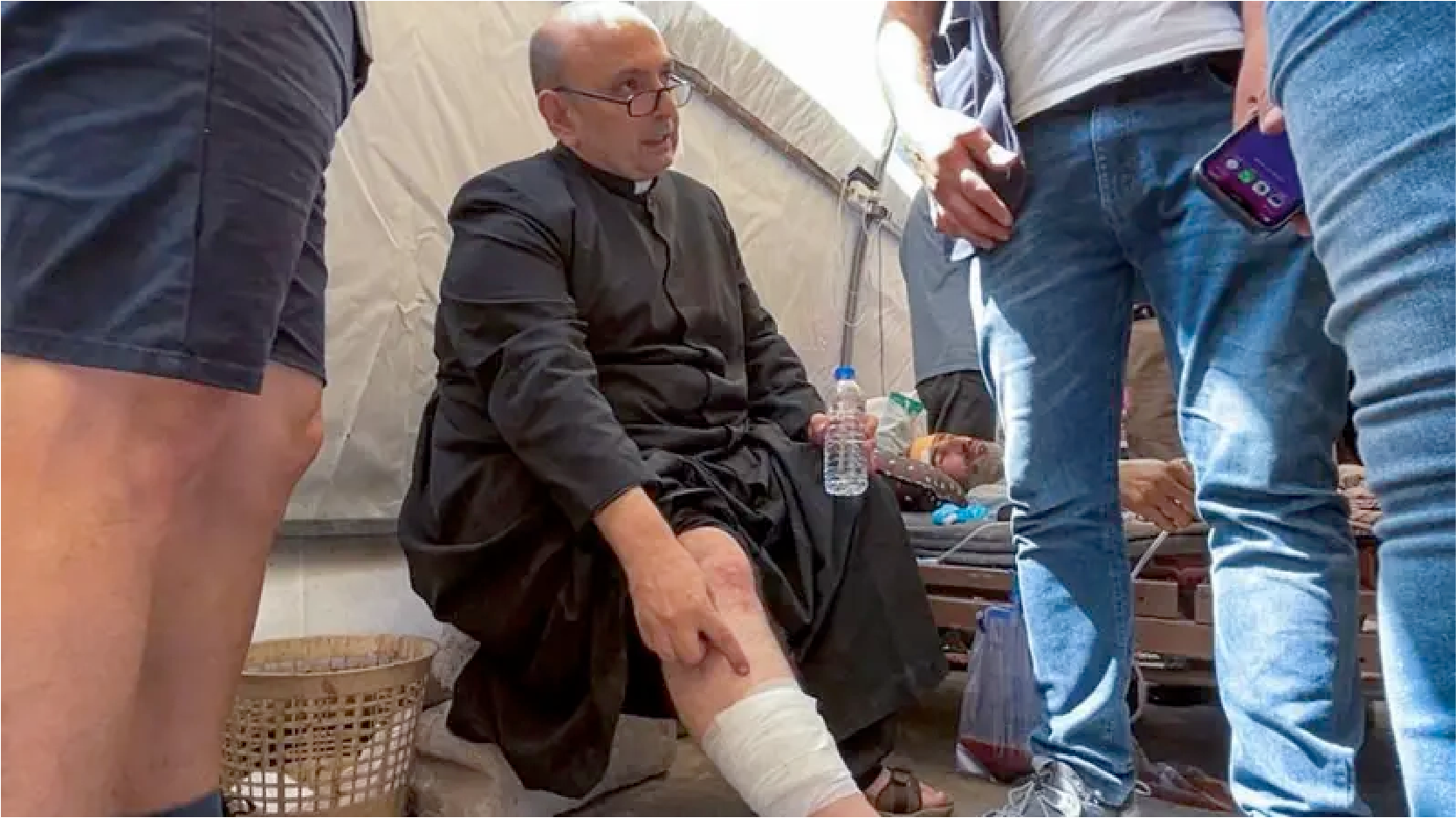
(ZENIT News / Tel Aviv, 07.25.2025).- In the dense fog of war, there are moments that transcend military calculations and enter the realm of moral reckoning. One such moment came on July 17, when a deadly strike hit the only Catholic parish in Gaza City, the Church of the Holy Family, killing three people and injuring at least ten more. At the time of the incident, around 500 displaced civilians—many of them children, the elderly, and people with disabilities—were taking shelter inside its walls.
Days later, the Israel Defense Forces (IDF) described the incident as the result of a “technical failure,” not a human miscalculation. In a report, military investigators claimed the damage had been caused by an unintentional munition deviation during an operation in the area. The strike, they added, was the product of a malfunction either in the projectile itself or in the firing mechanism, and therefore no individual soldier could be held responsible.
While the army has since clarified protocols for operations near religious sites and sensitive structures, the broader implications of the incident remain unresolved—and, for many, deeply troubling. The IDF’s announcement that no disciplinary or legal consequences would follow echoes a pattern that has accompanied other high-profile incidents, such as the killing of journalist Shireen Abu Akleh in 2022 and the deaths of Nahida and Samar Kamal Anton in the same church struck this month.
This pattern of investigations that end without accountability is fueling skepticism well beyond Gaza. Speaking to Italy’s national broadcaster, Vatican Secretary of State Cardinal Pietro Parolin openly questioned whether the strike could truly be dismissed as a mistake. “One may legitimately doubt the accidental nature of the event,” he said, pointing to the moderating role that Christian communities have historically played in Middle Eastern societies. “What has happened is gravely serious.”
The wounded parish priest, Argentine-born Gabriel Romanelli, had become a familiar name to Italian viewers through daily phone calls with the late Pope Francis, who followed closely the church’s efforts to shelter the vulnerable. Romanelli survived the attack, but the strike left more than physical damage—it has shattered what little remained of a fragile sense of sanctuary in Gaza’s war-scarred Christian minority.
In a show of solidarity, Cardinal Pierbattista Pizzaballa, Latin Patriarch of Jerusalem, and Greek Orthodox Patriarch Theophilos III visited the enclave days after the bombing. Their visit included humanitarian aid deliveries and spiritual support to a community now further diminished and traumatized. Yet their symbolic presence also underscored a deeper frustration: the sense that diplomatic gestures and pastoral visits cannot substitute for justice or meaningful deterrence.
Meanwhile, another fire—this one literal—has ignited controversy in the West Bank village of Taibeh, a historically Christian enclave. The fire broke out near the Church of Saint George amid rising tensions with nearby settler communities. While local clergy and residents accused Jewish settlers of incitement and intimidation, a police report from Israeli authorities painted a strikingly different picture. According to the investigation, not only were settlers not responsible, they reportedly helped extinguish the blaze. Still, the report failed to identify any perpetrator.
Such contradictions have only deepened distrust between Christian communities and Israeli institutions. That both incidents—Gaza and Taibeh—occurred within days of each other speaks to a wider concern: that Christian minorities, long seen as a bridge in interfaith dialogue, are increasingly caught in the crossfire of geopolitical conflict and internal tensions.
With trust fraying and doubts mounting, the question now is not only whether these acts were intentional, but whether anyone—anywhere—will be held to account.
***
Full text of the statement:
Yesterday [July 22], the Southern Command completed an inquiry regarding the mortar hit on the Holy Family Church in Gaza City on Thursday, July 17, 2025.
The inquiry revealed that during operational activity by IDF troops in the area of Gaza City, the church was accidentally hit due to an unintentional deviation of munitions. The impact caused damage to the structure and injured several Gazan civilians. During the operation, adjustments were made to improve the accuracy of fire, and following the incident, guidelines for opening fire near religious buildings, shelters, and other sensitive sites were further clarified.
We emphasize, in accordance with the request of representatives of the Patriarch in Jerusalem, the IDF, via COGAT, has facilitated the entry of humanitarian aid, including food, medical equipment, and medication, to the Holy Family Church in Gaza. Additionally, in recent days the IDF coordinated the entry of a delegation on behalf of the Greek and Latin Patriarchs, accompanied by a group of Christian clergy to visit the Latin Church in the Strip. Furthermore, the IDF coordinated the evacuation of the injured from the incident for further medical treatment.
The IDF directs its military strikes solely at military targets and works to mitigate harm to civilians and civilian infrastructure as much as possible, including religious institutions. The IDF regrets any harm caused to civilians.
Thank you for reading our content. If you would like to receive ZENIT’s daily e-mail news, you can subscribe for free through this link.

Publicaciones relacionadas:
 American Catholic Church Commends President Trump for Acknowledging Starvation in Gaza and Urges Administration to Expand Humanitarian Access
 President of U.S. Bishops Conference Calls for Special Collection for Humanitarian Relief and Pastoral Support in Gaza
 Pope Leo XIV comments on Trump’s peace plan for Gaza (and other current topics of general interest)
 Israel Bombs Catholic Church in Lebanon and Attacks UN Blue Helmets
