

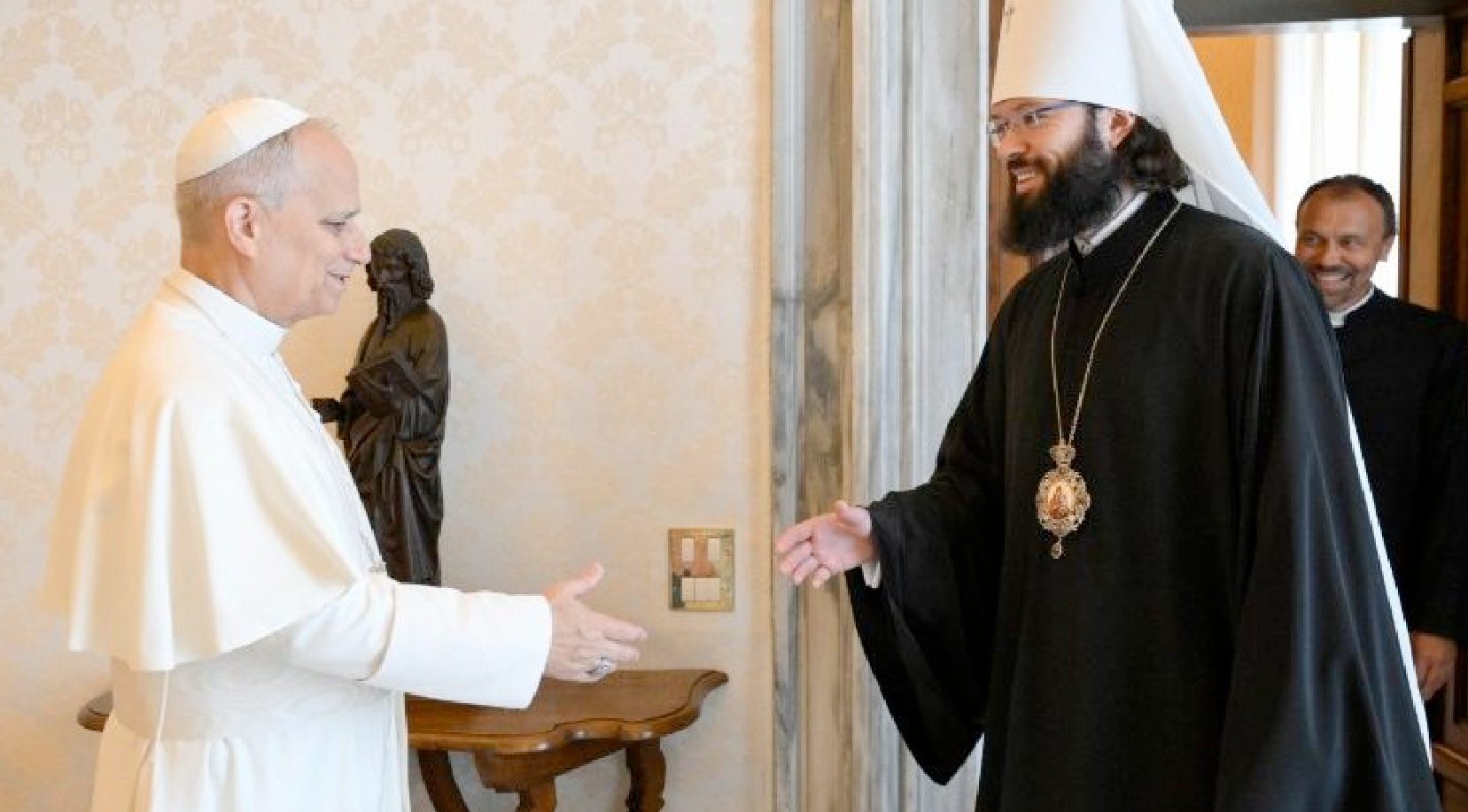
(ZENIT News / Vatican City, 07.26.2025).- In a quiet yet symbolically charged meeting at the Vatican on July 26, Pope Leo XIV received Metropolitan Anthony, the Russian Orthodox Church’s head of external relations and personal envoy of Patriarch Kirill of Moscow. The encounter, the first of its kind under Leo XIV’s pontificate, marks a tentative step toward rekindling a strained relationship between Rome and Moscow—one frayed by the war in Ukraine and diverging moral alignments in recent years.
For more than a decade, relations between the Catholic Church and the Russian Orthodox Patriarchate have swayed between fragile diplomacy and theological detachment. The historic 2016 meeting between Pope Francis and Patriarch Kirill in Havana had once raised hopes of a new era of ecumenism. But following Kirill’s vocal endorsement of Russia’s invasion of Ukraine, that promise collapsed into recrimination and frost.
Metropolitan Anthony, who also attended the funeral of Pope Francis as Kirill’s representative, came bearing a message of goodwill and congratulations from the Moscow Patriarch to Leo XIV, recently elected Bishop of Rome. The Vatican, in turn, acknowledged the gesture as a sign of continuing relevance of dialogue, however cautious.
According to a statement from the Russian Orthodox Church, the private conversation extended beyond formal greetings. Topics included the state of Catholic-Orthodox dialogue, the plight of Christian communities in global conflict zones—including the Middle East and Ukraine—and the ongoing suffering of the canonical Ukrainian Orthodox Church, which remains under pressure both from state policies and ecclesial reconfigurations following the granting of autocephaly to a rival Orthodox body in 2019.
Metropolitan Anthony reportedly raised this concern directly with the Pope, describing it as a form of persecution. The Vatican has not commented publicly on this portion of the exchange, though Leo XIV was said to have expressed his desire to maintain an open channel with the Russian Church and welcomed future cooperation.
Prior to the meeting, in remarks published by the Italian newspaper «La Repubblica», Anthony expressed hope for “an honest and open discussion on the future of relations between our Churches.” He highlighted the importance of Christian collaboration in a rapidly secularizing world, insisting that spiritual unity could offer a counterbalance to the fragmentation of contemporary societies.
The conversation came at a time when Christian institutions globally are navigating shifting political and theological landscapes. For Leo XIV, still early in his papacy, the meeting offered a chance to test the waters of high-stakes ecumenical diplomacy, without the weight of past personal confrontations. His predecessor’s direct clashes with Kirill, fueled by moral and geopolitical disagreements, had left little room for compromise.
Whether this new contact signals a recalibration or remains a mere protocol exchange remains to be seen. Yet the very fact that dialogue has resumed, however tentatively, suggests that the bridges built in Havana may not have collapsed entirely. In the increasingly polarized world of global Christianity, even the thinnest thread of conversation can sometimes bear surprising weight.
Thank you for reading our content. If you would like to receive ZENIT’s daily e-mail news, you can subscribe for free through this link.

Publicaciones relacionadas:
 Leo XIV to separated Christians: “I consider the reestablishment of full and visible communion a priority”
 “We cannot and do not want to forget”: Pope Leo XIV at ecumenical celebration for martyrs and witnesses of the faith
 Official: British monarchs announce state visit to Pope Leo XIV
 [Pope in Turkey: Day 2] Who is Jesus Christ in the lives of women and men today? The question (and answer) of Leo XIV
