

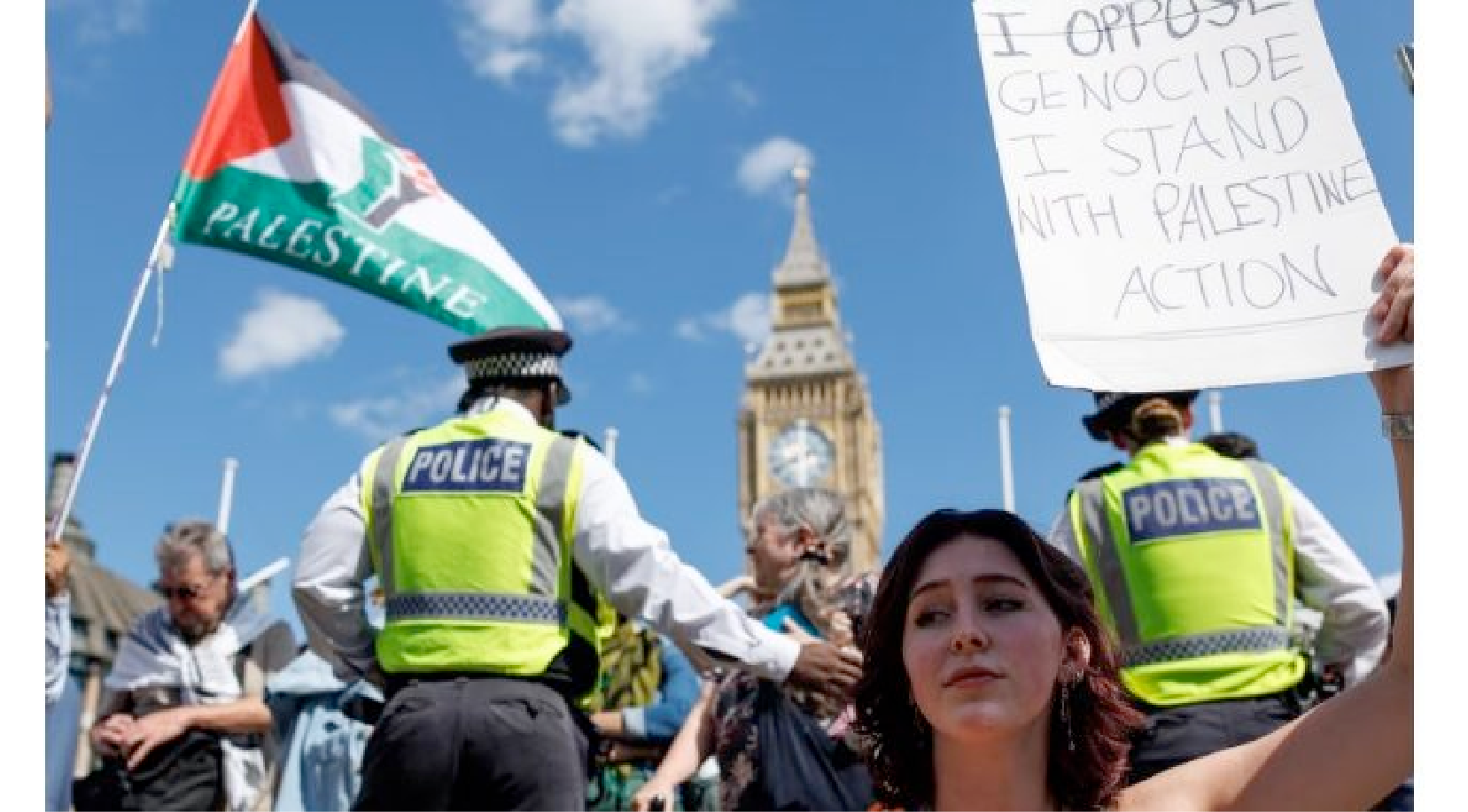
(ZENIT News / London, 08.14.2025).- London’s Parliament Square became the stage for one of the most striking acts of civil disobedience in recent memory, as more than 500 people — including senior Christian leaders — were detained over the weekend of August 16–17 for displaying placards in support of the controversial group Palestine Action.
The arrests came in the wake of the UK government’s June 2025 decision to proscribe the organisation under terrorism legislation, a move that has polarised public opinion and drawn criticism from across the religious spectrum.
For some clergy, the day was less about political protest than an expression of personal conscience. Father John McGowan, parish priest of St Joseph’s in Chalfont St Peter, Buckinghamshire, described an almost spiritual calm after being taken into custody. “I’m prepared for anything, even prison,” he reflected online. “When I called a friend in the West Bank who works with Palestinians, I felt I could finally look him in the eye. My conscience is clear.”
The Reverend Dr Sally Mann, a Baptist minister from East Ham’s Bonny Downs Church, voiced a similar conviction despite anticipating legal consequences. “It’s the right side of history,” she told The Independent, adding that she was at peace with her decision.
Not all of those arrested were card-carrying supporters of Palestine Action. Martin Clay, a licensed lay minister from Southborough, carried a sign explicitly stating he did not back the group — but defended the right to support it as part of the broader principle of freedom of assembly. Released on bail, he is scheduled to report to police in October.
According to the Metropolitan Police, nearly half of those detained on August 16 were over the age of 60, underscoring the generational breadth of the movement. Among them was an 83-year-old priest arrested last month in a similar protest, and the Reverend Stephen Collier, 78, who days earlier was forcibly removed from Westminster Abbey for unfurling a banner calling for national repentance over Britain’s historical role in Palestine during the Mandate period.
For Collier, the Abbey’s symbolism — intertwined with both Church and State — made it the only fitting place for his witness. “I knew they wouldn’t tolerate me there,” he admitted, but insisted that repentance should be “public, communal, and national.”
The Home Secretary, Yvette Cooper, has defended the ban, describing Palestine Action as far from a non-violent movement. Legal restrictions, she noted, mean the public may be unaware of the full extent of the group’s activities.
Still, opposition to the proscription has been loud and organised. Last week, more than 300 British Jews — including author Michael Rosen and comedian Alexei Sayle — signed an open letter urging the government to reverse the decision, rejecting the conflation of anti-occupation activism with antisemitism or terrorism.
The events in Westminster have highlighted a rare convergence of religious conviction and political activism, with clergy prepared to risk arrest for a cause they view as morally urgent. Whether their actions will shift public perception of Palestine Action — or of Britain’s role in the Middle East — remains uncertain. But for those who took part, the decision to act appears as much a matter of faith as of politics.
Thank you for reading our content. If you would like to receive ZENIT’s daily e-mail news, you can subscribe for free through this link.

Publicaciones relacionadas:
 Census Shows that Only Four Out of Every 10 Australians are Christians. Catholics Are a Majority but Those with No Religion Increase
 President Biden Signs Executive Order to “Protect” Abortion Against the Supreme Court’s Decision
 Church proposes to French government recognition of candlelight procession as intangible cultural heritage of the country
 In which US dioceses do the most people convert to Catholicism?
