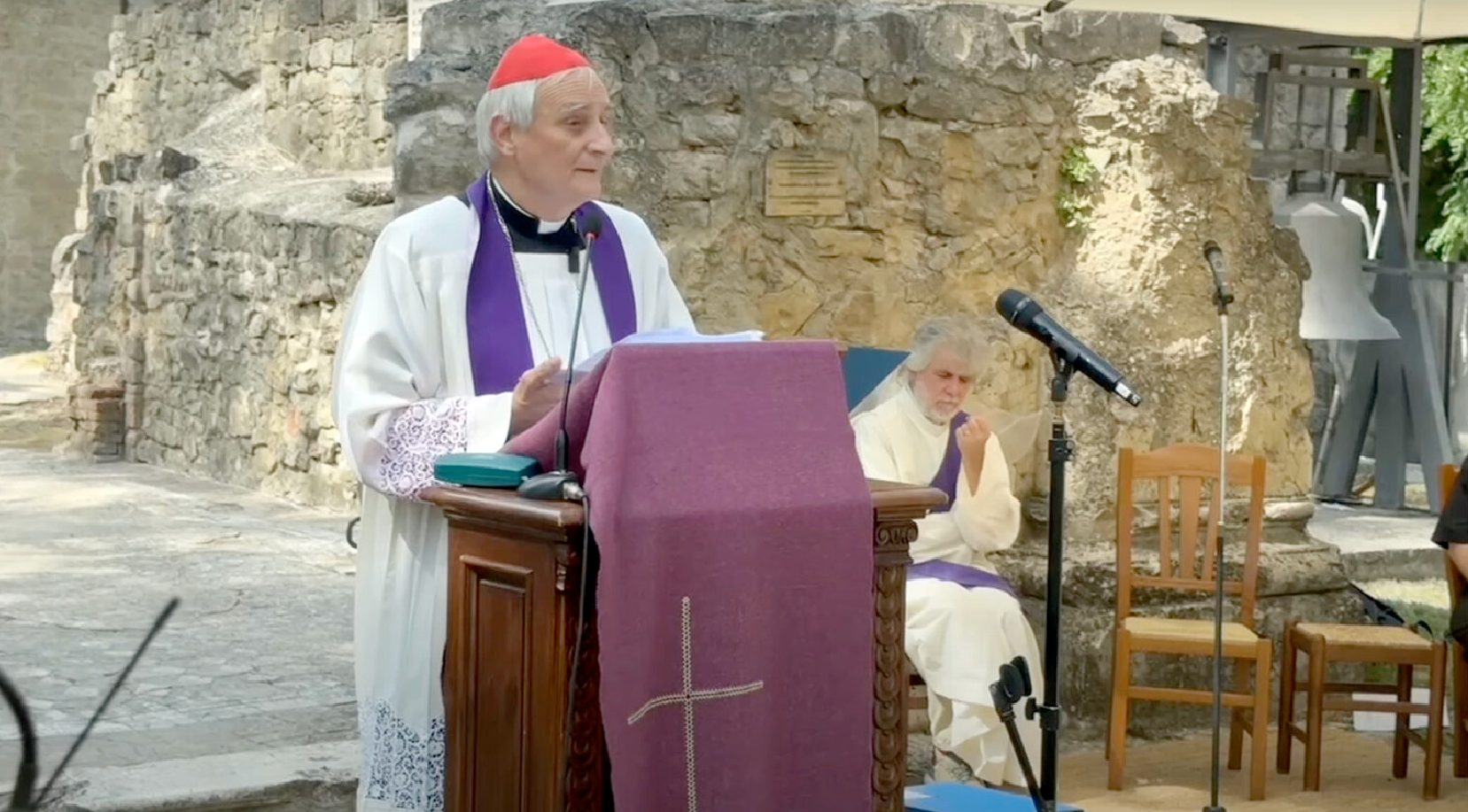
(ZENIT News / Bologna, 08.23.2025).- On the eve of the Feast of the Assumption, Cardinal Matteo Zuppi, president of the Italian Bishops’ Conference, chose to make a statement that was both liturgical and political, prayerful and prophetic. Standing among the ruins of a church once torched by the Nazis, he read aloud—name by name—the children killed in the war between Israel and Hamas.
The vigil, held at the Monte Sole memorial near Bologna, stretched into the night. A 469-page register listed 16 Israeli children killed in the Hamas assault of October 7, 2023, alongside more than 12,000 Palestinian children who perished in Gaza in the following months under Israeli bombardment and blockade. Zuppi and dozens of readers alternated voices in what became a seven-hour recitation of innocence lost.
The choice of location was no coincidence. Casaglia’s church, where Zuppi stood, was destroyed in 1944 during a Nazi massacre that claimed nearly 800 civilian lives, including over 200 children. Linking past atrocities to present suffering, Zuppi declared: “Each child’s name is a cry to God, but also to us. We cannot consign them to anonymity. Their memory must change us.”
Organizers—the monastic community of the Piccola Famiglia dell’Annunziata—designed the vigil as a sign that memory can resist indifference. For them, the site has long stood as a place where the wounds of war are not forgotten but transformed into a plea for peace.
The cardinal’s act was also deeply personal. Zuppi, often cited as one of Pope Francis’ closest allies, has been sent to Ukraine as papal envoy in delicate negotiations for prisoner exchanges and the reunification of deported children. His reputation as a bridge-builder has made him a global voice for dialogue. That credibility was visible again in Marzabotto, where the litany of names became both lament and call to conscience.
Catholic leaders worldwide have raised their voices with greater urgency as civilian deaths in Gaza mount. Women religious declared a global day of fasting and prayer earlier this month; the parish priest of Gaza, Fr. Gabriel Romanelli, warned in a recent video of daily bombardments and the constant fear among his parishioners. The Patriarch of Jerusalem, Cardinal Pierbattista Pizzaballa, reminded the faithful in Abu Gosh that “the blood of the innocent is not forgotten.” Even Pope Leo XIV, addressing journalists at Castel Gandolfo, urged that the weapons fall silent: “After so much time, what purpose does war serve? Dialogue and diplomacy are always possible.”
Beyond statistics and political debate, Zuppi’s vigil gave the war’s youngest victims something that missiles and speeches cannot erase: a name, spoken aloud, entrusted to prayer. In the silence between each recited name, a church without walls became a sanctuary of memory, echoing the hope that humanity might still learn to choose life over destruction.
Thank you for reading our content. If you would like to receive ZENIT’s daily e-mail news, you can subscribe for free through this link.