

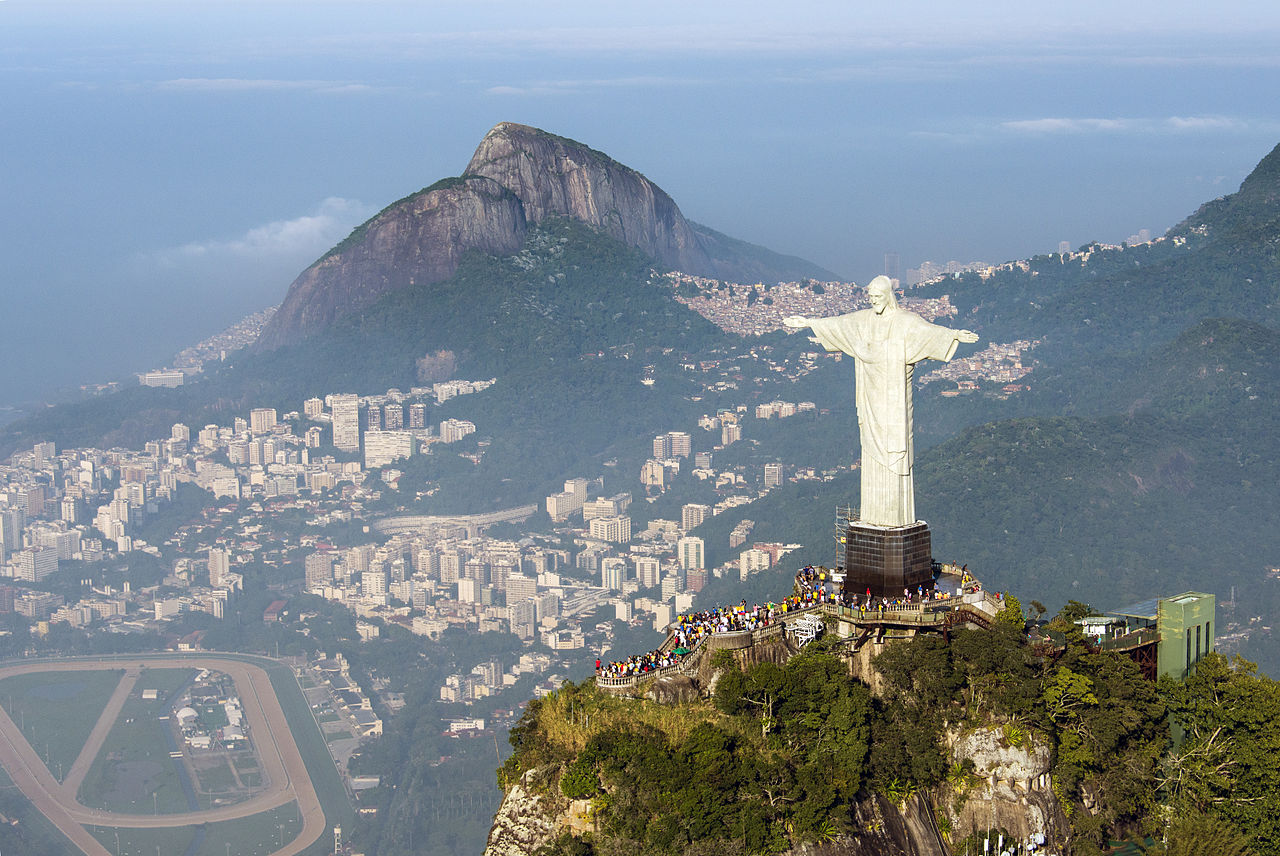
(ZENIT News / Rio de Janeiro, 08.26.2025).- From the slopes of Corcovado, Christ the Redeemer gazes over Rio de Janeiro with open arms, a figure that has long symbolized both faith and nation. For millions, it is not simply a tourist attraction but a sanctuary in the sky — a place of prayer, pilgrimage, and sacramental life where weddings, baptisms, and daily Masses continue against the backdrop of Brazil’s most famous skyline.
Yet behind the serenity of this landmark lies an ongoing dispute that pits the Church’s historical role against the demands of environmental authorities. The heart of the conflict is not the statue itself — consecrated in 1931 and entrusted ever since to the Archdiocese of Rio de Janeiro — but the land around it, a fraction of the vast Tijuca National Park.
In late June, a federal court ruled in favor of the Chico Mendes Institute for Biodiversity Conservation (ICMBio), the agency managing the park, in a case concerning commercial stalls along the stairways leading up to the monument. While the Archdiocese was not formally on trial, it has sided with the vendors, many of whom operate under long-standing agreements with the Church. The ruling sparked confusion in the press and on social media, with some questioning who truly governs the sanctuary.
The Archdiocese responded firmly in August: the monument, the plateau, and the chapel beneath remain Church property, safeguarded by the Mitra Arquidiocesana. “The Brazilian people must have certainty that Christ the Redeemer is sacred,” declared Father Omar Raposo, rector of the sanctuary, who underlined that the Church is the only legitimate authority over its use and preservation.
His reminder carries weight. The Redeemer is more than a religious symbol; it is woven into Brazil’s history. The origins stretch back to Princess Isabel, who in the late 19th century encouraged the idea of honoring not herself but the Sacred Heart of Jesus atop Corcovado. By the 1920s, donations from the faithful financed engineer Heitor da Silva Costa’s design — a 30-meter-high figure with a span of outstretched arms nearly as wide, crowned with a chapel at its base.
Since then, the monument has been under the care of the Archdiocese, which sees itself as both guardian of a sacred place and steward of a national treasure. Its role has been recognized repeatedly: in 1973 Christ the Redeemer was declared part of Brazil’s Historical and Artistic Heritage, and in 2007 it was voted one of the New Seven Wonders of the World.
Still, legal ambiguities remain. Because Tijuca National Park was only established decades after the statue’s completion, overlapping jurisdictions have led to tensions. A bill now before Brazil’s Senate seeks to resolve the matter by carving out a small area — less than 0.02 percent of the park — to be managed solely by the Archdiocese. Supporters argue that this adjustment would free the Church from bureaucratic restrictions while having no impact on biodiversity, as the disputed zone is already heavily urbanized.
Grassroots movements have rallied in favor of the measure, urging senators to guarantee that stewardship of the sanctuary stays with the Church. For Father Omar, these initiatives reflect not politics but devotion: “They show how the Brazilian people love and wish to care for Christ the Redeemer, a monument built by the Church with the offerings of the faithful, and one that welcomes all with open arms.”
Thank you for reading our content. If you would like to receive ZENIT’s daily e-mail news, you can subscribe for free through this link.

Publicaciones relacionadas:
 Catholic Church in China: The Strange Case of Bishop Ji Weizhong
 Religious sisters are “the foot soldiers of Christ” in Zimbabwe, says bishop
 Which U.S. dioceses have vocational replacement, which do not and why? Study answers
 Cardinal welcomes landmark agreement between UK Muslim and Jewish denominational leaders
