

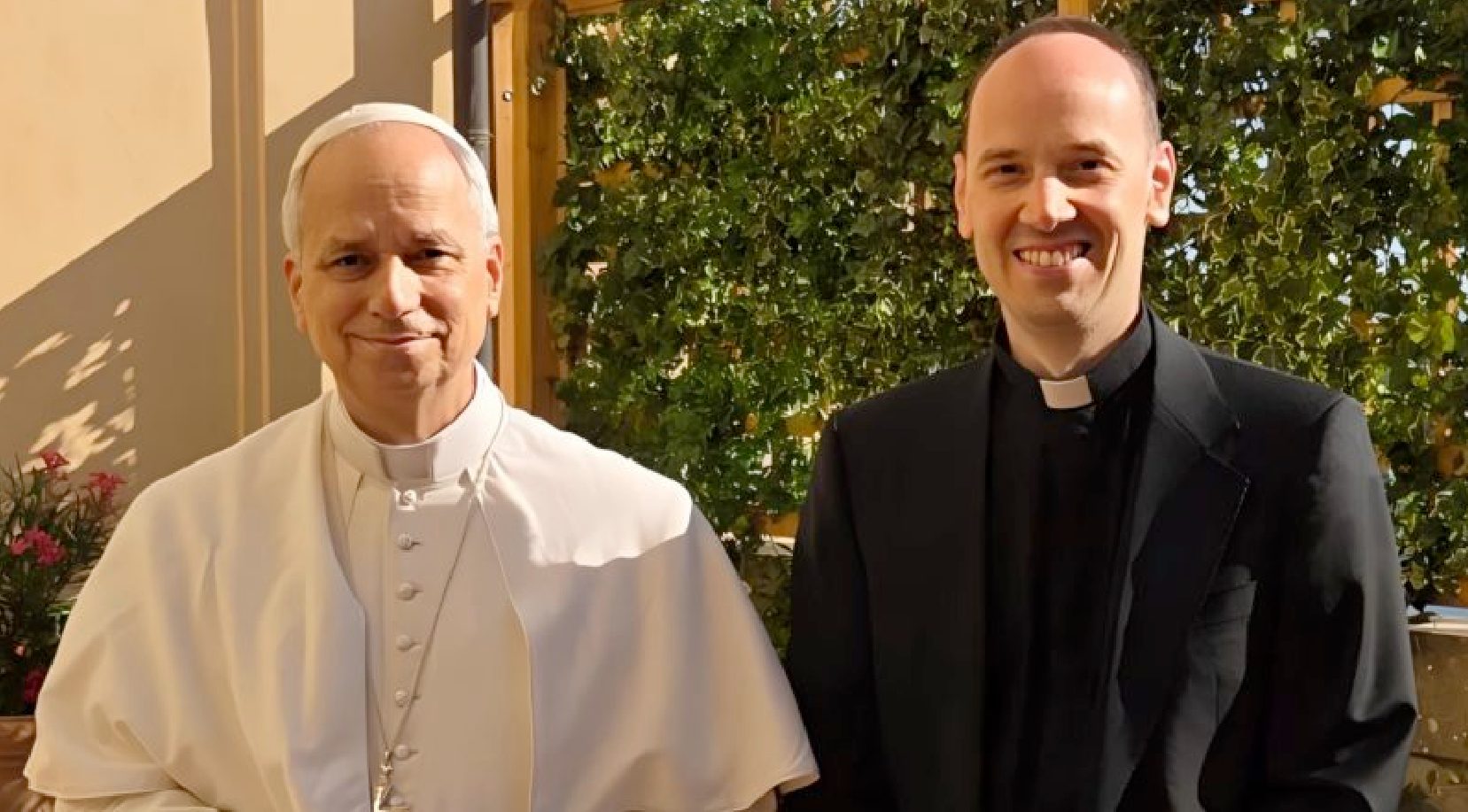
(ZENIT News / Roma, 09.30.2025).- When Pope Leo XIV quietly phoned the Bishop of San Miniato last week, it was more than a personal courtesy. It was the beginning of a decisive shift in how the new pontiff intends to govern. On the line, the Pope asked Bishop Giovanni Paccosi for permission to bring into his household one of the diocese’s most promising priests, Father Marco Billeri. Within days, the young canon lawyer and parish vicar was announced as the Pope’s second personal secretary—a role that, in practice, functions as the nerve center of papal decision-making.
Billeri, ordained in 2016, brings an unusual résumé to the Apostolic Palace. Before entering seminary, he trained as a computer engineer, and later pursued a doctorate in canon law. That combination of digital fluency and legal rigor is rare within the clerical ranks, and it has not gone unnoticed. Pope Leo has spoken repeatedly since his election of the urgent need for the Church to grapple with the social and ethical upheavals unleashed by artificial intelligence and digital culture, much as Pope Leo XIII once did with industrialization in «Rerum Novarum». For those who have followed his priorities closely, the appointment of a secretary with both technical and canonical expertise looks less like coincidence than strategy.
Bishop Paccosi admitted to mixed feelings when he received the Pope’s call. “It is a great gift for our diocese,” he told his faithful in a pastoral letter, “though not without a sense of loss. Don Marco is both a friend and an invaluable collaborator. But now he will serve at the heart of the universal Church.” The bishop’s candor captured the paradox of papal appointments: they elevate individuals while inevitably leaving gaps in the local churches they once served.
The naming of Billeri followed closely on another unexpected move: the installation of Neapolitan canon lawyer Archbishop Filippo Iannone as prefect of the Dicastery for Bishops. That office oversees the selection of every bishop worldwide, making it one of the most influential posts in the Curia. The twin announcements, delivered within twenty-four hours, signal that Pope Leo is no longer merely “settling in” after his election. Four months into his pontificate, he is beginning to draw the outlines of his own administration.
What surprised Vatican-watchers was not only the speed of these decisions but their originality. Neither Iannone nor Billeri were circulating as obvious candidates in the usual Roman rumor mill. Their emergence suggests that Pope Leo intends to bypass traditional networks of influence and place trust in figures whose profiles align with his vision rather than with entrenched expectations.
Curia insiders are now bracing for further changes. Several senior cardinals have passed the canonical retirement age of 75, including Arthur Roche at Divine Worship, Marcello Semeraro at the Causes of Saints, and Kevin Farrell at Laity, Family, and Life. Others, like Cardinal Kurt Koch at Christian Unity and Cardinal Michael Czerny at Integral Human Development, have reached moments when renewal might be expected. Even the positions of non-retiring figures, such as Secretary of State Pietro Parolin or Cardinal Víctor Fernández at the Dicastery for the Doctrine of the Faith, are being speculated about in Apostolic Palace corridors.
For now, the focus remains on the Pope’s household—his immediate circle, the small team that shapes the rhythm of daily papal life. Father Edgar Peña Rimaycuna, the Peruvian secretary who has accompanied Leo XIV from the beginning, will now be joined by Billeri, forming a duo that reflects both continuity and innovation. In Rome’s careful choreography, the choice of a secretary can reveal as much about a pontificate’s direction as the appointment of a cardinal.
Seen in that light, the arrival of a Tuscan priest with expertise in law and digital culture may prove emblematic. Pope Leo XIV, it seems, is positioning his pontificate not only to navigate the machinery of Church governance but also to confront the moral questions of a rapidly changing world.
Thank you for reading our content. If you would like to receive ZENIT’s daily e-mail news, you can subscribe for free through this link.

Publicaciones relacionadas:
 Pope Leo XIV to publish new document on Catholic education and declare Newman co-patron of Catholic education
 Mystical Phenomena and Holiness Explained by Pope Leo XIV
 Leo XIV perfects the mission of the Pontifical Academy for Life
 Pope Leo XIV continues to reshape the Roman Curia: Meet the new Australian prefect of the Dicastery for Legislative Texts
