

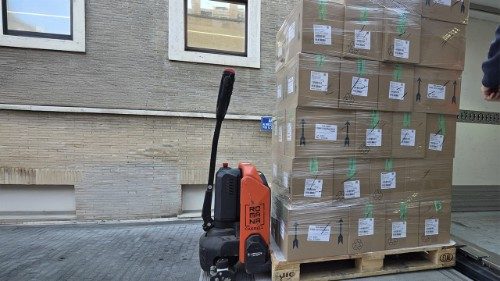
(ZENIT News / Vatican City, 10.15.2025).- Pope Leon XIV continues to practice a diplomacy of compassion — one measured not in treaties or declarations, but in medicine and bread. This week, through the Vatican’s Apostolic Almoner, the Pope sent 5,000 doses of antibiotics to children in Gaza, part of a humanitarian effort that reaches across the front lines of multiple conflicts.
For two years, Gaza’s hospitals have faced desperate shortages, its children among the most vulnerable victims of war. Now, with the fragile reopening of border crossings, aid is once again trickling in — and the Vatican has made sure that some of the first boxes to arrive bear its yellow-and-white seal. The antibiotics were distributed through the Latin Patriarchate of Jerusalem, which works directly with local clinics.
“This is not just about sending medicine,” said Cardinal Konrad Krajewski, the papal almoner and head of the Dicastery for the Service of Charity. “It is about transforming the Pope’s words in «Dilexi te» into actions. The Gospel becomes credible only when it is lived through gestures of concrete love.”
Krajewski, who often refers to his office as “the Pope’s first-aid post,” has become the visible hand of Leon XIV’s charity. His mission has taken him from earthquake zones to war-ravaged cities, personally driving aid trucks and sleeping in refugee shelters. His latest journey of mercy — coordinating medicine for Gaza — follows a long tradition of papal almsgiving that views the Church not as a distant observer but as an active participant in healing wounds.
The effort in Gaza coincides with a rare moment of respite. Following the ceasefire and the first stage of U.S. President Donald Trump’s peace plan, Israel has permitted up to 600 trucks of humanitarian aid into the enclave each day. On Sunday alone, the UN confirmed that 170 trucks entered the strip carrying food, fuel, and medical supplies. Among them were the Vatican’s parcels marked, in Italian and Arabic, “A gift from Pope Leon XIV.”
Meanwhile, another front of papal compassion remains in Eastern Europe. In Ukraine, where winter once again looms over shattered cities, the Vatican’s white vans continue to roll out from the Basilica of Saint Sophia in Rome — the spiritual home of the Ukrainian diaspora. Each vehicle carries boxes of food staples, oil, canned meat, and cleaning products, clearly labeled in two languages: “From Pope Leon XIV to the people of Kharkiv.”
For the Pope, these gestures are not mere philanthropy but an extension of prayer — a way of making mercy tangible. “The Church’s mission is not to issue statements of sympathy,” Krajewski said earlier this year, “but to arrive before the tears dry.”
Other Catholic organizations have joined in this momentum. Caritas Jerusalem, among the first to mobilize after the Gaza ceasefire, has already distributed 10,000 cans of infant formula to families who had been cut off from basic nutrition. Its medical teams, working in coordination with parish networks, have become a lifeline for newborns and young children in a region still reeling from conflict.
Observers note that Leon XIV’s humanitarian approach — rooted in proximity rather than politics — reflects a distinctive papal strategy. While global leaders negotiate frameworks of peace, the Pope’s diplomacy operates in gestures: a convoy of food, a generator for a hospital, or a box of medicine for a child.
In the words of one Vatican official, “Every antibiotic, every loaf of bread the Pope sends is a prayer turned into substance — a sign that hope, even in war, can still be delivered.”
Thank you for reading our content. If you would like to receive ZENIT’s daily e-mail news, you can subscribe for free through this link.

Publicaciones relacionadas:
 3 very interesting challenges from the Pope to politicians and rulers at a meeting at the Vatican
 Statement by then Father Prevost, now Leo XIV, against the death penalty in the U.S. comes to light
 Justice and its function: a reflection by Pope Leo XIV before judges from around the world on the occasion of the Jubilee
 Trump responds to Pope Leo XIV: I don’t want a ceasefire
