

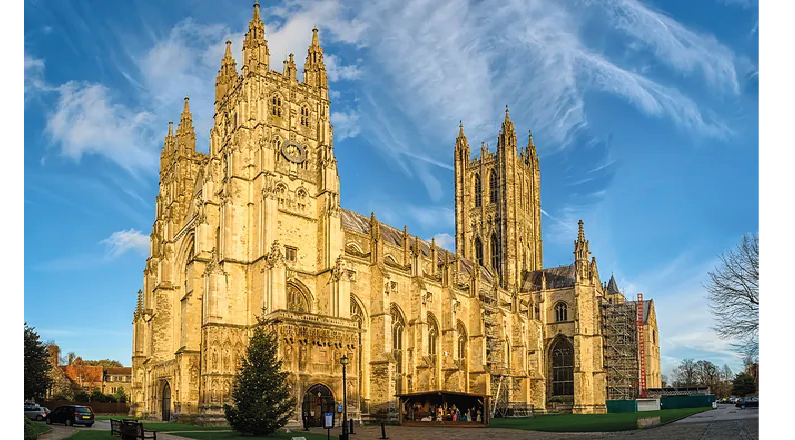
(ZENIT News / London, 10.20.2025).- The Anglican world awoke to a historic rupture as the Global Anglican Future Conference (GAFCON) formally severed ties with Canterbury and the Church of England, declaring that it could no longer “remain in communion with those who have abandoned the infallible Word of God as their final authority.”
The declaration, issued on October 16 and signed by Archbishop Laurent Mbanda of Rwanda—GAFCON’s chairman and primate of the Anglican Church of Rwanda—marks the most decisive fracture in Anglicanism since its birth in the sixteenth century. With this statement, GAFCON’s member Churches, which represent roughly 80 percent of the world’s Anglicans, have effectively redrawn the map of global Anglicanism.
At the heart of the conflict lies the Church of England’s recent election of Sarah Mullally as the first female Archbishop of Canterbury—a decision hailed in London as a historic step toward inclusion, but condemned by many Anglicans in Africa, Asia, and Latin America as a capitulation to secular cultural pressures.
“This choice abandons global Anglicans,” Mbanda said earlier this month, “by appointing a leader who will further divide an already divided communion.”
Now, GAFCON has made good on that warning. Its communiqué not only rejects the Archbishop of Canterbury as an “instrument of communion” but also renounces participation in all global Anglican structures traditionally linked to that office—the Lambeth Conference, the Anglican Consultative Council, and the Primates’ Meeting. “These bodies,” the statement says, “have ceased to uphold the doctrine and discipline of our faith.”
In their place, GAFCON announces a bold reordering of Anglican identity: “We are now the Global Anglican Communion.”
Founded in 2008 in Jerusalem as a movement of “confessing Anglicans,” GAFCON emerged in response to what its members saw as the moral and theological drift of the Church of England and the Episcopal Church in the United States, particularly regarding sexuality, gender, and biblical authority. From its inception, the movement’s rallying cry was repentance—a call for Anglican leaders who had embraced revisionist theology to return to the authority of Scripture. That call, GAFCON says, has gone unheeded for nearly two decades.
The group’s manifesto, titled The Future Has Arrived, reaffirms that the only authentic foundation of communion is “the Holy Scripture—translated, read, preached, taught, and obeyed in its plain and canonical sense, faithful to the historic and consensual reading of the Church.”
In practice, this means that GAFCON will now act as the de facto global center of Anglican orthodoxy. It plans to form a new Primates’ Council and elect a presiding leader who will serve as primus inter pares—first among equals—within this reconstituted communion. The first organizational meeting is set for March 2026 in Abuja, Nigeria.
GAFCON’s global reach is staggering. Its member provinces stretch across Africa—from Nigeria, Kenya, and Uganda to Sudan, Rwanda, and the Democratic Republic of Congo—and include growing Churches in Asia, Latin America, and the Pacific. Together, they represent nearly 49 million Anglicans. In the West, it has also inspired a constellation of breakaway congregations and networks, especially in the United States, Europe, and Australia, made up of Anglicans who rejected progressive policies on marriage, sexuality, and ordination.
The rift is not merely theological but ecclesiological. GAFCON insists it is not abandoning Anglicanism but reclaiming it, restoring what it calls the “original structure” of the communion: a fellowship of autonomous provinces bound not by institutional bureaucracy but by the Reformation formularies—the Thirty-Nine Articles, the Book of Common Prayer, and the Ordinal. In this vision, Canterbury is no longer the spiritual axis of Anglican unity, but simply one province among many.
For the Church of England, the break is both a symbolic and practical blow. The Archbishop of Canterbury, historically recognized as primus inter pares among Anglican primates, has served as a moral and spiritual point of reference. With GAFCON’s withdrawal, that moral center shifts southward—to Lagos, Kampala, Kigali, and Nairobi, where Anglicanism remains vibrant and growing.
The implications extend beyond Anglican boundaries. The decision underscores a broader realignment within global Christianity, in which demographic growth and theological authority are migrating toward the Global South. For many observers, the move echoes tensions long visible in other Christian traditions—the struggle to balance cultural adaptation with doctrinal fidelity.
Meanwhile, the Vatican will be watching closely. In 2009, Pope Benedict XVI created the Personal Ordinariates, special jurisdictions for Anglicans seeking full communion with the Catholic Church while retaining their liturgical heritage. Yet these ordinariates have remained small—barely 5,000 members across three regions. GAFCON’s declaration confirms that most conservative Anglicans prefer to reform Anglicanism from within rather than cross the Tiber.
Whether GAFCON’s claim to represent “the true Anglican Communion” will be recognized by others remains uncertain. But its leaders are confident that history—and Scripture—are on their side. “The restoration of our beloved communion is now in our hands,” Mbanda declared. “We exist, we resist, and we are ready to lead.”
Thank you for reading our content. If you would like to receive ZENIT’s daily e-mail news, you can subscribe for free through this link.

