

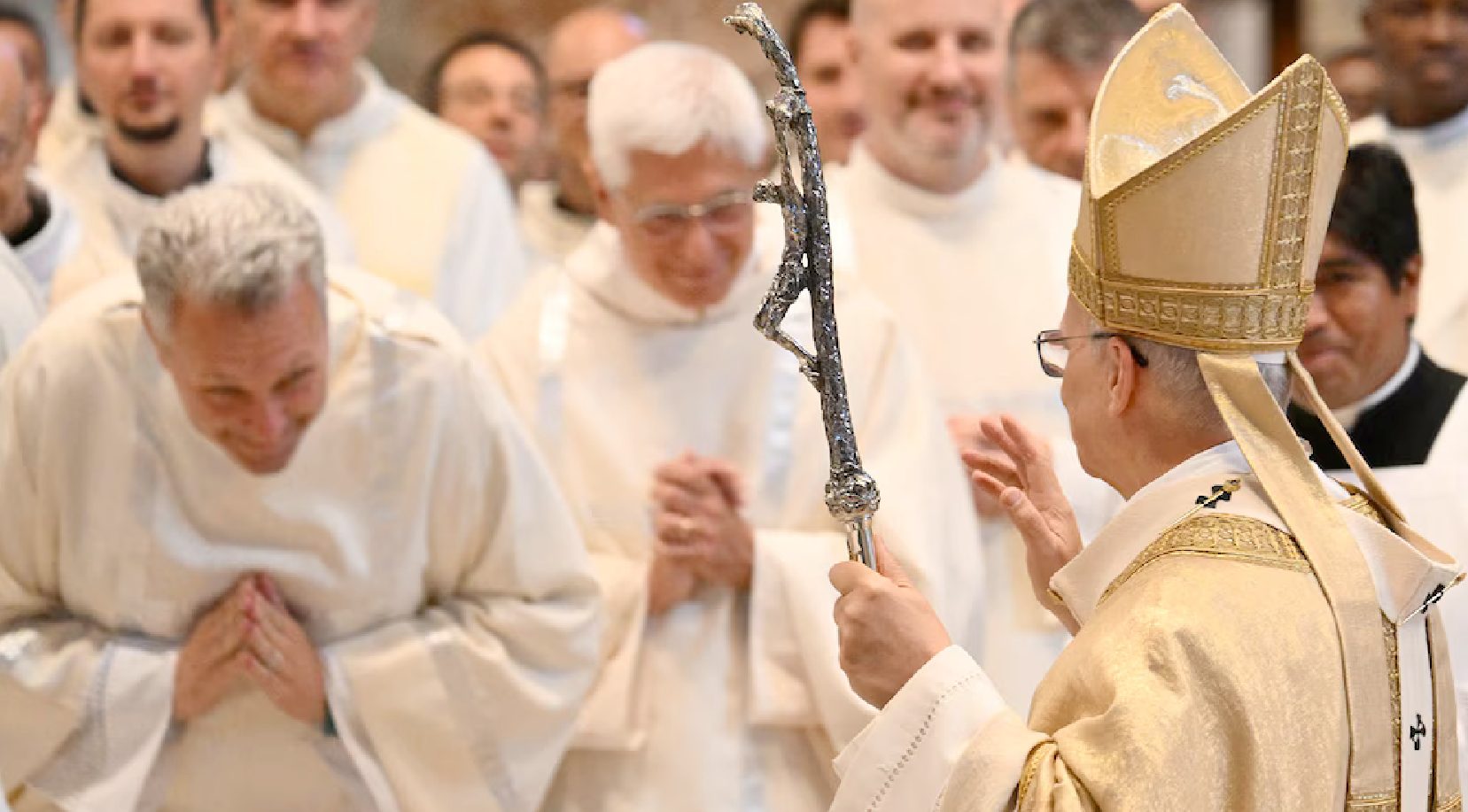
(ZENIT News / Washington, 10.20.2025).- When the Catholic University of America’s National Study of Catholic Priests 2025 was released this October, one contrast drew immediate attention inside and outside ecclesial circles: priests’ overwhelming trust in Pope Leo XIV versus their far more hesitant confidence in their own bishops. Just beneath that surface tension, the report also revealed another, perhaps deeper fault line shaping the future of American Catholicism—the growing ideological divide between younger, more conservative clergy and their older, more progressive peers.
The survey, conducted by Gallup for the Catholic Project, revisited more than 1,100 priests first interviewed in 2022. Their responses paint a complex picture of a presbyterate both energized and uneasy: buoyed by a sense of personal well-being and by a pontiff who inspires unusual consensus, yet still wrestling with isolation, disillusionment with episcopal leadership, and generational shifts in theology and pastoral priorities.
If the American priesthood can be read as a barometer of Catholic life in the United States, the reading in 2025 is clear: confidence in Rome is strong; confidence in the local hierarchy, weak; and the new generation of priests is reshaping what fidelity looks like.
Nearly 86 percent of priests expressed either “a great deal” or “quite a lot” of confidence in Pope Leo XIV—the first American-born pope and, to many, a symbol of pastoral vigor and doctrinal steadiness. Only one percent reported having “very little” trust in him. The numbers are striking not only for their breadth but also for their contrast: barely half of diocesan priests said they trusted their own bishop, and barely a quarter expressed confidence in the U.S. episcopate as a whole.
In 2001, the latter figure had stood at 39 percent. Today it has fallen to 27.
The erosion of trust in bishops has many causes—decades of abuse scandals, administrative distance, and what many priests describe as a growing sense of managerial oversight replacing fatherly care. Still, three out of four priests said they believe their bishop “cares about them,” and more than 80 percent said they can reach him when needed. The gap, it seems, is not one of access but of confidence.
The contrast with the papacy is almost paradoxical. Pope Leo, who has sought to balance moral clarity with diplomatic caution, commands broad support from priests across theological lines. Most also predicted that relations between the U.S. Church and the Vatican will improve under his pontificate, signaling a recovery of unity after years of strain during previous administrations.
But the deeper transformation of the American clergy may not be administrative at all—it is generational.
Among priests ordained before 1975, more than 70 percent describe themselves as theologically progressive; among those ordained since 2010, barely 8 percent do. Nearly three quarters of younger priests self-identify as “conservative” or “orthodox.” The difference is not only ideological but pastoral: older priests tend to prioritize social and ecological issues, while younger ones emphasize Eucharistic devotion, family formation, and evangelization.
When asked whether access to the Traditional Latin Mass should be a pastoral priority, 40 percent of priests ordained after 2000 agreed, compared to only 11 percent of those ordained before 1980. Conversely, 77 percent of the oldest cohort saw the synodal process as a major priority, while only 37 percent of the youngest said the same.
This inversion of sensibilities—liberal elders and traditionalist youth—defies easy political framing. It suggests a renewal of conviction more than nostalgia, a generation that views orthodoxy not as resistance but as reform.
Paradoxically, it is among these younger conservatives that the sense of isolation runs deepest. Forty-five percent of priests ordained after 2000 reported feeling lonely, compared with 27 percent of those ordained before 1980. Many of the youngest clergy now manage multiple parishes amid shrinking numbers of priests, a reality that fosters exhaustion even as they express higher rates of “flourishing” than the general population.
The survey found an overall personal well-being score of 8.2 out of 10—a strong figure that has remained stable since 2022. Most priests report good mental and physical health, meaningful relationships, and a sense of purpose. Burnout, while still present, has modestly declined: 44 percent of diocesan priests experience some level of exhaustion, but only 7 percent describe it as high. Among religious priests, the rates are even lower.
Beneath these numbers, however, lies a quiet anxiety about identity and mission. Nearly half of the younger clergy say they are being asked to perform duties “beyond their priestly vocation”—administrative tasks, fundraising, compliance work—that leave less time for the pastoral and sacramental heart of their calling.
That tension—between faith and function, trust and distance—defines much of the American priesthood today. Priests express hope in a pope they see as steadying the Church, frustration with bishops they perceive as disconnected, and determination to reclaim a spiritual center they fear has been diluted by bureaucracy.
What emerges is not a Church in crisis but one in transition: its leadership questioned, its young priests more doctrinally firm than their mentors, its morale sustained by personal faith more than institutional cohesion.
For now, the figures suggest that the future of the American clergy may depend less on structural reform than on trust—trust that can bridge generations, reconcile conviction with compassion, and link the authority of bishops once more to the confidence of their priests.
Thank you for reading our content. If you would like to receive ZENIT’s daily e-mail news, you can subscribe for free through this link.

Publicaciones relacionadas:
 Germany: research reveals that young clergy are conservative and opposed to ecclesiastical progressivism
 New Survey Reveals Growing Belief Among American Catholics in the Real Presence of Jesus in the Eucharist
 Report shows that young Americans attend religious services more than their parents
 The Vanishing Line Between Sin and Choice: How America’s Moral Compass Is Being Rewritten
