

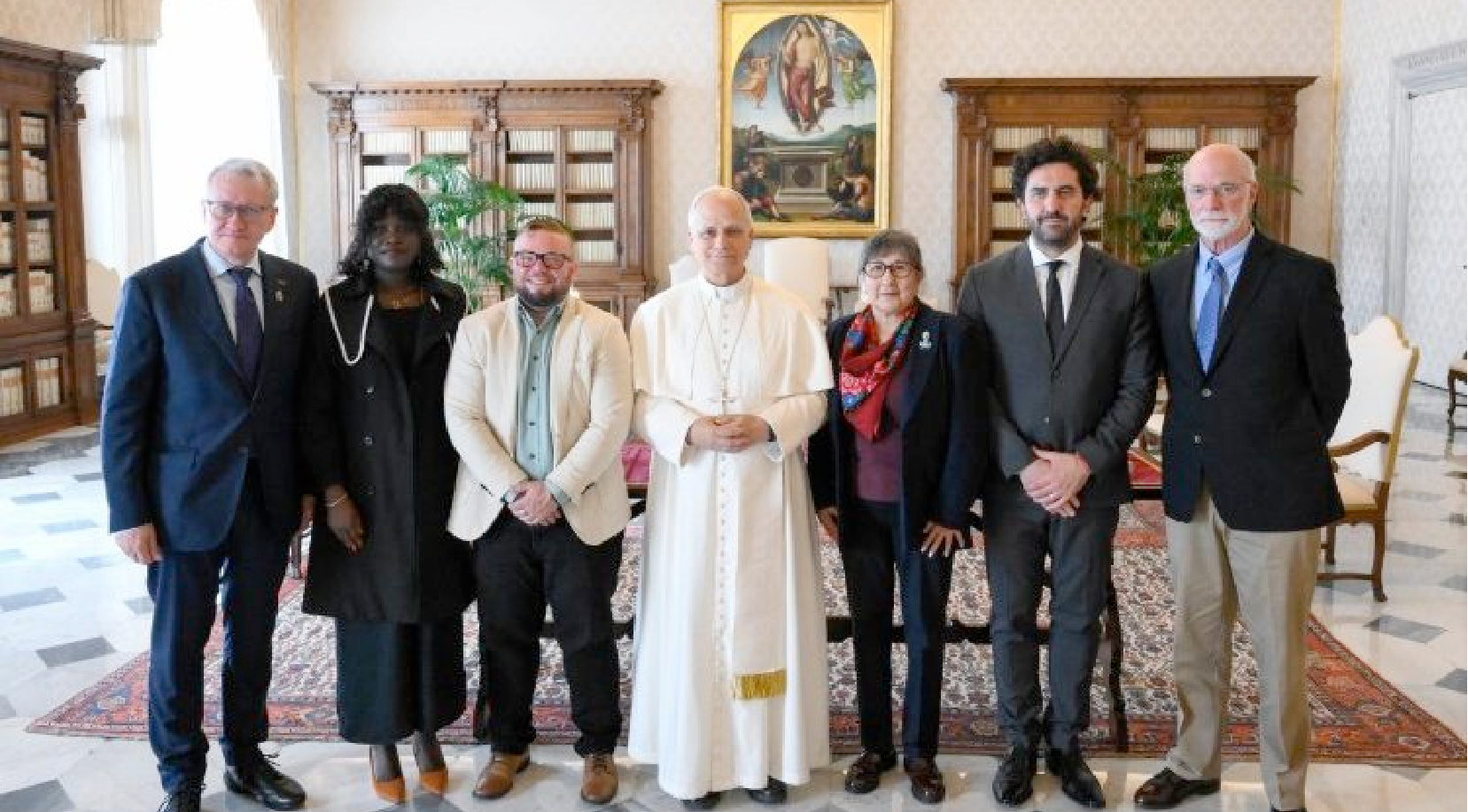
(ZENIT News / Ciudad del Vaticano, 10.21.2025).- For years, the voices of those abused within the Catholic Church have echoed across continents—heard, yet rarely heeded. On October 20, 2025, that sound entered the Apostolic Palace in Rome, where Pope Leo XIV met with six members of ECA Global, an international network of survivors and advocates for victims of clerical sexual abuse. For many, the moment felt less like a formal audience and more like the fragile beginning of something long overdue: a conversation grounded in dignity, empathy, and accountability.
ECA Global, which brings together activists from over 30 countries, has become one of the most visible survivor-led movements demanding reform from the Catholic Church. Founded in 2018, it seeks to ensure that the Church fulfills the United Nations’ 2014 call for a global policy of “zero tolerance” toward sexual abuse. This week’s audience, the first of its kind with Pope Leo XIV, was described by participants as “historic” and “filled with hope for genuine cooperation.”
Among those seated before the Pope were Gemma Hickey and Evelyn Korkmaz from Canada, Timothy Law from the United States, Matthias Katsch from Germany, Janet Aguti from Uganda, and Sergio Salinas from Argentina—six individuals from five continents, united by trauma but determined to transform it into justice.
“The Pope was open and warm,” said Hickey, herself a survivor of abuse in Newfoundland. “Each of us shared personal reflections, and he listened attentively. He has a sense of humor, and a humility that made the room feel human.” The group began the meeting by reading a joint statement calling for “open minds” and presented their Zero Tolerance Initiative, which advocates consistent global standards and survivor-centered policies.
Pope Leo XIV responded by suggesting a formal dialogue between ECA and the Pontifical Commission for the Protection of Minors, whose annual report had been released just days earlier. “It was a deeply meaningful exchange,” Hickey said. “For the first time in a long time, survivors felt they had a place at the table.”
The meeting lasted about an hour—enough time, according to participants, to share stories, proposals, and an unmistakable sense of moral urgency. “We came not only to express our pain,” said Janet Aguti, “but to explore how we can work together to ensure the protection of children and vulnerable adults worldwide.”
From the start, the tone of the conversation was markedly different from the confrontational encounters of the past. As co-founder Tim Law explained, “Our goal is not conflict, but collaboration. True accountability and transparency can only emerge when both sides are willing to face the truth together.”
For survivors like Evelyn Korkmaz, a member of Canada’s First Nations and a survivor of a residential school, the audience carried generational weight. “I carry the intergenerational trauma caused by institutions that were supposed to protect us,” she said. “Today’s meeting is one more step toward truth and reconciliation.”
The German participant, Matthias Katsch, who has long been one of Europe’s leading voices for reform, emphasized that the group asked the Pope for “hope”—not as sentiment, but as structure: “hope in the form of justice, fair compensation, and stronger guarantees for the protection of children and adults.” He added that “it’s not enough for survivors to speak; society must be willing to listen.”
According to Vatican observers, the encounter was prompted by a letter ECA sent shortly after Leo XIV’s election. In it, the group described itself as “bridge builders, willing to walk together toward truth, justice, and healing.” The Pope’s reply was swift and affirmative—a gesture that many see as a hallmark of his early papacy: dialogue as the most radical act of leadership.
Inside the room, that spirit was palpable. “There was no anger,” Hickey reflected afterward, “only the hope of accountability and lasting change. We believe in the inherent dignity of every child and every vulnerable adult, and in the Church’s moral duty to lead with transparency and compassion.”
At a press conference later that day, Francesco Zanardi, another member of ECA and head of Italy’s Rete L’Abuso association, announced the forthcoming release of a detailed report on clerical abuse in Italy—evidence, he said, of how “truth continues to emerge, one testimony at a time.”
The meeting closed with a shared commitment to ongoing dialogue. “The safety, dignity, and voices of survivors must not just be protected,” the group’s statement read, “they must become the model for all.”
Thank you for reading our content. If you would like to receive ZENIT’s daily e-mail news, you can subscribe for free through this link.

Publicaciones relacionadas:
 PHOTO GALLERY: Pope Leo XIV revives childhood tradition: mass blessing of “baby Jesus” figures at the Vatican
 Pope Leo XIV brings spiritual exercises back to the Apostolic Palace: they will be preached by a Norwegian monk (and bishop)
 Peruvian government announces Pope’s trip; Vatican officially announces he will not visit the United States
 For the first time, a Pope will address the Spanish Parliament: it will be Leo XIV during his visit to Madrid in June 2026
