

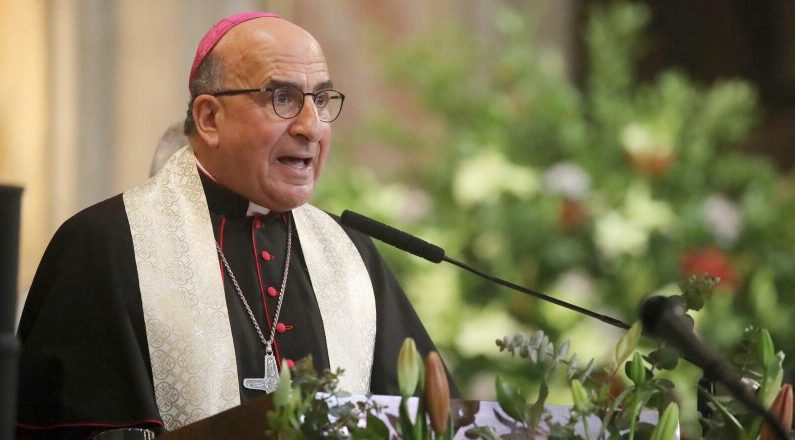
(ZENIT News / Roma, 10.22.2025).- In a time when every silence in Gaza trembles with the threat of renewed violence, one voice from the far side of the world has asked to be heard—a voice that carries both the anguish and the hope of the Holy Land. Cardinal Fernando Chomali, the archbishop of Santiago de Chile and the only cardinal of Palestinian descent in the College of Cardinals, has offered himself as a mediator for peace in the Middle East, with the blessing of Pope Leo XIV.
Chomali, 68, met with the Pope on October 20, 2025, to formally express, among other things, his desire to play an active role in fostering dialogue between Israel and Palestine. It was more than a diplomatic proposal; it was a personal plea. “I told him that I wanted to take part in creating bonds of peace, of dialogue,” the cardinal said after the meeting. “I asked him to count on me—and on the entire Palestinian community that longs for peace and the end of this war.”
The cardinal’s Palestinian roots run deep. All four of his grandparents were migrants, part of the early 20th-century wave of Christians who left the turmoil of the Middle East for Latin America. Though born and raised in Chile, Chomali has never ceased to see himself as a son of the Holy Land. “The immense majority of the people who live there want peace, they want to live in peace, in an atmosphere of fraternity,” he told Spanish reporters following his audience with the Pope.
Chomali’s appeal comes amid a delicate truce in Gaza that many fear could unravel at any moment. For him, peace cannot be reduced to the absence of fighting—it must also mean justice, stability, and mutual recognition. “It is not only about ending the war, which must end now,” he said, “but about building nations capable of developing within secure borders.” The statement echoes the long-standing diplomatic stance of the Holy See, which has consistently advocated for a two-state solution and the international status of Jerusalem.
Those who know Chomali describe him as a man of pastoral energy and quiet determination. In the days leading up to his participation in his first conclave earlier this year, it was not unusual to see him jogging through the streets of Rome before dawn—a small image of discipline and simplicity that belies the weight of his responsibilities. His voice, shaped by both faith and a deep sense of heritage, now enters one of the most intractable conflicts of the modern era.
Chile, too, carries a stake in Chomali’s mission. It is home to one of the largest Palestinian diasporas outside the Arab world, a community that watches events in the Middle East with a mixture of sorrow and solidarity. “Hundreds of thousands of descendants of Palestinians in Chile have their eyes fixed on this situation,” Chomali noted, “and it causes great pain.”
While the Vatican has not yet announced any formal peace initiative under Chomali’s leadership, his willingness to serve has drawn attention across diplomatic and ecclesial circles. In a region where trust is scarce, a figure rooted in both the universal Church and the Palestinian experience may offer a rare moral bridge.
The Chilean prelate’s proposal aligns closely with the Vatican’s quiet yet persistent diplomacy—one that prefers listening to lecturing, encounter to confrontation. If Pope Leo XIV’s recent pontificate continues in the pragmatic, bridge-building spirit of Francis, Chomali could find himself at the center of an emerging Vatican role in Middle Eastern peacemaking.
For now, his offer stands as a gesture of faith against despair. “My heart breaks when I see what happens in Gaza,” he said simply. “But faith moves us not to resign ourselves. Peace is always possible—when someone dares to believe it is.”
Thank you for reading our content. If you would like to receive ZENIT’s daily e-mail news, you can subscribe for free through this link.

Publicaciones relacionadas:
 Catholic Patriarch Emeritus of Jerusalem demonstrates that Israel’s security cannot be achieved through violence
 “We return from Gaza with broken hearts”: Cardinal Pizzaballa at press conference in Jerusalem
 Statement by the bishops of the Holy Land on “Christian Zionism”
 Jerusalem: Holy Week Behind Closed Doors. A Statement from the Catholic Patriarch
