

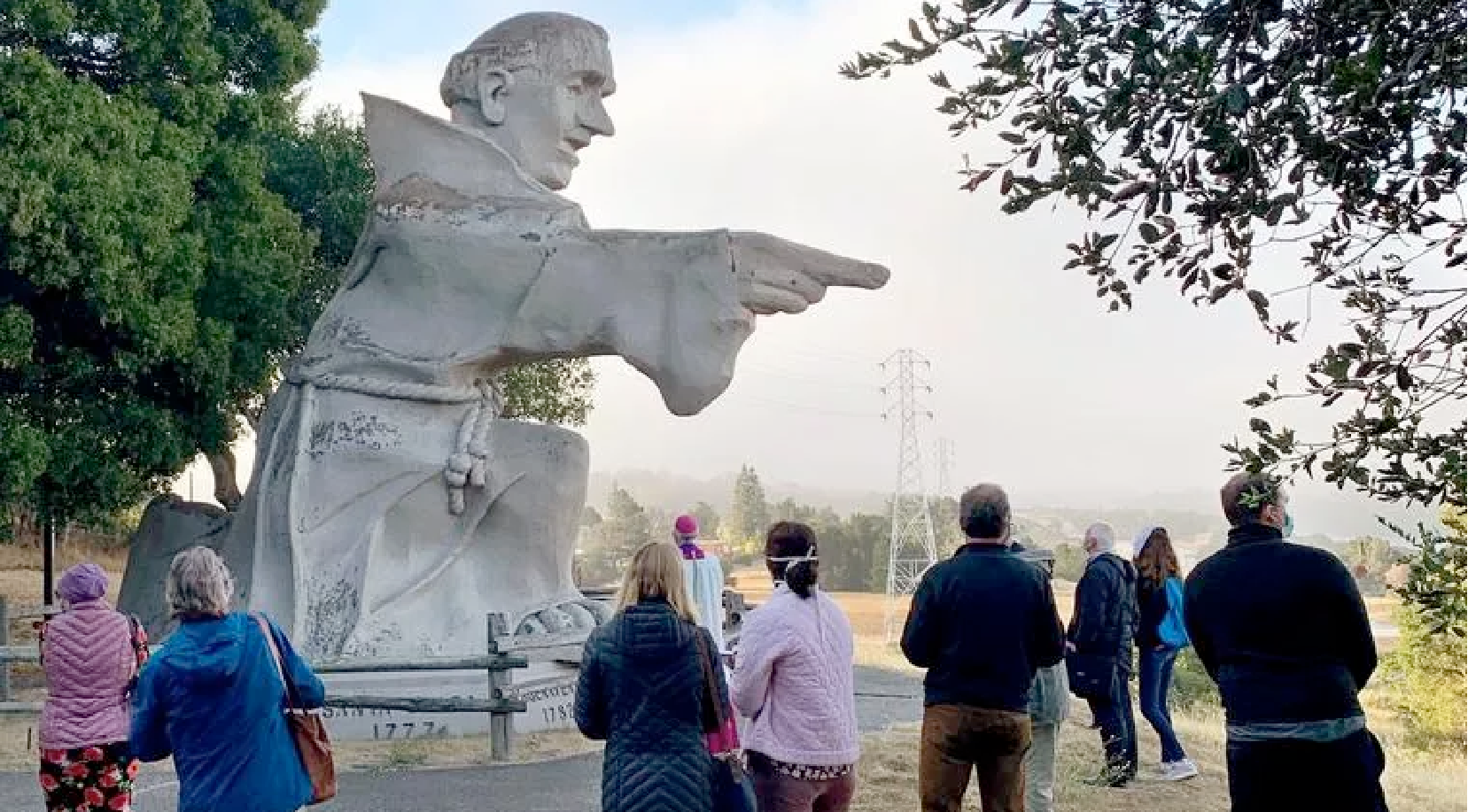
(ZENIT News / San Francisco, 11.04.2025).- In California’s long and restless dialogue between faith, history, and identity, the latest fault line has opened around a demolished bronze figure — the 22-foot statue of St. Junípero Serra that once stood beside Interstate 280. Its removal this summer, justified by the state’s transportation department as a technical necessity, has become something far greater: a test of trust between church and state, and a reflection of the modern unease with a past that refuses to stay buried.
Archbishop Salvatore Cordileone of San Francisco, whose archdiocese encompasses many of the missions Serra founded in the 18th century, says he was blindsided by the decision. In an interview with the Register, Cordileone dismissed as “untrue” the state’s claim that it had notified him before the statue was removed. “They said they consulted religious organizations, but they did not consult us. We were completely excluded,” he said. “Once again, California institutions treat the Church as a problem rather than a partner. They lie, they discriminate, and they deny us a voice.”
The California Department of Transportation (Caltrans) insists it reached out to fifteen organizations before the demolition. But the archdiocese says no call, no letter, no meeting ever took place. Repeated requests for documentation have gone unanswered. A leaked email obtained by the Register confirmed what many suspected: the Serra statue, which had stood for nearly half a century, was not relocated but destroyed outright, deemed too structurally complex to move intact.
The image of Serra — the Franciscan friar who walked thousands of miles to found missions across Spanish California — has long been a flashpoint in the state’s cultural landscape. Canonized by Pope Francis in 2015, Serra is revered by many Catholics as a tireless evangelizer who defended Indigenous communities against the abuses of colonial rule. Yet for others, he remains a symbol of oppression, representing a system that crushed Indigenous autonomy and culture under the guise of salvation.
That division, more than two centuries after Serra’s death, continues to cut through California’s conscience. Statues of the missionary have been toppled, defaced, or removed in recent years, often amid broader debates about racial justice and historical memory. To Archbishop Cordileone, the destruction of the Interstate 280 statue marks another instance of state-sanctioned intolerance. “Why erase a man who protected the very people he’s accused of harming?” he asked. “If we can no longer recognize the difference between a flawed hero and an oppressor, we lose the capacity for historical truth.”
The story of the statue itself reflects California’s shifting relationship with its past. Built by Louis DuBois, a Catholic contractor who admired Serra’s life, it was completed in 1976, during the nation’s bicentennial. Serra’s figure, cast in dramatic proportions and pointing west toward the Pacific missions, stood for nearly fifty years as a roadside symbol of California’s spiritual origins. Around its base were engraved the names of Serra’s nine missions — places that would become Los Angeles, San Diego, San Francisco, and other modern cities.
But history’s reverence faded. By the 1990s, Indigenous leaders like Gregg Castro of the Ramaytush Ohlone began questioning why public land should honor a man tied to colonial systems. “Our ancestors lost their lives, their language, their culture,” Castro told the Register. His organization petitioned Caltrans to remove the monument, arguing that it violated the constitutional separation of church and state. No public hearing was held, but the agency quietly advanced the plan. “They kept me informed,” Castro said, “but they didn’t want another public debate.”
The controversy over Serra’s legacy is hardly new. In 2021, the California legislature voted to replace a statue of the saint in the state Capitol with one commemorating local Indigenous peoples. At the time, Archbishops Cordileone and José Gómez of Los Angeles published a joint essay in The Wall Street Journal defending Serra as “a man who denounced abuse and upheld the dignity of Indigenous women and men.” They cited his 2,000-mile journey to Mexico City to plead for Indigenous rights as evidence of his compassion.
Historians remain divided. Robert Senkiewicz, who co-authored the definitive 2015 biography Junípero Serra: California, Indians, and the Transformation of a Missionary, sees both heroism and hubris in Serra’s legacy. “He sincerely believed he was saving souls,” Senkiewicz said. “But he also believed salvation required civilization — European civilization. He tried to shield Indigenous people from the worst abuses of the colonial system, yet he operated squarely within it.”
For Andrew Galvan, a 70-year-old Ohlone Catholic and curator at Mission Dolores, the truth lies somewhere in between. His ancestors suffered under the mission system, yet his faith traces back to Serra’s evangelization. “He was a good man in a bad situation,” Galvan said. “I’ve spent forty years studying him, helping bring his cause to canonization. People can criticize the system — I understand that. But they can’t take away his sanctity.”
As California continues to reevaluate its monuments, the fate of Serra’s legacy remains uncertain. For the archbishop of San Francisco, the issue is no longer just about a statue, but about integrity — both civic and spiritual. “This is not merely an argument about history,” Cordileone said. “It’s about whether truth still matters in public life, or whether we’ve surrendered it to ideology.”
Thank you for reading our content. If you would like to receive ZENIT’s daily e-mail news, you can subscribe for free through this link.

Publicaciones relacionadas:
 India: Hindu persecution against Christians increases and reaches 800 cases. They also seek to apply a new anti-Christian law
 “They Took Our Children”: Christian Parents Bring Sweden Before European Court of Human Rights After Almost 3 Years’ Separation from Daughters
 Between Drones, Settlers and Classrooms: How Violence and Administrative Israeli Pressure Are Reshaping Palestinian Life
 The last historic Christian village in the Holy Land, threatened with annexation by the Jewish state of Israel
