

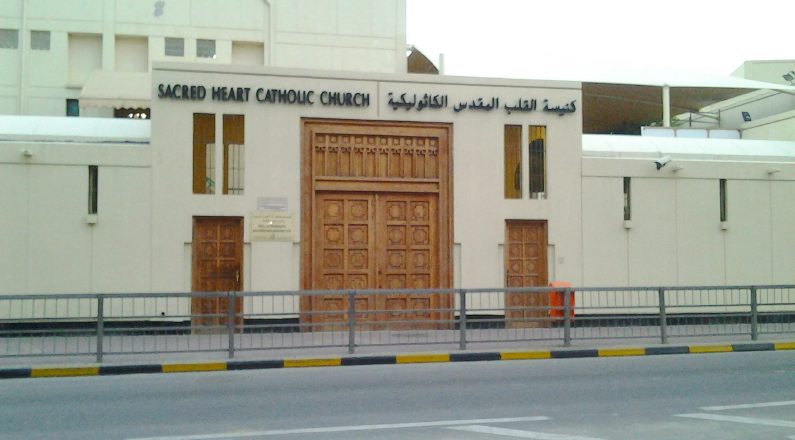
(ZENIT News / Bahrain, 11.05.2025).- In a landmark moment for the Catholic community of the Arabian Peninsula, the Sacred Heart Church in Manama, Bahrain — the oldest church in the Gulf region outside Yemen — has been formally elevated to the status of diocesan sanctuary. The decision, decreed on November 1, 2025, will take effect on November 8 during a solemn celebration led by Bishop Aldo Berardi, Apostolic Vicar of Northern Arabia.
For the faithful of Bahrain, the announcement is more than an ecclesial decree; it is the recognition of a spiritual home that has served generations of migrant Catholics from across Asia, Africa, and the Middle East. Consecrated in 1940, the Sacred Heart Church is affectionately known as the “mother church” of the Gulf — a modest but deeply symbolic space where faith, resilience, and community have flourished under the desert sun.
The elevation to sanctuary comes as the church marks its 85th jubilee year, giving new resonance to its long history of devotion. The Vicariate announced that pilgrims who participate in the votive Mass of the Sacred Heart on Thursdays or Fridays may obtain a partial indulgence, provided they fulfill the usual conditions of confession, communion, and prayer for the Pope’s intentions. Lay associations dedicated to the Sacred Heart will also be established to sustain and spread the devotion through prayer gatherings, novenas, and formation initiatives, while preserving the site’s historical and spiritual heritage.
As part of the new decree, Bishop Berardi will appoint a rector to oversee the pastoral and administrative life of the sanctuary. The rector’s mission will extend beyond liturgical care — to maintain the church’s physical integrity, to protect its archives and artifacts, and to keep alive the story of how a once small mission station became the beating heart of Catholic life in the Gulf.
Speaking to Vatican media, Bishop Berardi described the designation as “a historic moment for the Church in the Arabian Peninsula.” He expressed his gratitude to the Kingdom of Bahrain, its people, and King Hamad bin Isa Al Khalifa, noting that the occasion takes place “in a context of dialogue, peace, and friendship.” For Berardi, the sanctuary stands as a “milestone” not only for local Catholics but also as a sign of coexistence in a region where diverse faiths meet.
“Thanks to the progress made during the pontificate of Pope Francis,” he said, recalling the Pope’s groundbreaking visit to Bahrain in 2022, “we live in an environment of tolerance and fraternity that reminds us we are not strangers, but brothers and sisters sharing one humanity.” The bishop drew a striking historical parallel, evoking the meeting between Saint Francis of Assisi and Sultan al-Malik al-Kamil eight centuries ago as an early seed of Christian-Muslim dialogue. “True peace,” he added, “is not built by separation, but by understanding.”
For many Catholics across the Gulf, the Manama church has long been a spiritual refuge — a place where Indian, Filipino, Lebanese, Sri Lankan, African, and Western expatriates find common ground in prayer. The new sanctuary status acknowledges that reality, granting it a special role in the pastoral life of the Northern Arabian Vicariate, which spans Bahrain, Kuwait, Qatar, and Saudi Arabia.
When the Sacred Heart Church was first built, on Christmas Eve of 1939, it stood as a quiet sign of faith in a land where public expressions of Christianity were rare. Its bells first rang an hour before midnight Mass that same night, echoing across the still air of Manama. A few months later, on March 3, 1940, the church was consecrated — not just in brick and mortar, but in the faith of a small, diverse community who had come seeking work, stability, and hope.
Today, 85 years later, those same bells will ring again, this time not only to call the faithful to prayer, but to mark a new chapter.
Thank you for reading our content. If you would like to receive ZENIT’s daily e-mail news, you can subscribe for free through this link.

Publicaciones relacionadas:
 Sydney: photos of the impressive Corpus Christi procession, the largest since the pandemic
 This is the largest statue of the Virgin Mary in the world, which is in Argentina
 This is the 197-inch sculpture dedicated to Pope Leo XIV in his former Peruvian diocese
 Mass Attendance Boom: The Case of the US Diocese of Bridgeport
