

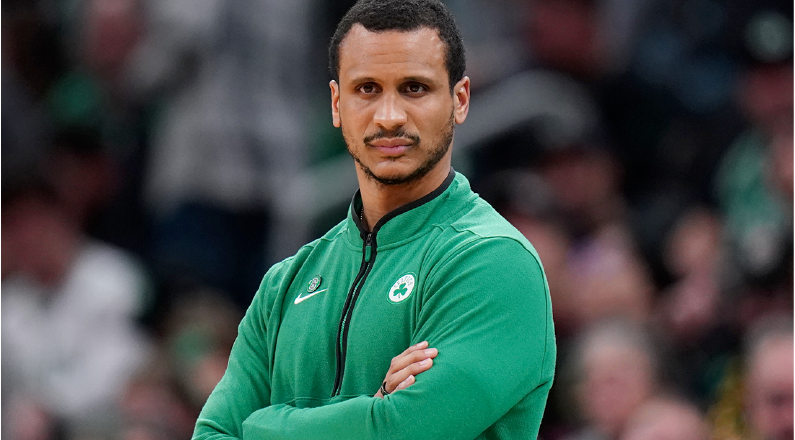
(ZENIT News / Rome, 10.11.2025). — Boston Celtics head coach Joe Mazzulla recently surprised many with an uncommon statement in the world of professional sports: his desire to become a Catholic deacon. In several interviews, the coach spoke about his faith and how his spiritual life helps him maintain balance both on and off the court.
“Being a coach is a privilege, but it’s not my final destination”, Mazzulla said. “I want to serve beyond basketball, and if one day I can do that as a deacon, it would be a blessing”.
The revelation comes at one of the most successful points in his career. Under his direction, the Celtics won the 2024 NBA championship and completed one of the best seasons in franchise history. Still, Mazzulla insists that his identity is not tied to trophies. “Sports give you joy and frustration, but they don’t define you. What defines you is whom you serve and how you use your gifts”, he explained.
The coach has said that his greatest challenge since childhood was “believing God about who I was… I’d say that for a long time I didn’t always believe that what He said about me was true. When you neglect that and don’t believe it, you go looking for falsehoods. They become things that are easier to believe. As a kid, it’s easier to believe your identity is in basketball than to believe that someone died for you and gave His entire life for you. You have this grace, and you can’t earn it — it’s simply given. And all you have to do is accept it. And that’s hard to accept”, he said in a recent interview.
Mazzulla has also shared his admiration for the Holy Family of Nazareth, a topic he mentioned after a game attended by the Prince and Princess of Wales. When asked if he had met them, the coach replied, “Jesus, Mary, and Joseph?… I only know one royal family. I don’t know much about the other one”.
In his remarks, the coach also drew a comparison to the rich young man in the Gospel, the character who turns away from Jesus for fear of giving up his possessions. “I don’t want to become the rich young man”, Mazzulla said. “My biggest fear is that ten years from now I’ll wake up and realize I am the rich young man — that life has passed me by and I wasn’t willing to give up my treasures on this earth because I gave everything to worldliness.”
His desire to become a deacon fits within that same logic; a search for consistency between faith and public life. In the Catholic Church, permanent deacons combine their professional lives with pastoral service, liturgy, and community work. “My vocation as a coach and my faith aren’t separate”, he said. “Both are about walking with others, teaching, and serving”.
Mazzulla grew up in Rhode Island in a Catholic environment and attended religious schools. That formation, he says, shaped his view of leadership. Inside the locker room, he promotes personal responsibility and human growth as much as athletic performance. “The court is a laboratory of life”, he commented. “That’s where you learn to lose, to get up again, and to respect others”.
Although his responses to the press are often brief and measured, Mazzulla doesn’t shy away from personal topics. In a recent press conference, when asked how he handles the pressure of his job, he replied, “I pray, I read, and I try to remember that basketball isn’t the most important thing. What matters is who you are when the lights go out”.
For many observers, his way of speaking shows a maturity that’s rare in an environment driven by immediacy and exposure. “Joe doesn’t seek attention — he seeks meaning”, one sports analyst commented after hearing his statements.
Mazzulla hasn’t set a timeline for pursuing ordination as a deacon but sees it as a natural extension of his current vocation. “It’s not about leaving basketball”, he said, “but about making sure that what I do has a greater purpose”.
In a league marked by narratives of ambition and success, the Celtics coach offers a different perspective; that of someone who measures his career not only by victories but by the human impact he leaves behind, making it clear that for him, the real victory lies in who he is, not just in what he does.

Publicaciones relacionadas:
 From cancer to the Church through a miracle: Jordan Peterson’s wife converts to Catholicism, thanks to the Rosary
 This Is the Young Spokeswoman for the U.S. Government: A Young Catholic Mother
 Monaco reaffirms its Catholic identity by halting abortion reform: Prince refuses to enact the law
 Carmelite friar who prays the Rosary online at 4 a.m. becomes Brazil’s most-watched streamer in 2025
