

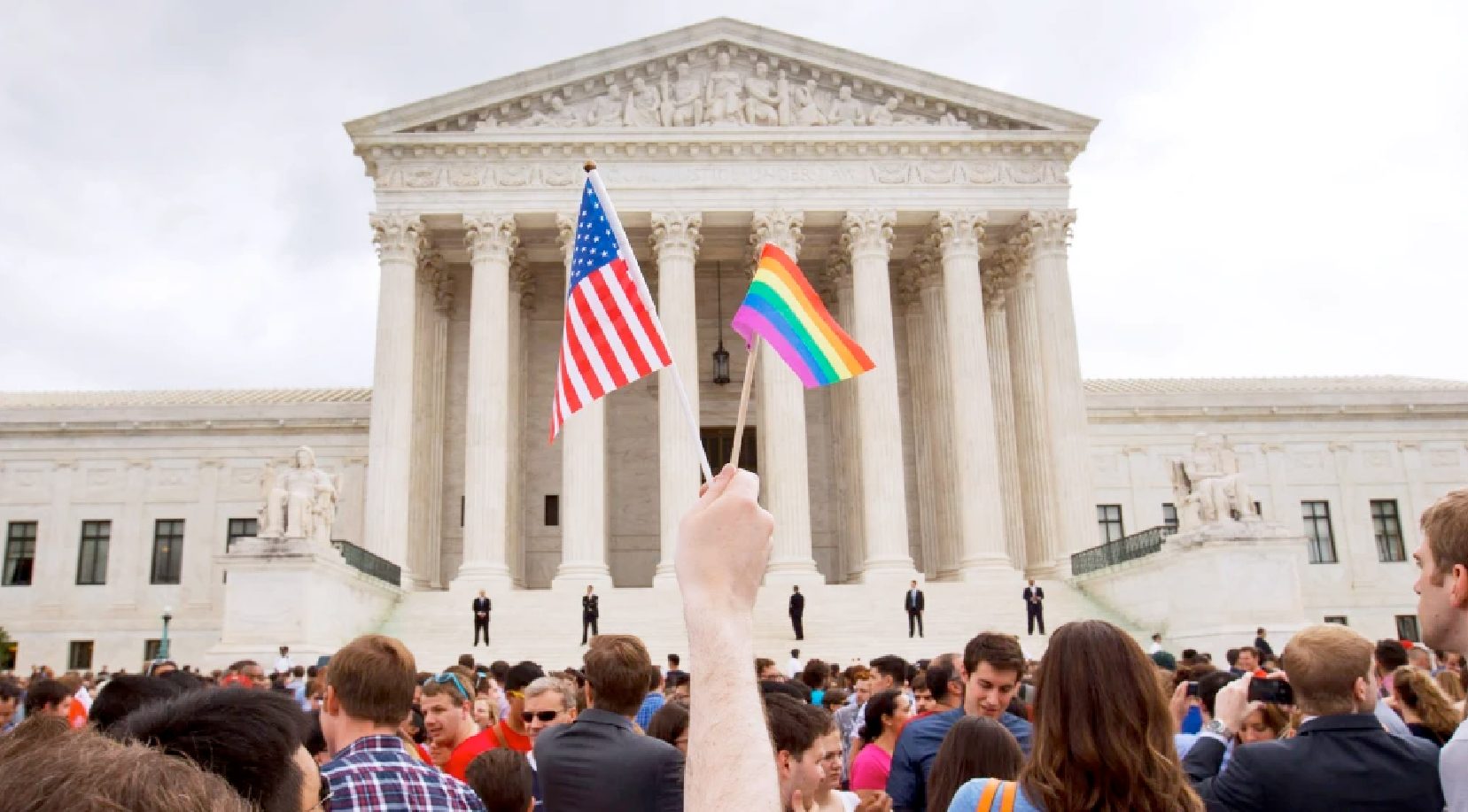
(ZENIT News / Washington, 11.11.2025).- Ten years after the landmark ruling that legalized same-sex «marriage» across the United States, the Supreme Court has quietly, but decisively, closed the door on efforts to overturn it. In a brief order, the justices declined to hear the appeal of Kim Davis, the former Kentucky county clerk who became a symbol of religious resistance to the Obergefell v. Hodges decision of 2015.
With a terse phrase—“the petition for certiorari is denied”—the Court signaled that the constitutional right to same-sex marriage remains untouched, despite years of legal maneuvering and cultural polarization. The denial leaves in place the lower court’s rulings against Davis, who was ordered to pay more than $360,000 in damages and legal fees to couples she refused to marry on religious grounds.
For Davis and her supporters, the decision marks the end of a long and contentious chapter. In 2015, as clerk of Rowan County, she defied a federal order by refusing to issue marriage licenses to same-sex couples, citing her Christian convictions. Her stance led to her brief imprisonment for contempt of court, ignited nationwide debate over religious freedom, and prompted Kentucky lawmakers to change the law so that clerks no longer need to sign marriage licenses personally.
Yet for the Supreme Court—now with a solid conservative majority—the choice not to revisit Obergefell carries profound implications. Many had speculated that the justices might use Davis’s appeal as an opportunity to reexamine the 2015 precedent, particularly after Justice Clarence Thomas’s comments in 2022 suggesting that Obergefell should be “reconsidered.” But the Court’s silence this week speaks volumes: a conservative bench, while ideologically diverse, appears unwilling to reopen a battle that would upend the lives of hundreds of thousands of couples and destabilize a decade of legal certainty.
According to the Williams Institute at UCLA, roughly 600,000 same-sex couples have married in the United States since Obergefell. For them, the Court’s refusal to hear the case reaffirms that their civil marriages—whatever their religious critics may argue—are not subject to legal reversal.
Still, the cultural debate remains far from settled. In October, the Texas Supreme Court ruled that state judges could decline to perform same-sex weddings on religious grounds, a sign that the tension between conscience rights and civil equality continues to smolder. Meanwhile, more than twenty states are reportedly preparing legislative frameworks that could restrict marriage rights if the federal precedent were ever overturned.
Thomas Jipping, a senior legal fellow at the Heritage Foundation, told EWTN that Davis’s appeal was “never the right vehicle” to challenge Obergefell, because “she was not acting as a private citizen exercising her faith, but as a government official.” The First Amendment, he explained, “applies differently to public officials than to private individuals.”
For some Catholic scholars, the episode reflects a broader lesson about priorities. Mary Rice Hasson, director of the Kate O’Beirne Center for Ethics and Public Policy, noted that energy would be better spent teaching Catholic truth about marriage than hoping for a judicial reversal. “We should focus on explaining and living out the Church’s understanding of marriage and sexuality,” she said, “rather than expecting the courts to undo Obergefell.”
Her words touch a deep contradiction within American Catholicism. According to a 2024 Pew Research survey, nearly 70 percent of self-identified Catholics in the U.S. support same-sex marriage—a proportion slightly higher than the national average. For Church leaders, this is both a pastoral and theological challenge: how to remain faithful to Catholic doctrine, which defines marriage as a union between one man and one woman, while engaging a culture that has largely moved in the opposite direction.
The Supreme Court’s refusal to reopen the debate does not end the moral conversation; it merely stabilizes the legal framework. Behind the quiet dignity of the Court’s denial lies a fractured national conscience—one that continues to wrestle with the meaning of liberty, faith, and equality in a pluralistic age.
For now, Obergefell stands as it did in 2015: a pillar of constitutional law and a lightning rod of moral debate. The justices may have chosen silence, but their silence has spoken clearly—America’s marriage law will not be rewritten, at least not by this Court.
Thank you for reading our content. If you would like to receive ZENIT’s daily e-mail news, you can subscribe for free through this link.

