

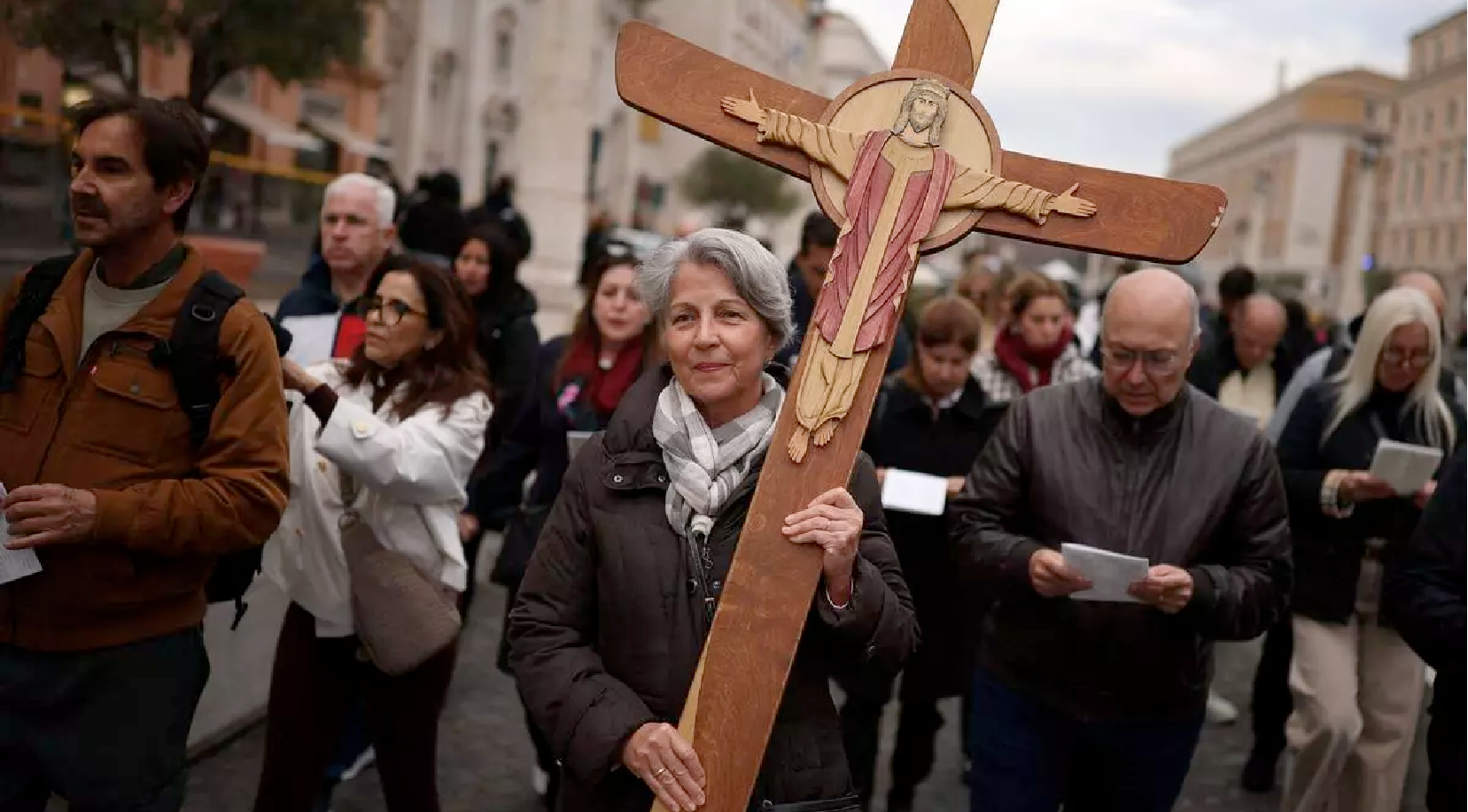
(ZENIT News / Vatican City, 12.04.2025).- A new Vatican document has reopened one of the most delicate theological debates of recent decades. The Holy See has published the conclusions of a years-long study on the possibility of admitting women to the diaconate as part of the sacrament of Holy Orders, a review initiated by the late Pope Francis and delivered to his successor, Leo XIV, in mid-September.
The report, prepared by a second commission chaired by Cardinal Giuseppe Petrocchi, emeritus archbishop of L’Aquila, does not endorse moving forward with female deacons within the sacramental hierarchy. Its argument is cautiously firm: the current state of biblical, historical, and theological research does not justify opening that path. The commission stresses nonetheless that its judgment cannot be considered definitive, echoing the language that the Church has used regarding the priesthood but leaving the door slightly less sealed.
The commission’s work unfolded in three phases and revealed an intellectual landscape filled with nuances and occasional tensions. Early discussions in 2021 confirmed that Christian communities across the centuries did employ the term diaconissa, but not with consistent meaning. Roles varied widely, sometimes resembling liturgical office, sometimes pastoral service, and sometimes charitable ministry with no link to sacramental identity. That historical ambiguity proved central to subsequent disagreements.
By the end of its first year, the group unanimously acknowledged a problem that has long shaped the debate: when viewed strictly through the theology of Holy Orders, admitting women to diaconal ordination raises unresolved questions about the unity among the three grades—diaconate, priesthood, and episcopate. At the same time, all members supported the creation of new instituted ministries that might better reflect the contributions women already offer throughout the Church.
Momentum shifted in 2022, when the commission, by a strong majority, adopted the formulation now published by the Holy See. The text affirms that research continues to indicate no grounds for admitting women to the diaconate as a sacramental order, while reiterating that the conclusion is not final. The phrasing is a study in Catholic caution: decisive enough to guide practice, flexible enough to allow future developments should the Church’s broader theological understanding deepen.
The commission’s final phase, completed in February 2025, incorporated submissions from individuals and groups invited by the Synod process to share their perspectives. The volume was substantial, yet representation was narrow: only twenty-two contributions from a limited number of countries. The members concluded that the material, while often sophisticated, could not be considered a reliable voice of the universal Church.
Still, the arguments presented mirror the broader currents in the Church today. Supporters of sacramental ordination for women often appeal to biblical anthropology and social equality, invoking passages such as Paul’s declaration to the Galatians that distinctions of gender give way to unity in Christ. Critics, however, argue that such appeals tend to rely more on emotional resonance than on a rigorous reading of tradition. They maintain that the reservation of Holy Orders to men, including the diaconate, is rooted not in cultural bias but in sacramental symbolism tied to Christ’s own identity.
One particularly contested line of reasoning, discussed extensively by the commission, centered on the importance of Christ’s masculinity in the sacramental economy. A paragraph defending this thesis split the group evenly: half wished to keep it in the report, half asked for its removal.
Despite such divisions, consensus formed on at least one point. With nine votes in favor and only one dissenting, the commission urged an expansion of instituted ministries accessible to women, insisting that greater ecclesial recognition of their service would be a prophetic sign, especially in places where women still face structural discrimination.
In his concluding reflections, Cardinal Petrocchi highlights the “intense dialectic” between two coherent but divergent theological visions. One sees the diaconate as oriented primarily to service rather than priestly ministry and therefore more open to female participation. The other views the sacrament of Holy Orders as an indivisible whole, its three degrees unified by a spousal symbolism that cannot be selectively reinterpreted. If the first view prevailed, some ask, how could women be admitted to the first degree of the sacrament while remaining excluded from the others?
For the cardinal, future progress depends on a clearer understanding of the diaconate itself. He calls for a more rigorous theological and pastoral examination of its identity, noting that in some regions the permanent diaconate is scarcely present, while in others its functions blend almost indistinguishably with those of lay ministry. Clarifying that landscape, he argues, is essential before any further discernment about women’s roles can truly advance.
What the report ultimately provides is not closure but a map: a chart of the questions that still divide scholars, bishops, and believers. It is now in the hands of Pope Leo XIV, who must decide whether this moment calls for patience, creativity, or a fuller reopening of the question. For the global Church, the conversation has not ended. It has only become more transparent.
Thank you for reading our content. If you would like to receive ZENIT’s daily e-mail news, you can subscribe for free through this link.

Publicaciones relacionadas:
 Prefect of Dicastery for Doctrine of the Faith: there will be no priestly ordination of women
 Ecumenism: Pope Francis includes Isaac of Nineveh in Roman Martyrology – Context? Visit of Assyrian East Patriarch
 Vatican institutes task force against spiritual abuse and false mysticism
 Lefebvrists at the Dicastery for the Doctrine of the Faith in the Vatican: This Is How the Meeting Went Towards a Canonical Statute for the Fraternity
