

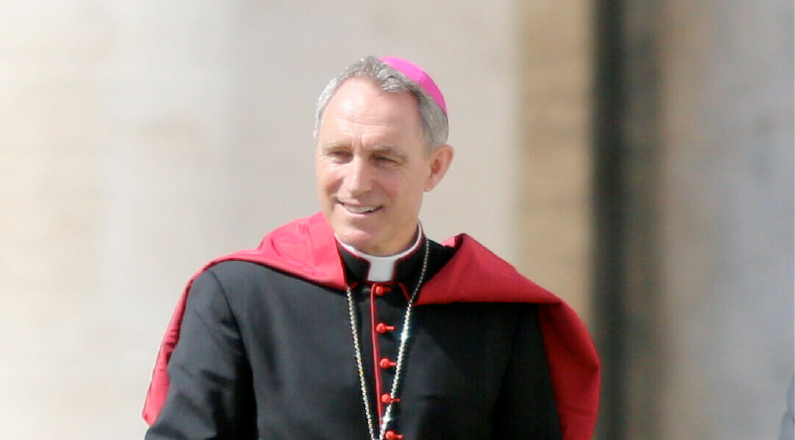
(ZENIT News / Rome, 12.07.2025).- Archbishop Georg Gänswein has reopened a conversation that never truly disappeared from the life of the Church: what to do with the rich, complex and still-unfolding legacy of Pope Benedict XVI. During a televised interview with the Catholic network K-TV, the longtime private secretary of Joseph Ratzinger offered one of his clearest and most personal appeals to date. He not only expressed hope that the cause for beatification be opened soon, but also voiced his conviction that the late pope may one day be proclaimed a Doctor of the Church.
Speaking from his current mission in the Baltic states, Gänswein framed his reflections around a theme he considers fundamental in Benedict XVI’s theology: joy as the heartbeat of faith. He described Ratzinger as a thinker convinced that Christian belief, if truly lived, naturally blossoms into joy. Any faith that fails to produce it, he suggested, signals a deeper spiritual imbalance. For Gänswein, this insight is not a footnote but a centerpiece of Benedict’s understanding of God, the Church and the human person.
His remarks inevitably touch a sensitive point in contemporary Catholic debates: the place of the Traditional Latin Mass. The archbishop did not shy away from the subject. He called for revisiting the prudent approach set forth by Benedict XVI when he broadened access to the older liturgical form. That policy, Gänswein argued, had been designed to lower internal tensions, not heighten them, and to provide a stable framework in which different liturgical sensibilities could coexist without suspicion.
Benedict XVI’s death in 2022 closed a public chapter but not the spiritual, theological and cultural influence he continues to exert. Gänswein’s comments revive questions that extend far beyond formal processes in Rome. What aspects of Benedict’s legacy remain most urgent for the Church today? Which of his writings will shape Catholic life for generations? And how might his vision for liturgical harmony be re-evaluated in a moment marked by both renewal and polarization?
For now, the archbishop’s reflections function less as a campaign and more as an invitation: to reconsider the depth of Ratzinger’s thinking, the pastoral clarity he tried to offer, and the possibility that his contribution has not yet been fully received. In Gänswein’s view, the story of Benedict XVI is still unfolding—quietly, steadily, and with the same inner joy that he believed was the unmistakable sign of authentic faith.
Thank you for reading our content. If you would like to receive ZENIT’s daily e-mail news, you can subscribe for free through this link.

Publicaciones relacionadas:
 Eleven Priests Martyred by Communism and Nazism To Be Beatified Following Authorization by Pope Leo XIV
 “We Accept with Sincere Filial Obedience These Provisions,” Said the Prelate of the Opus Dei, in Face of the Pope’s Modifications
 This Is the Mongolia the Pope Is Visiting: The World’s Youngest Cardinal Talks About the Church in a Buddhist Country
 The smiling Carmelite is on her way to the altars: she is recognized as a “servant of God”
