

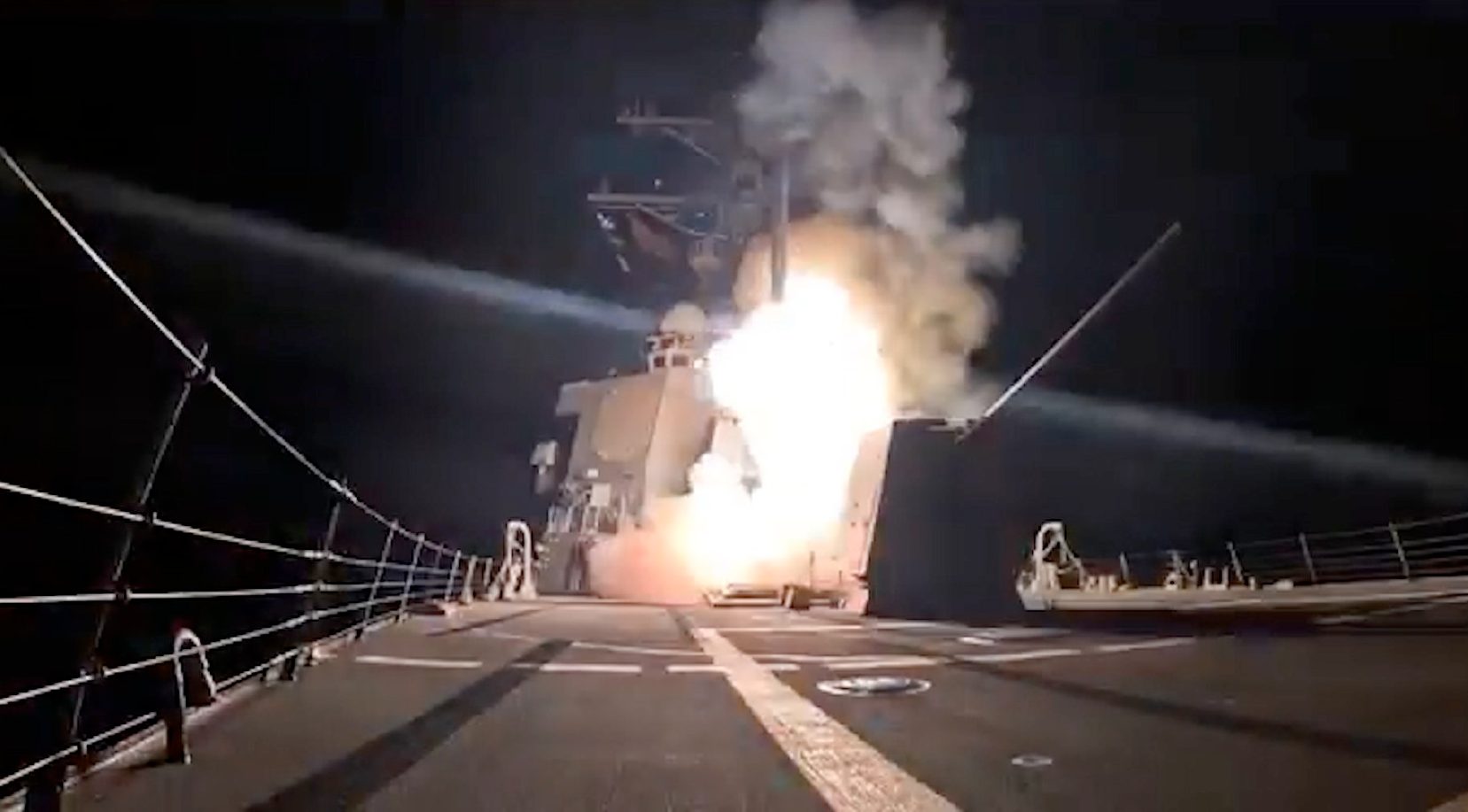
(ZENIT News / Abuja, 12.29.2025).- In the early hours of Christmas Day, while churches across the world proclaimed peace on earth, U.S. missiles were cutting through the night sky over northwestern Nigeria. President Donald Trump, announcing the strikes with characteristic bluntness, framed the operation as a decisive response to what he described as the brutal slaughter of Christians by jihadist groups linked to the Islamic State. The timing was deliberate, the language unmistakably moral, and the message unmistakably political: Washington was prepared to act where Nigeria, in Trump’s view, had failed.
The airstrikes, carried out in coordination with Abuja, targeted militant camps hidden in dense forest areas of Sokoto State, near the border with Niger. Nigerian authorities later confirmed that the operation was not unilateral but part of an intelligence-sharing and security partnership that included presidential approval and the use of offshore launch platforms in the Gulf of Guinea. Precision-guided missiles, reportedly fired from drones, struck what officials described as training and planning hubs for large-scale terrorist attacks.
Trump’s Christmas message, posted on his Truth Social platform, left little room for nuance. He accused ISIS-linked militants of killing Christians “at levels not seen in many years, even centuries,” and warned that further bloodshed would be met with further force. The tone oscillated between religious invocation and martial threat, blessing U.S. troops while promising more strikes should the violence continue.
Yet almost as quickly as the bombs fell, a different conversation began to unfold—one less dramatic, but far more complex. Nigerian officials pushed back against the characterization of their country as the site of a one-sided religious massacre, insisting that extremist violence has claimed Muslim and Christian lives alike. Analysts and church leaders echoed this caution, arguing that Nigeria’s crisis cannot be reduced to a single narrative of Christian persecution, however real and painful that persecution may be.
At the heart of the dispute lies the identity of the groups targeted. While Trump spoke broadly of ISIS, security experts point to Lakurawa, a relatively small armed faction affiliated with the Islamic State’s Sahel Province, as the most likely target of the Christmas strikes. Active mainly in Sokoto and neighboring Kebbi State, Lakurawa emerged less than a decade ago as a self-defense force against banditry, before radicalizing and imposing a harsh version of Islamic law on local Muslim communities. Their numbers are limited—perhaps a few hundred fighters—but their connections to larger jihadist networks make them strategically significant.
This distinction matters. The groups most notorious for attacks on Christians—Boko Haram and the Islamic State West Africa Province—are concentrated in northeastern Nigeria, particularly Borno State and the Lake Chad basin. In central Nigeria, meanwhile, much of the bloodshed involves armed Fulani militias whose violence blends criminal, ethnic, and religious motives. By some estimates, these militias are responsible for a majority of Christian deaths each year, particularly in Plateau, Benue, and Taraba states. None of these dynamics can be neutralized by a single air campaign.
Criticism has also come from within the Catholic Church. Cardinal Augusto Paolo Lojudice, speaking to the Italian press, warned that bombing campaigns risk worsening the plight of Christians rather than alleviating it. Violence, he argued, tends to reproduce itself, exposing local communities to retaliation and deepening cycles of fear. His remarks resonated with a broader concern among church leaders that external military interventions, however well intentioned, may ignore the social and political roots of Nigeria’s instability.
Those roots are well documented. Since 2009, jihadist insurgencies have killed at least 35,000 people and displaced more than 2.5 million. Criminal gangs exploit the near-absence of state authority in vast rural areas, while poverty, unemployment, and corruption provide fertile ground for recruitment. Even Nigeria’s own defense officials have acknowledged that military action addresses only a fraction of the problem; governance, justice, and development are the harder—and more decisive—battles.
For Washington, the strikes mark an escalation after months of diplomatic pressure. Nigeria has once again been designated a Country of Particular Concern under U.S. religious freedom law, visa restrictions have been imposed on individuals linked to mass violence, and human rights groups continue to lobby for stronger action. Whether the Christmas operation represents the start of a sustained campaign or a symbolic warning shot remains unclear. Initial assessments from AFRICOM suggest militant casualties, but local reports have questioned whether any bodies were recovered at all.
What is certain is that Nigeria’s tragedy cannot be solved from the air. The suffering of Christian communities is real, as is the fear that drives families from ancestral villages into camps for the displaced. But so too is the suffering of Muslim civilians caught between jihadists, bandits, and a struggling state. Christmas bombs may send a signal, but they do not resolve the deeper question haunting Africa’s most populous nation: how to restore security, dignity, and coexistence where the social fabric has been torn apart.
In that sense, the Christmas strikes illuminate both the urgency of Nigeria’s crisis and the limits of force. They offer a moment of reckoning, not only for Abuja and Washington, but for a global community too often tempted to mistake firepower for peace.
Thank you for reading our content. If you would like to receive ZENIT’s daily e-mail news, you can subscribe for free through this link.

Publicaciones relacionadas:
 USA: Transexual Woman Kills Three Children and Three Adults in a Christian School
 Revealing Report Highlights Growing Marginalization of Christians in the United Kingdom
 After 112 vandalized churches, Canada ends funding for research on Catholic school tombs
 Syria: in 14 years, the Christian presence has fallen by 84%: these are the numbers
