

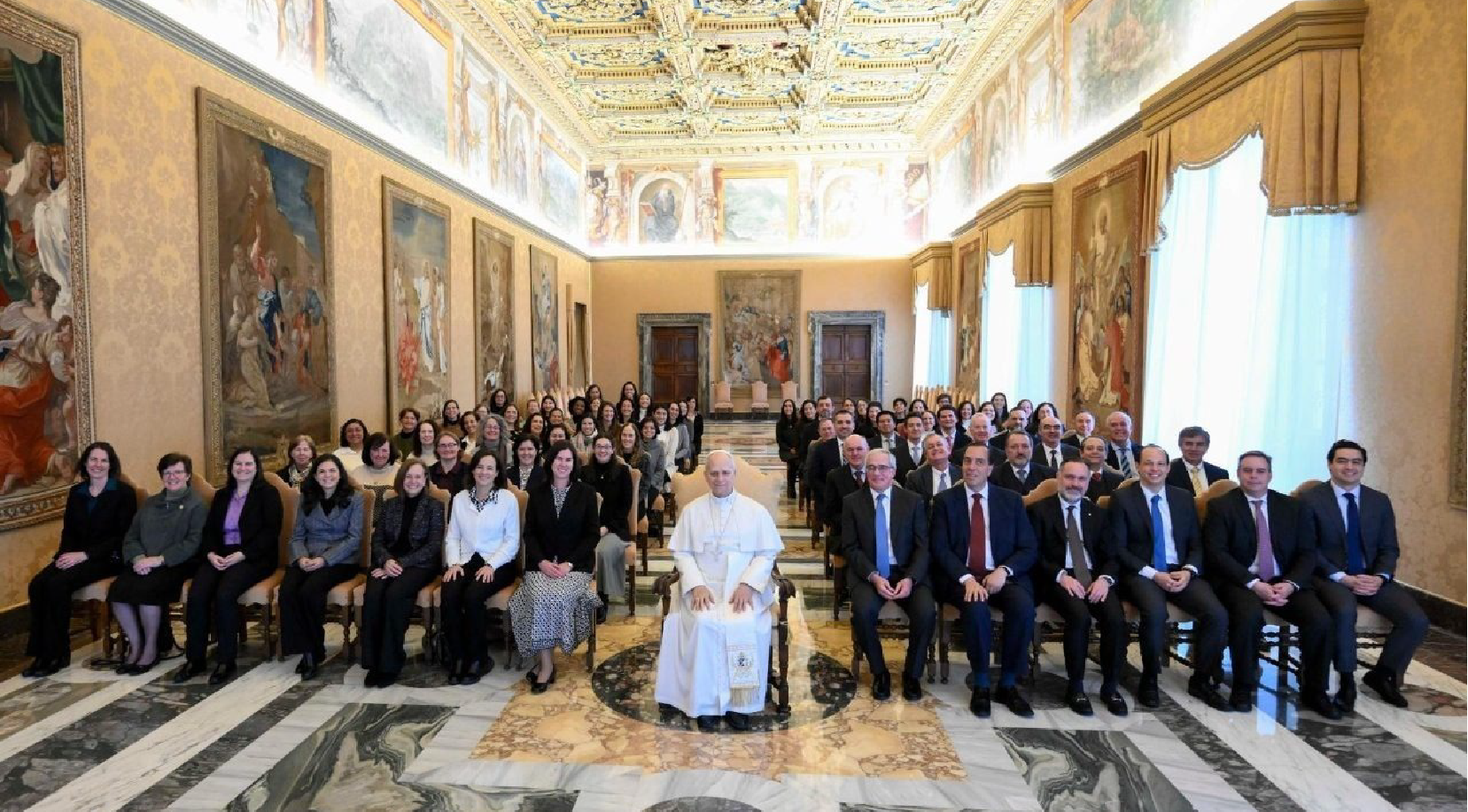
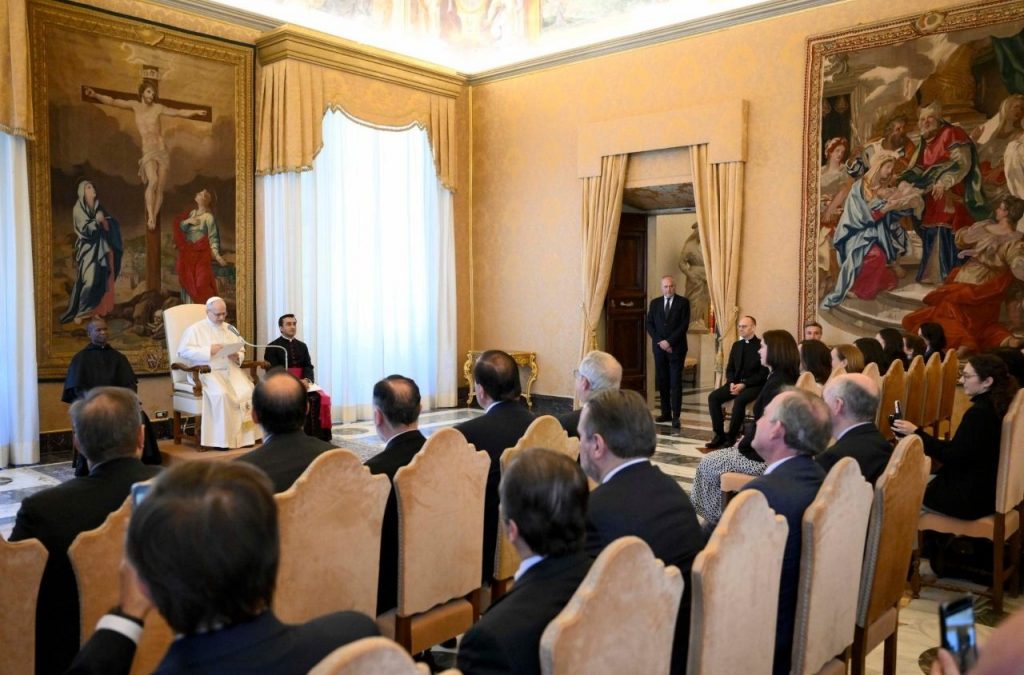
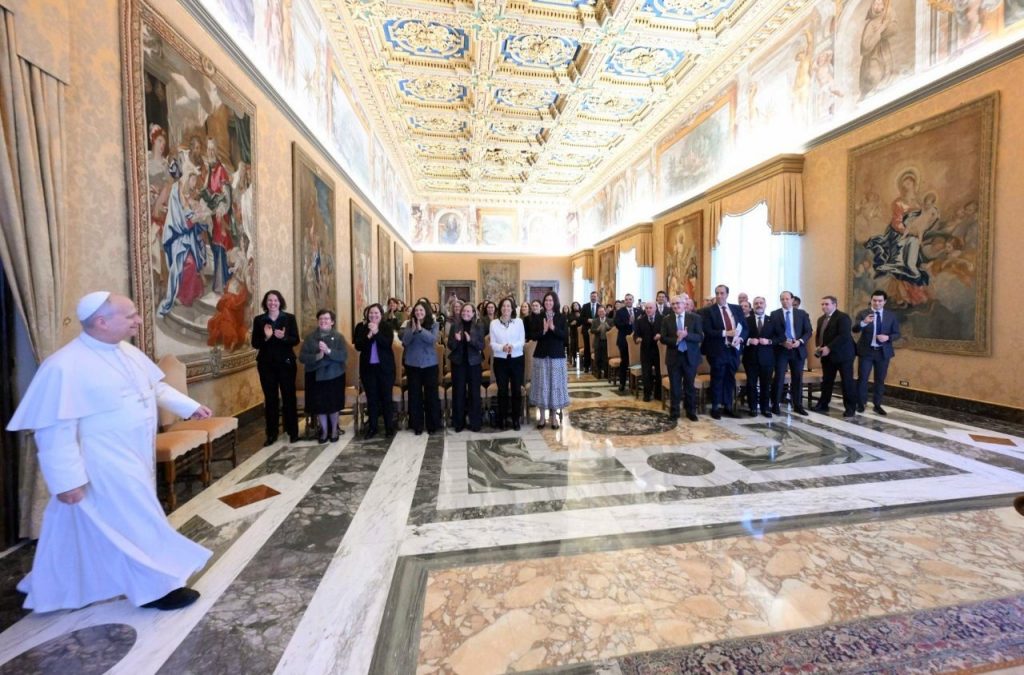
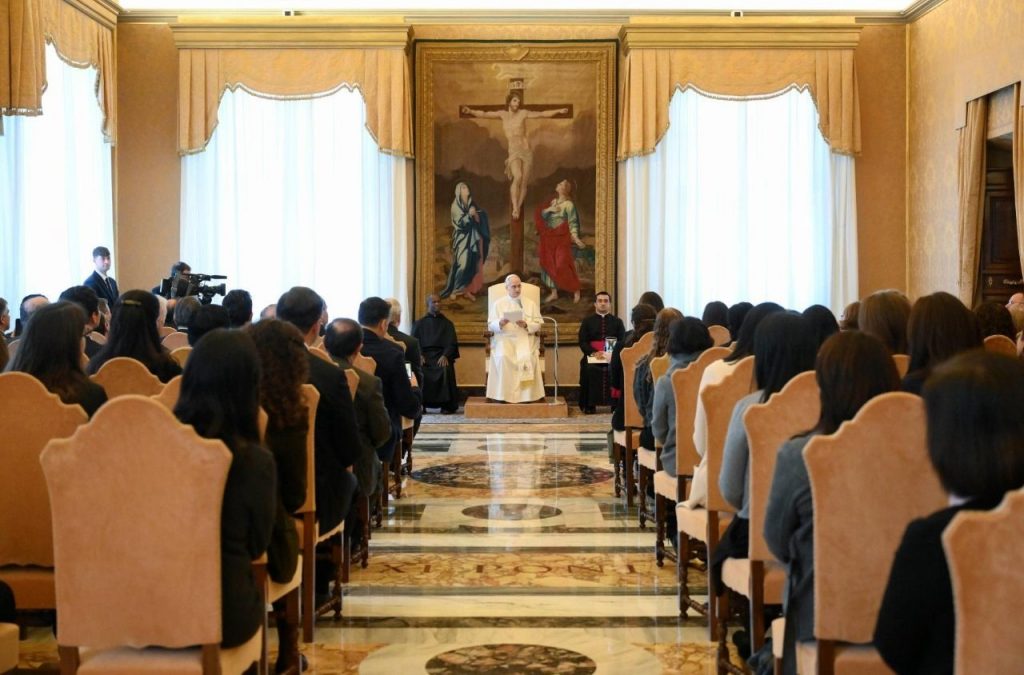
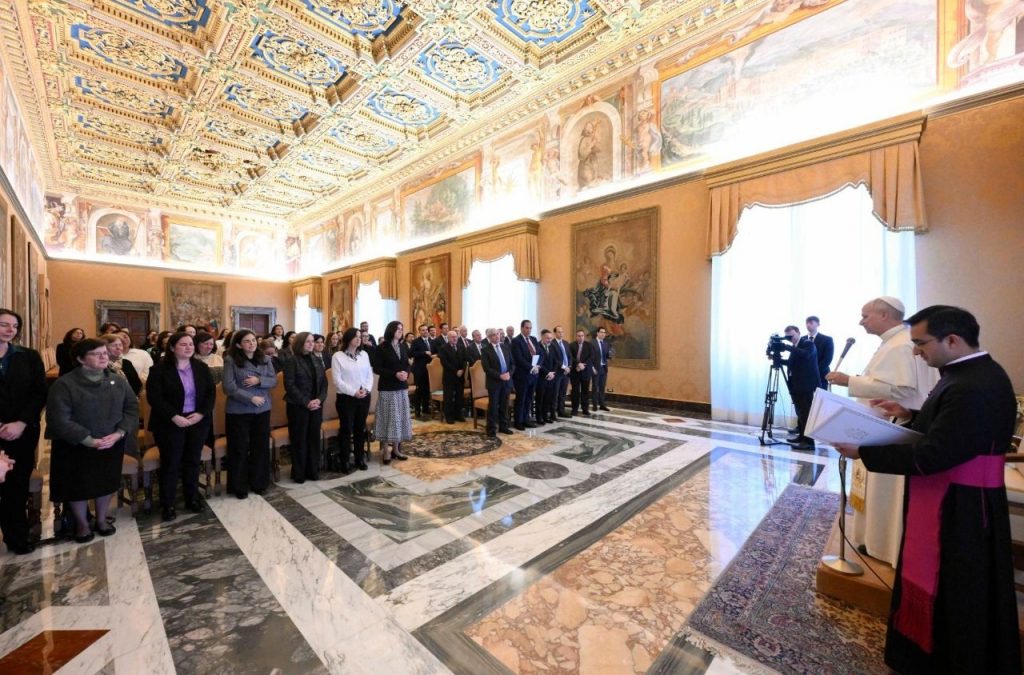
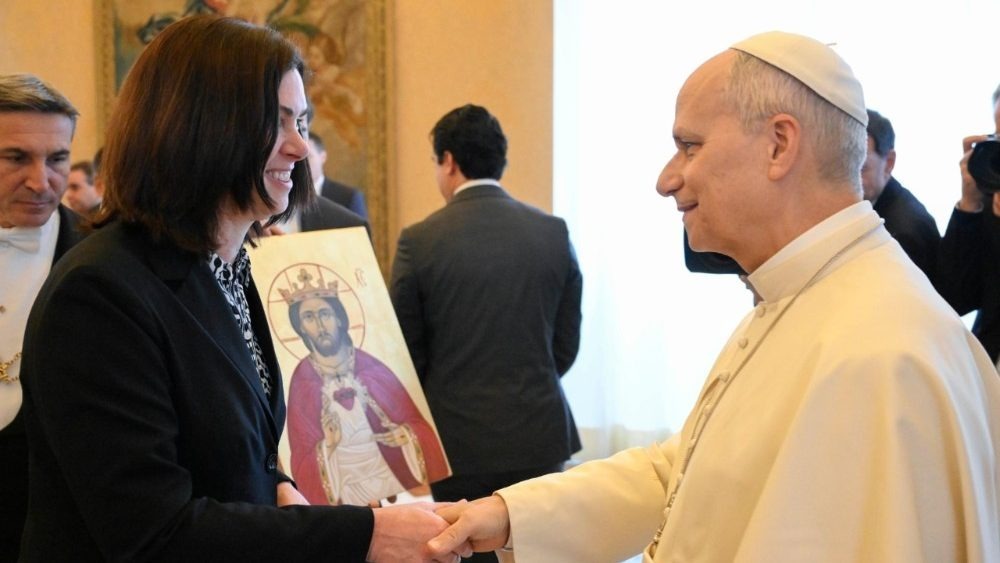
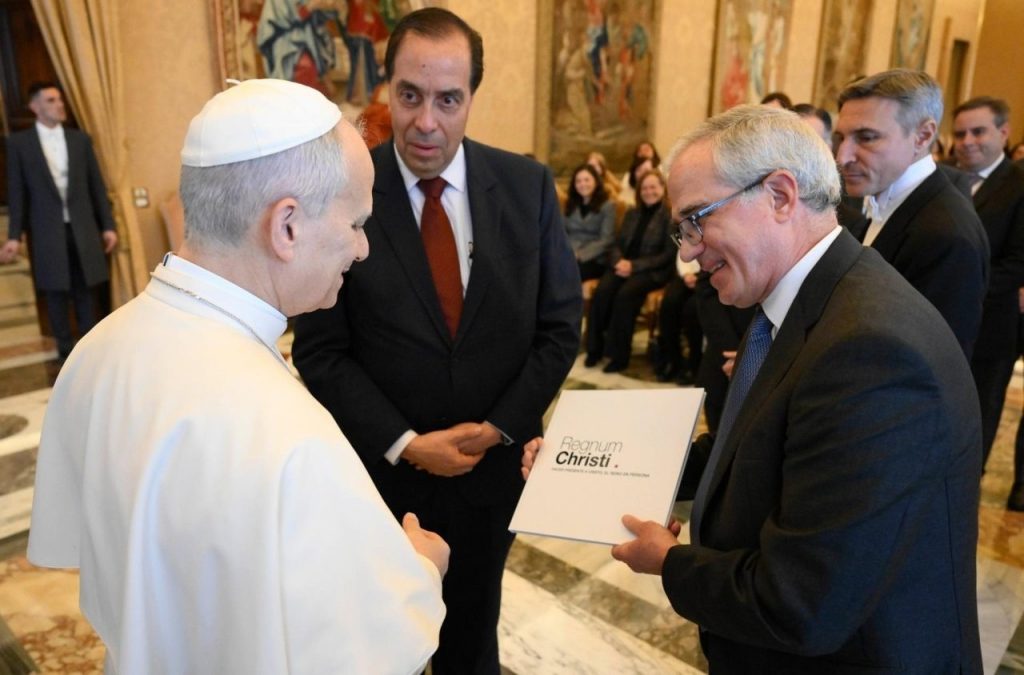
(ZENIT News / Vatican City, 01.29.2026).- On the morning of Thursday, January 29, the Holy Father received the consecrated lay members of Regnum Christi in audience in the Consistory Hall of the Apostolic Palace. The private audience took place in the context of the General Assemblies of both branches of the Regnum Christi Federation. The Pope summarized his speech in three words: “Charism, governance, and communion.” Below is the text of the Pope’s speech, unofficially translated into English:
***
In the name of the Father, and of the Son, and of the Holy Spirit.
Peace be with you.
Dear sisters and brothers, good morning and welcome!
I am pleased to meet with you on the occasion of your General Assemblies, and I take this opportunity to share a reflection with you, which I would like to articulate in three points: charism, governance, and communion.
[Charism]
Regarding the first point, the Magisterium teaches us that “the Church is rejuvenated by the power of the Gospel and continually renewed by the Spirit, building her up and guiding her ‘with various hierarchical and charismatic gifts. (1)
The Second Vatican Council repeatedly emphasized the wonderful work of the Holy Spirit who sanctifies the People of God, guides them, adorns them with virtues, and enriches them with special graces for their edification.” (2)
In these days, you have had the opportunity to reflect and discuss the definition of the charism of your respective Societies of Apostolic Life, recognizing in it a gift from the Paraclete, offered to the Church to rekindle its life and energize its mission, both within itself and in society.
This gift, while generating life and vitality in the Institute, also confers upon it a specific identity, which qualifies and makes your presence in the Church and in the world recognizable. Today, more than ever, it is necessary to know who we are if we wish to engage in authentic dialogue with society without being absorbed or conforming to it. To evangelize the environments in which you live—the specific aim of your vocation—it is therefore essential that you define your identity with ever greater clarity.
Every sister and brother who receives the charism is called to keep it alive within themselves, so that it does not become static, but rather it becomes a vital force that flows creatively and freely. As Pope Francis reminded us , “It is a question of remaining faithful to the original source, striving to rethink it and express it in dialogue with the new social and cultural situations.” (3)
The Institute, the Society, is a living body where the charismatic energy permeates every cell and every member, and they, in turn, are bearers and transmitters of it. And this energy must give life to the mission they carry out and illuminate the path they are to travel, so that they may bequeath it as a living inheritance to future generations, who are also called to fall in love with it and make it the source of their service.
[Government]
Precisely to achieve this goal, the second topic I would like us to reflect on is important: government, which, in order to begin mature decision-making processes in a climate of authentic discernment, needs communion.
Consecrated persons moreover are called to the following of the obedient Christ within an “evangelical project” or a charismatic one, inspired by the Spirit and authenticated by the Church,” (4) and that “In this journey persons in authority are invested with the pastoral task of leading and deciding.” (5)
Governance is a necessary service in Societies of Apostolic Life; an authentic ecclesial ministry that accompanies the sisters and brothers toward a conscious, free, and responsible fidelity in following Christ. (6) Moreover, every Institute and every Society is called to recognize in it its own style, in harmony with its specific charism and with its spirituality.
A truly evangelical government, on the other hand, is always oriented toward service: it sustains, accompanies, and helps each member to configure themselves more and more each day to the person of the Savior. In this sense, communal discernment is the privileged place where shared decisions can mature, capable of generating communion and co-responsibility.
Do not be afraid to experiment with new forms of governance; (7) indeed, it is important to always bear in mind that searching together for your own style in the exercise of authority opens paths that not only enrich the Societies and their individual members but also strengthen the sense of belonging and participation in the common mission.
[Communion within the Regnum Christi Family]
This brings us to the third theme I want us to consider: communion within the Regnum Christi Family. Your particular journey, embedded in the broader history of an apostolic body, bears the marks of the silent and powerful action of the Holy Spirit, who continually renews the Church and keeps her young in hope. In this context, you are called to foster ever deeper communion throughout the Family, sharing spirituality and apostolate, living fully the specific vocation to which God has called you as members of the Society to which you belong, committed to bearing witness, through your own lives, to fidelity to the charism you have received.
As the Apostolic Exhortation Vita Consecrata reminds us, “By virtue of their rebirth in Christ, all the faithful share a common dignity; all are called to holiness; all cooperate in the building up of the one Body of Christ, each in accordance with the proper vocation and gift which he or she has received from the Spirit (cf. Rom 12:3-8).” (8)
Unity in baptismal dignity and diversity of vocations are not opposed, but rather mutually illuminating. Organic communion in diversity is the work of the Holy Spirit, who transforms each vocation into service to the others, so that the Body of Christ may grow in history and fulfill its mission in the world.
We are all lives on a journey, whose dreams God continues to inspire through the prophets of yesterday and today, to liberate humanity from old and new forms of slavery, involving young and old, poor and rich, men and women, saints and sinners in the works of his mercy and the wonders of his justice. The Lord makes no noise, but his Kingdom springs up and grows in every corner of the world. And in this sense, many cities and many communities need to be told: “Truly you are by no means the least” (cf. Mt 2:6).
Yes, the Lord continues to surprise us and continues to let himself be found on paths that are not our own (cf. Is 55:8), and because of this his faithfulness continues to surprise us. As we respond to divine gifts, let us entrust ourselves to Mary, Star of the Morning.
My dearest friends, thank you for what you do. I pray for you and bless you from my heart. Thank you.
Notes:
1 Second Vatican Ecumenical Council, Dogmatic Constitution Lumen Gentium (November 21, 1964), 4
2 Congregation for the Doctrine of the Faith, Letter Iuvenescit Ecclesia (May 15, 2016), 1.
3 Francis, Address to the participants in the General Assembly of the Focolare Movement (February 6, 2021).
4 Congregation for Institutes of Consecrated Life and Societies of Apostolic Life, Instruction The service of authority and obedience (May 11, 2008), 9.
5 [1] Ibid .
6 Cf. Congregation for Institutes of Consecrated Life and Societies of Apostolic Life, New wine in new wineskins (January 6, 2017), 41.
7 Cf. ibid . , 9.
8 St. John Paul II, Exhort. ap. Vita consecrata (March 25, 1996), 31.
Thank you for reading our content. If you would like to receive ZENIT’s daily e-mail news, you can subscribe for free through this link.

Publicaciones relacionadas:
 Pope asks to define principles, norms, and guidelines for Latin rite priests accompanying Eastern rite Catholics arriving in the West
 How God makes us into his dwelling places: a reflection of Pope Leo XIV
 Leo XIV to Personally Bestow Palliums in Return to Historic Ritual: A Subtle but Symbolic Shift in Papal Style
 The Trinity of God “explained” (respectfully) with sport by Pope Leo XIV
