

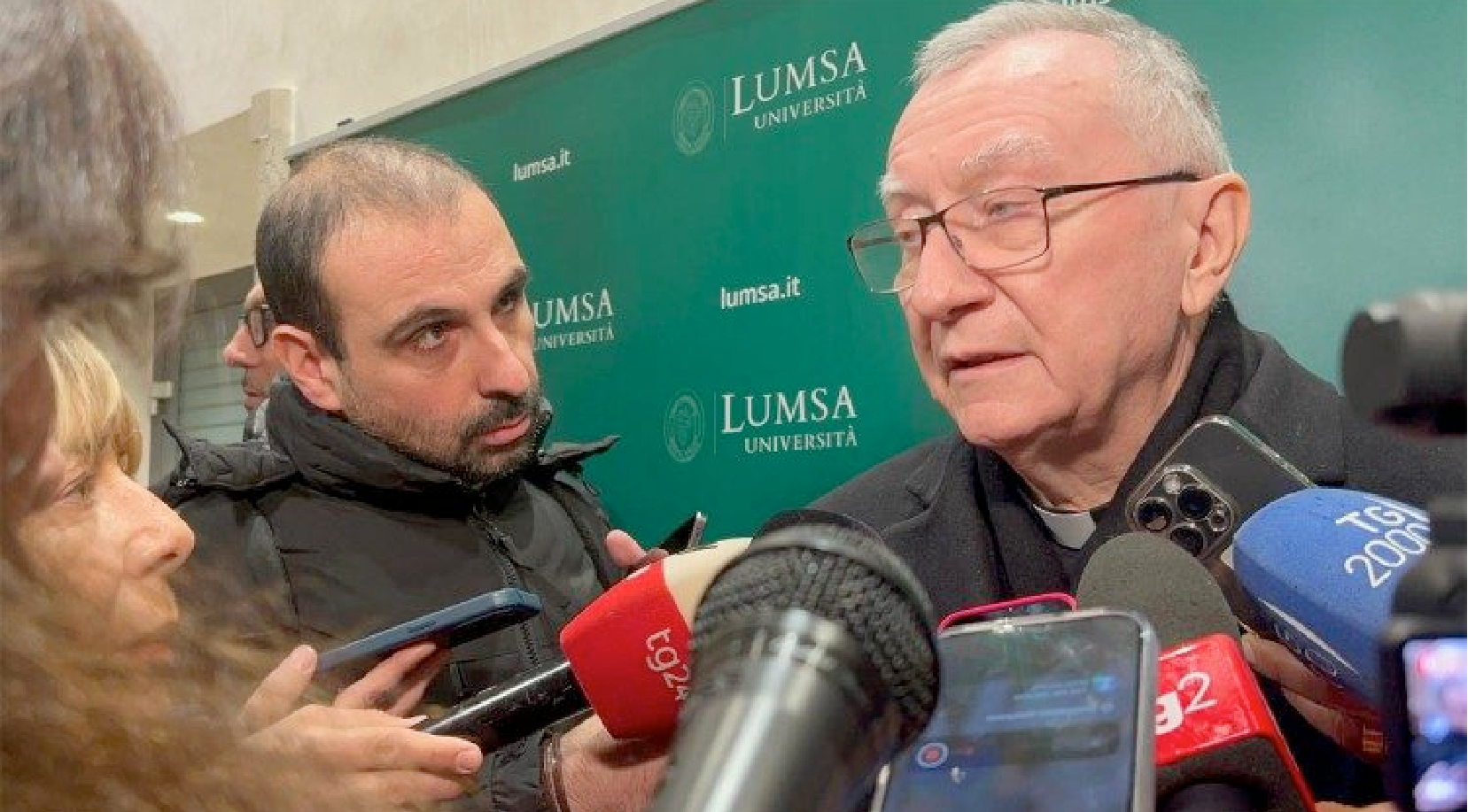
(ZENIT News / Romes, 01.29.2026).- From the deaths linked to U.S. immigration raids to the ethics of rebuilding Gaza, Cardinal Pietro Parolin used a public appearance in Rome this week to sketch the Vatican’s moral red lines in a world increasingly shaped by force, geopolitics, and economic imbalance.
Speaking on Wednesday, January 28, 2026, on the sidelines of a conference on “Ethics and Economy” at LUMSA University, the Holy See’s Secretary of State addressed journalists’ questions ranging from ICE operations in Minnesota to Greenland diplomacy and the financial crisis of a Vatican-owned hospital in southern Italy.
At the heart of his remarks was a blunt condemnation of violence.
“The position of the Holy See has always been to avoid any form of violence,” Parolin said when asked about U.S. Immigration and Customs Enforcement actions in Minnesota that have reportedly led to the deaths of two American citizens. “We cannot accept episodes like this. Difficulties, problems, and contradictions must be resolved in other ways.”
His words echoed recent statements by U.S. Catholic bishops, who have described the situation as “unacceptable” amid mounting concern over aggressive enforcement tactics, civilian casualties, and widespread fear in migrant communities.
A cautious Vatican on Gaza
Parolin was also pressed about an open letter sent to him by the “Network of Priests Against Genocide,” urging the Holy See not to join a proposed international board overseeing Gaza’s reconstruction — an initiative reportedly being shaped under the political sponsorship of President Donald Trump.
The cardinal acknowledged their concerns and confirmed that the Vatican has not yet made a decision.
“Facing this proposal, there are real critical issues that must be carefully considered,” he said. “The response has not yet been given, but I believe one cannot ignore the weaknesses of this plan.”
His measured tone suggested a Vatican walking a tightrope: eager to support humanitarian reconstruction while wary of being drawn into politically charged frameworks that could compromise its neutrality or moral credibility.
When asked whether ICE teams might also operate in Italy during the upcoming Winter Olympics, Parolin declined to engage in controversy, noting only that he was aware of the reports and of the public debate surrounding them.
Diplomacy in the Arctic shadow
Fresh from a visit to Denmark marking the legacy of St. Ansgar, the ninth-century missionary often called the “Apostle of the North,” Parolin confirmed that he met Danish Foreign Minister Lars Løkke Rasmussen. Their discussions included Greenland, a territory of growing strategic interest amid renewed U.S. attention.
Parolin relayed that Rasmussen described recent contacts with Washington as positive and said Danish public opinion — including Lutheran bishops — had welcomed Copenhagen’s diplomatic stance.
Without revealing details, Parolin expressed cautious optimism: “It seems we are moving toward a solution, an agreement. I don’t yet know the precise terms, but the foreign minister appeared rather encouraged by the dialogue. Let us hope that this is the case.”
A Vatican hospital in crisis
Closer to home, Parolin was questioned about Casa Sollievo della Sofferenza, the large hospital in San Giovanni Rotondo owned by the Holy See and founded by Padre Pio. Facing a serious financial deficit and labor unrest, the facility has become a flashpoint for workers demanding transparency and job security.
“We are trying in every way to resolve the problem and help the hospital emerge from its difficulties,” Parolin said, promising to consult the board’s president for further details and reaffirming the Vatican’s commitment to addressing employees’ concerns.
Ethics, economy, and a “disarmed peace”
Parolin’s broader intervention at the LUMSA event returned repeatedly to the relationship between economics and morality — a theme central to contemporary Catholic social teaching.
Introducing a new book by Italian author Tullio Chiminazzo, Impresa e Società – Le persone intelligenti fanno il Bene, the cardinal argued that economic efficiency without solidarity ultimately collapses under its own weight.
“A more just world is possible only if it is a more united world,” he said. “And an efficient economy only if it is a more human one.”
He invoked Pope Paul VI’s famous line — “Development is the new name for peace” — to frame a vision of integral progress that benefits the whole person, not merely markets. Parolin traced a continuous thread through modern papal teaching, from Leo XIII’s Rerum Novarum to John Paul II’s Centesimus Annus, Francis’ Laudato si’, and most recently Pope Leo XIV’s call for a peace that is both “disarmed and disarming.”
Ethics, Parolin insisted, cannot be an afterthought or cosmetic correction to economic systems. It must be embedded in real financial and social processes, forming what he called an “integrated vision” capable of generating authentic development.
The planet, he concluded, can no longer be treated as an arena of permanent confrontation. It must become a shared home — a space where no one is structurally excluded from social or economic life, and where solidarity functions not only as a moral imperative but as a genuine multiplier of human and economic value.
In a single afternoon, the Vatican’s chief diplomat moved seamlessly from immigration deaths in America to Arctic geopolitics and Catholic social doctrine. The message underlying it all was consistent: power, whether political or economic, finds its legitimacy only when it serves life, dignity, and peace.
Thank you for reading our content. If you would like to receive ZENIT’s daily e-mail news, you can subscribe for free through this link.

Publicaciones relacionadas:
 This is the new archivist and librarian of the Holy Roman Church chosen by Pope Francis
 Cardinal Elector announces he will not go to Conclave. Who is he and why?
 The Successor of Francis According to Statements by the Cardinals (Part I)
 9th General Congregation of Cardinals: communion, Francis’ magisterium, curia and synodality were the topics discussed
