

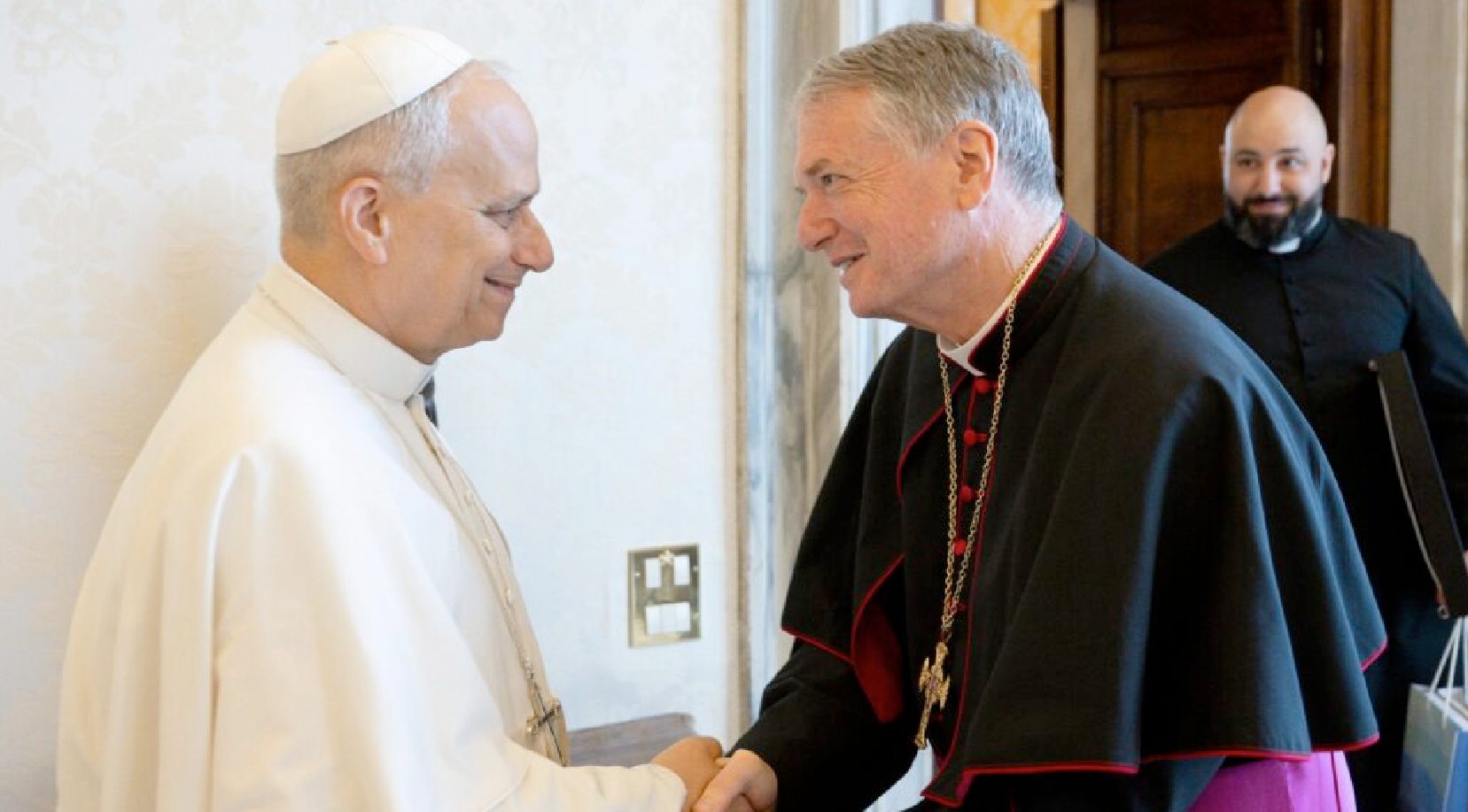
(ZENIT News / Sidney, 02.09.2026).- Sydney is preparing to reclaim a place at the heart of global Catholic life. Pope Leo XIV has indicated his intention to travel to Australia in the spring of 2028 to preside over the International Eucharistic Congress, a gathering expected to draw hundreds of thousands of pilgrims and to mark a historic milestone for the Church in the country.
The clearest confirmation to date came on February 9, when Bishop Richard Umbers, auxiliary bishop of Sydney and executive director of Eucharist28, publicly stated that the Pope had personally signaled his willingness to attend. According to Umbers, Archbishop Anthony Fisher raised the matter directly with Leo XIV during a recent meeting in Rome. The papal response was brief but decisive: the timing may still be distant, but “I will be there.”
The diplomatic choreography behind the visit began almost immediately after Leo XIV’s inauguration in May 2025. Australian Prime Minister Anthony Albanese formally invited the Pope to Sydney for the Congress, following the protocol required when a head of state—Leo XIV governs the Vatican City State—receives an invitation from another government. While such invitations do not automatically translate into travel commitments, papal assent is widely regarded as the strongest signal that preparations can move forward in earnest.
The 2028 Congress will carry particular historical weight. It will coincide with the centenary of Australia’s first International Eucharistic Congress, held in Melbourne in 1928, a landmark moment that helped consolidate Catholic identity in a young nation. Melbourne hosted the event again in 1973, an edition remembered for the presence of two future saints: Cardinal Karol Wojtyła, later Pope John Paul II, and Mother Teresa of Calcutta.
Although many logistical questions remain unresolved more than two years out, the broad outline of the Sydney Congress is already taking shape. Bishop Umbers has indicated that the event will span an entire week, opening with a solemn Mass and culminating in a large-scale Eucharistic procession followed by a closing liturgy. If the Pope is present for the final days—as organizers hope—the procession is expected to be one of the most significant public acts of worship ever staged in Australia.
Attendance figures are still speculative, but expectations are high. Australia is home to roughly five million Catholics, and organizers anticipate that several hundred thousand people could attend the final Mass and associated events. International participation is also expected to be substantial, reflecting the global character of Eucharistic Congresses, which traditionally combine theological reflection, catechesis, liturgy and public witness.
The visit would mark the fifth time a reigning pope has set foot on Australian soil. Paul VI broke new ground in 1970, followed by John Paul II in 1986 and again in 1995, when he beatified Mary MacKillop, Australia’s first saint. Benedict XVI presided over World Youth Day in Sydney in 2008, an event remembered for the largest Mass ever celebrated in the country, with an estimated 400,000 people gathered at Randwick Racecourse. Each of these papal visits also used Randwick as the principal liturgical venue, establishing it as a symbolic space in Australian Catholic memory.
Yet Bishop Umbers has been careful to stress that the true measure of the 2028 Congress will not be counted in crowd sizes alone. For Church leaders, the primary goal is spiritual renewal. The hope is that Eucharist28 will deepen belief in the real presence of Christ in the Eucharist and foster personal conversion, sending participants back to their parishes with renewed faith and commitment. In practical terms, Umbers has said, this should translate into a noticeable rise in Sunday Mass attendance—an ongoing challenge for many Western churches.
The personal history of Leo XIV also adds resonance to the planned visit. Before his election, then-Father Robert Prevost traveled to Australia several times and is familiar with its Catholic landscape, marked by strong multicultural communities drawn from across the globe. Organizers see the Congress as an opportunity for the Pope to speak to that diversity and to project a distinctly Eucharistic message to the wider world.
Some logistical hurdles remain, including the possibility that the Congress could overlap with the National Rugby League Grand Final, one of Australia’s major sporting events. Bishop Umbers has treated the issue with humor, expressing confidence that Sydney’s experience as a global city will allow it to accommodate both pilgrims and sports fans—even if it proves difficult to persuade some clergy to miss a decisive match.
Thank you for reading our content. If you would like to receive ZENIT’s daily e-mail news, you can subscribe for free through this link.

Publicaciones relacionadas:
 7 out of 10 Spanish citizens believe that Leo XIV’s papacy will be good or better than that of Pope Francis
 Leo XIV surpasses Francis in popularity according to first published survey: these are the percentages
 Monaco will be the second destination for a trip by Pope Leo XIV at the end of March 2026: here is what is known
 Milei formally invites the Pope to visit Argentina: he sends his foreign minister to the Vatican to deliver a letter by hand to Leo XIV
