

(ZENIT News / Jerusalem, 02.12.2026).- The fragile equilibrium of the West Bank is fraying under mounting pressure. In recent weeks, coordinated radical Jewish settlers raids, violent assaults on Palestinian civilians—including Christian communities—and sweeping Israeli cabinet decisions to expand settlements have converged into a volatile mix. Local clergy speak of daily fear; international actors warn of legal and political consequences; Washington signals caution even as tensions escalate on the ground.
At the heart of the latest incidents is Taybeh, a village of approximately 1,300 to 1,500 residents, located some 30 kilometers north of Jerusalem and east of Ramallah. It is widely known as the last entirely Christian Palestinian town in the West Bank. More than 600 of its inhabitants belong to the Latin Catholic Church, with the remainder affiliated with the Greek Orthodox and Melkite Greek Catholic communities. Three churches serve a population that has long considered itself both spiritually resilient and increasingly vulnerable.
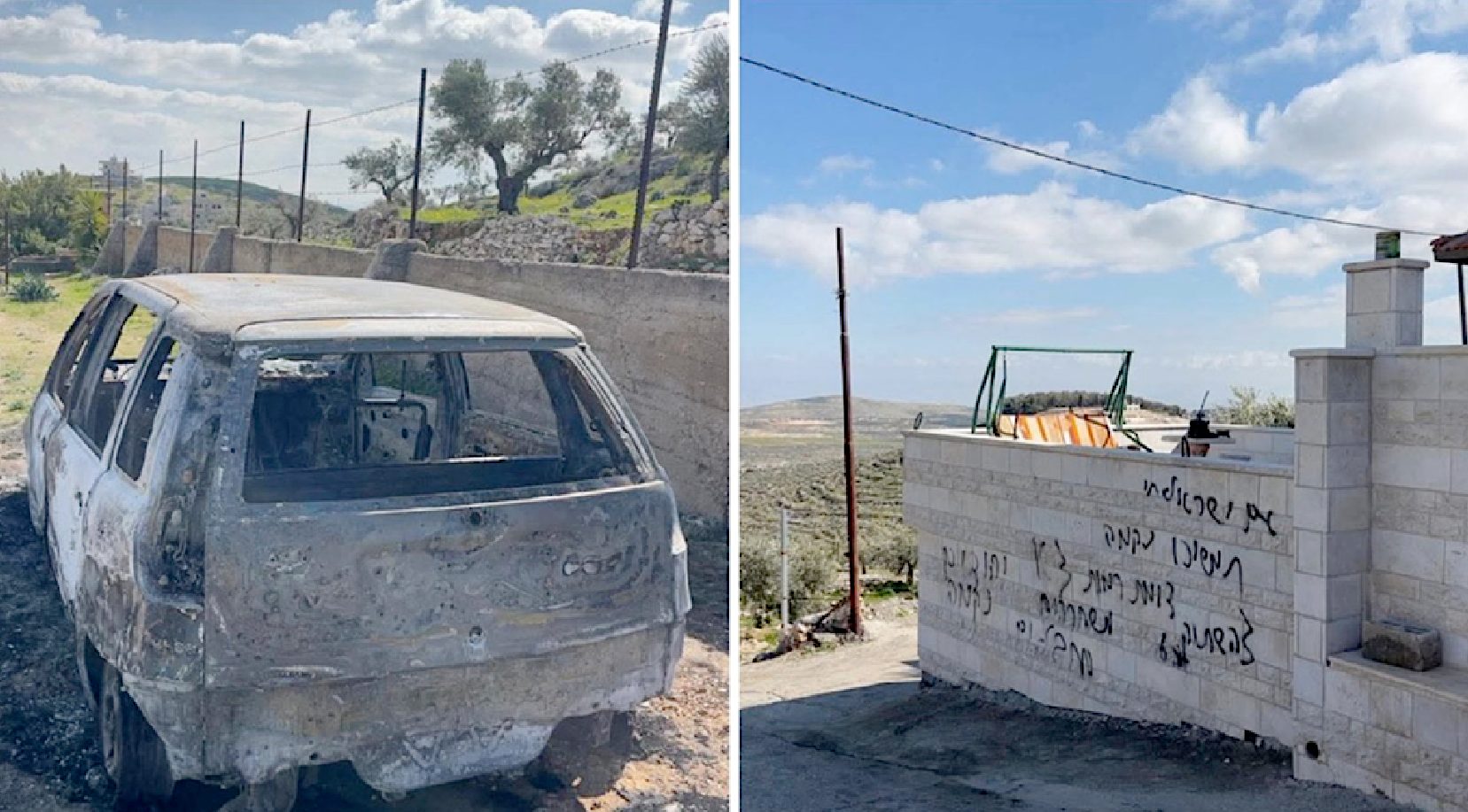
According to Father Bashar Fawadleh, the Latin parish priest, the pattern of violence is no longer sporadic but systematic. In a detailed account covering January 2026 through February 5, he describes land seizures, intimidation, vandalism and arson. In the early hours between 2:30 and 3:00 a.m. on February 4, three individuals reportedly linked to the so-called “Hilltop Youth” (Jewish) set fire to two civilian vehicles near the village cemetery. Surveillance cameras captured other episodes, including the invasion of private property, racist graffiti and additional vehicle burnings.
The damage extends beyond symbolic attacks. Palestinian officials report that on February 5 alone, coordinated settler actions across several areas of the West Bank led to the uprooting of roughly 300 olive trees in the northern Ramallah and al-Bireh province. In al-Mughayyir, northeast of Ramallah, residents were assaulted while grazing livestock. In the Nablus governorate, pepper spray was used against Palestinians, and three young men were beaten while working. Olive cultivation, a pillar of Palestinian rural life, has been hit particularly hard. In recent months, 1,245 olive trees have reportedly been uprooted, destroyed or poisoned: 750 in Hebron, 245 in Ramallah and 250 in Nablus. Palestinian statistics cite 349 acts of vandalism and theft against property in the same period.
For Taybeh’s residents, such figures translate into daily anxiety. Father Fawadleh speaks of “constant uncertainty, fear and pressure,” noting that even on days without headline-grabbing violence, the expectation of further attacks shapes daily life. Farmers and poultry workers in the eastern part of the village report threats while attempting to access their land. Illegal grazing of settler livestock near homes has damaged crops and intensified tensions. In Birzeit, a Palestinian woman was physically assaulted and hospitalized; subsequently, her sons and relatives were arrested, raising accusations of collective punishment. In Ein Arik, a member of the local Latin parish was beaten. The priest frames these actions as violations of the Fourth Geneva Convention, citing intimidation of protected persons, destruction of civilian property and failure to protect civilians under occupation.
Violence has not spared students. On February 4, during a school trip to the Park HaMa’ayanot area near Beit She’an, Palestinian pupils from the Ibn Khaldun School in Sakhnin—including Christians and Muslims—were attacked by a group of Israeli youths. Pepper spray was used; more than ten students and teachers required hospital treatment. Israeli police arrested three minors and one adult suspect. The school’s principal, Kamal Abu Younis, described the incident as racially motivated.
Taybeh’s ordeal is not new. In late June, settlers set fire to the village entrance. On July 7, flames reached areas near the historic cemetery and the ruins of the fifth-century Church of St. George. Further arson targeted private property days later. Masked individuals burned cars on the night of December 4–5, only hours after the opening of the Christmas market. Visits of solidarity by the Latin Patriarch of Jerusalem, Cardinal Pierbattista Pizzaballa, the Greek Orthodox Patriarch Theophilos III, Cardinal Jean-Marc Aveline of Marseille and diplomats—including the U.S. ambassador to Israel—have not halted the cycle.
Parallel to these local incidents, structural changes are reshaping the political landscape. On February 9, a White House official reiterated President Donald Trump’s opposition to Israeli annexation of the West Bank, stating that a stable West Bank “keeps Israel secure” and aligns with U.S. objectives for regional peace. The comment followed the Israeli security cabinet’s approval of measures enabling extensive settlement expansion and facilitating land purchases and building permits in areas that, under the Oslo Accords, fall under full or partial Palestinian control.
The approved measures include steps to repeal a Jordanian-era law that has historically restricted land purchases by non-Arabs in Palestinian territories—legislation that had limited Israeli settlers’ acquisition of property in occupied areas. Authority over building permits for settlements in Hebron, a city with a Palestinian majority, is set to shift from the Palestinian-controlled municipality to Israeli control. Finance Minister Bezalel Smotrich stated that the policy aims to “kill the idea of a Palestinian state,” underscoring the ideological dimension of the move.
The reaction has been swift. Eight Muslim-majority countries—Saudi Arabia, Qatar, Jordan, the United Arab Emirates, Egypt, Turkey, Indonesia and Pakistan—condemned what they called illegal measures intended to impose Israeli sovereignty. The European Union denounced the decisions as “another step in the wrong direction.” The United Nations, through spokesperson Stéphane Dujarric, warned that developments on the ground are undermining prospects for a two-state solution and reiterated its position that Israeli settlements in the occupied West Bank, including East Jerusalem, lack legal validity under international law.
Meanwhile, Israeli Defense Forces report ongoing security operations, including the arrest of more than 20 suspected militants in the West Bank and the seizure of explosives and weapons. In Rafah, four armed men emerging from a tunnel were killed after attacking Israeli soldiers. Prime Minister Benjamin Netanyahu met President Trump in Washington on February 11 to discuss the second phase of the Gaza plan, even as legislative proposals in Israel signal potential tightening of family reunification rules for Palestinians on security grounds.
Beyond the West Bank, tensions ripple along the Lebanese border. Lebanese authorities accuse Israel of spraying herbicides, including glyphosate, on agricultural fields in southern villages near the Blue Line. Laboratory tests cited by Lebanon’s Agriculture and Environment ministries reportedly found concentrations between 20 and 30 times commonly accepted levels. President Joseph Aoun described the alleged actions as violations of sovereignty and environmental crimes. The Israeli military has not issued an official comment. The issue has reached the United Nations, where concern is mounting over developments in areas governed by a fragile ceasefire.
For Christian communities such as Taybeh’s, these geopolitical maneuvers translate into a stark question: can they remain on their ancestral land? Decades of land confiscations—some now incorporated into settlements such as Rimunim or used for roads linking colonies toward Jericho and the Jordan Valley—have already narrowed their territorial and economic space. Clergy and lay leaders insist they are not seeking visibility only in moments of tragedy, but recognition of a persistent, grinding insecurity that rarely dominates international headlines.
The convergence of grassroots violence and high-level political decisions suggests that the West Bank is entering a new, precarious phase. Whether diplomatic engagement, legal scrutiny or internal political recalibration can reverse the trajectory remains uncertain. What is clear is that for villages like Taybeh, the question of survival is no longer abstract policy debate—it is an everyday reality measured in uprooted trees, burned vehicles and the endurance of faith under pressure.
Thank you for reading our content. If you would like to receive ZENIT’s daily e-mail news, you can subscribe for free through this link.

